Fact-checked by the SnapMessages editorial team
Quick Answer
The most common sleep tracking app mistakes include ignoring sleep stage accuracy, obsessing over scores, and misreading data. Studies show consumer sleep trackers have an accuracy rate of only 78% for detecting wake periods. Fixing these habits takes less than a week and meaningfully improves sleep quality outcomes.
Updated July 2026
Key Takeaways
- Only 36.8% of young adults aged 18–30 in the UK use or have used sleep apps, according to Frontiers in Sleep (2025).
- Approximately 28% of adults use a cellphone to track their sleep, including through dedicated apps, based on Sleep Foundation (2026).
- Consumer sleep trackers misclassify sleep stages up to 30% of the time compared to clinical polysomnography, per Sleep Foundation research on wearable accuracy.
- Resting heart rate is measured with 95–99% accuracy in consumer devices, according to clinical validation data.
- Most platforms require at least 14 consecutive nights of tracking before generating reliable personalized insights, as confirmed by WHOOP and Garmin Connect.
- Consumer sleep apps are not HIPAA-covered entities, allowing them to share biometric data with third parties without the same legal protections as clinical providers, as outlined in FTC guidance.
Sleep tracking apps are everywhere now, but most people using them don’t realize how easily the data can mislead. Consumer devices often misclassify sleep stages, sometimes by as much as 30% compared to clinical polysomnography. That gap means you’re likely looking at a simplified, imperfect snapshot of what actually happened while you were asleep. Knowing where the data breaks down is the first step toward using it without letting it work against you.
Millions of people now use platforms like Fitbit, Apple Health, WHOOP, and Oura to shape their sleep habits. These tools are convenient, sure, but without a clear framework for reading the numbers, they can nudge users toward habits that backfire. In the U.S., 28% of adults track sleep via their phones, often through dedicated apps, according to the Sleep Foundation’s 2026 report.
Are Sleep Scores Actually Accurate Enough to Trust?
Not really. Sleep scores are rough estimates, not medical facts. Each app runs its own formula to spit out a number. A “72” on Oura isn’t the same as a “72” on Fitbit or a Samsung Galaxy Watch. Differences in how each system weighs heart rate, movement, and time in bed mean the numbers simply aren’t comparable across brands.
Most consumer wearables lean on accelerometry and heart rate variability to guess at sleep stages. They don’t measure brainwaves the way clinical polysomnography does, and that’s a real limitation, not a minor footnote. The American Academy of Sleep Medicine has warned against using these devices for medical decisions. Treating a daily score like a verdict from a doctor is a mistake with actual consequences.
Use scores to spot a trend, not to grade yourself. A dip that lasts seven nights in a row might mean something worth addressing. A single rough score after a long, stressful day? Probably not worth losing sleep over, literally. Pair the number with how you actually feel in the morning. Your own read on your energy, focus, and mood is a better signal than any algorithm.
For context: if you’re a young adult in the UK, your odds of using a sleep app are roughly 1 in 3, 36.8% of your peers report using one. That’s nearly 37 out of every 100 people. Compare that to the 28% of U.S. adults who track sleep via phone, about 1 in every 3.5 adults. Widespread use doesn’t equal reliable data, though. It just means a lot of people are checking.
Key Takeaway: Consumer sleep scores are algorithmic estimates, not medical readings. The American Academy of Sleep Medicine advises against clinical reliance on them. Look for 7-day trends, not single-night results, to get actionable signal from your data.
Can Sleep Apps Cause Anxiety About Sleep?
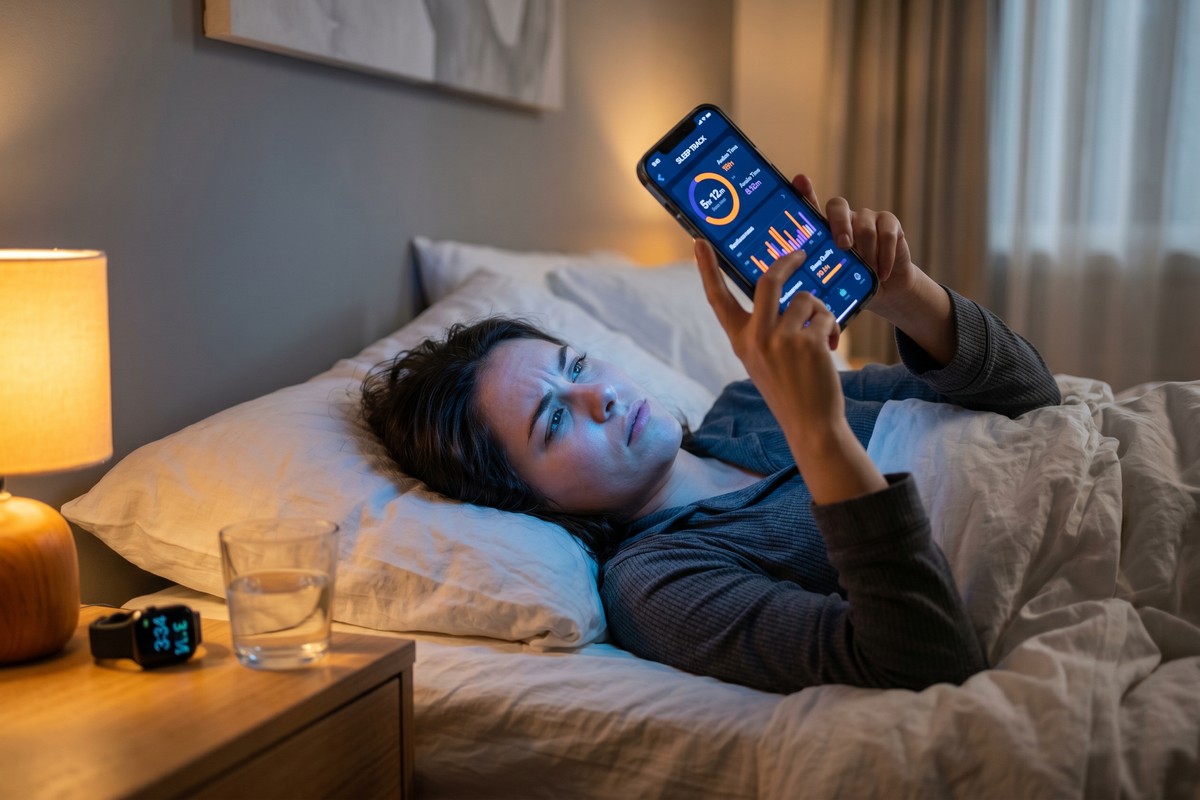
Yes. Researchers actually have a name for it: orthosomnia. It’s what happens when tracking sleep turns into a source of stress instead of relief. Instead of improving rest, the obsession with the data ends up making insomnia worse.
A study in the Journal of Clinical Sleep Medicine found that patients whose sleep got worse after they started tracking tended to fixate on their deep sleep percentages. Worrying about hitting a target creates mental arousal, which happens to be exactly the thing that keeps people awake.
This mistake is easy to overlook because it feels productive. Checking your score the second you wake up, shifting your bedtime to chase a number, feeling deflated when deep sleep dips below some threshold, these are all warning signs. If your tracker is the first thing you reach for before you’ve even paused to notice how you feel, you probably need a break. Try stepping away for three to five days and see what your sleep feels like without the constant feedback loop.
Consider this: if you’re a 28-year-old with a 620 credit score needing $8,000 for a medical procedure and are using a sleep tracker to manage stress-related insomnia, that tracking may be doing more harm than good. A 620 score sits in the subprime range, and sleep disruption tends to worsen anxiety, which then bleeds into financial decision-making and recovery. In a case like this, stepping back from tracking, especially given the existing anxiety, is probably the smarter move. The data isn’t helping you make better choices. It’s reinforcing the loop.
Key Takeaway: Orthosomnia affects a measurable subset of users. Research in the Journal of Clinical Sleep Medicine links data fixation to worsening insomnia. Take a 3–5 day break if tracking triggers anxiety.
Are Users Ignoring the Most Actionable Sleep Data?
Yes. Most people obsess over sleep stages while ignoring the data that actually matters most: bedroom temperature, pre-sleep heart rate, resting heart rate. These metrics are consistently more accurate than stage classification, and they give you real levers to pull for change.
Apple Health, Oura, and WHOOP can all record ambient temperature, noise, and pre-sleep heart rate through third-party integrations. These inputs shape your sleep directly. The National Heart, Lung, and Blood Institute names environmental control as a primary factor in improving both sleep duration and quality.
What Environmental Metrics Actually Predict Sleep Quality
Bedroom temperature is one of the most powerful variables you can control. Your core body temperature needs to drop by 1–2 degrees Fahrenheit for you to fall asleep in the first place. If your resting heart rate stays elevated at midnight compared to your baseline, something, light, noise, heat, is interfering with your body’s natural cool-down process.
Pairing sleep data with hydration logs from apps like those reviewed in our guide to the best water tracking apps can reveal patterns you’d otherwise miss. Drinking a lot of water late in the afternoon, for instance, might show up as an elevated overnight heart rate, hinting at a link between hydration timing and recovery.
| Sleep Metric | Consumer Tracker Accuracy | Best Use |
|---|---|---|
| Sleep/Wake Detection | 78–90% | Total sleep time estimates |
| REM Stage Detection | 60–70% | Trend tracking only |
| Deep Sleep Detection | 49–65% | Directional reference only |
| Resting Heart Rate | 95–99% | Recovery and stress monitoring |
| Heart Rate Variability | 85–92% | Readiness and autonomic balance |
Key Takeaway: Consumer trackers measure resting heart rate at 95–99% accuracy but only detect deep sleep correctly 49–65% of the time. Focus your optimization efforts on heart rate and environmental inputs rather than sleep stage percentages for more reliable guidance.
Does Inconsistent Tracking Ruin Your Sleep Data?
Yes. Tracking on and off undermines the whole foundation your app is trying to build. Most platforms need at least 14 consecutive nights of consistent data before they can generate insights worth trusting. Skip a few nights, forget to wear your tracker to bed, or only use it on weekends, and you end up with a skewed dataset.
Without consistency, your app might end up comparing your worst nights to your best, then recommending changes based on an average that doesn’t reflect reality. WHOOP and Garmin Connect both require sustained tracking before their coaching features kick in. If your data is spotty, the advice they give will be off, sometimes noticeably so.
Some people are honestly better off not tracking at all. If you’re already hyper-focused on metrics, or anxious about sleep to begin with, a tracker can make the problem worse, not better. The data won’t help if you’re not in a place to interpret it calmly, it can actively do more harm than good. For anyone with a history of sleep anxiety or eating disorders, sleep tracking can trigger rigid habits or obsessive patterns. In those situations, stepping back really is the better call.
Take this example: a 34-year-old with a 680 credit score and $9,500 in medical debt, currently struggling with sleep because of financial stress. Leaning on a sleep app to fix that rest could easily backfire. The app might flag a low deep sleep percentage, which could ramp up anxiety that’s already high. In a situation like this, better sleep comes from cutting stressors and building consistent routines, not from staring at more data. The app’s recommendations won’t touch the actual cause.
Building a new habit sticks better when it fits into routines you already have. If you’re already using a focus app, pairing sleep tracking with a Pomodoro timer system can help both habits reinforce each other. Our roundup of the best Pomodoro timer apps for deep work includes tools built for that kind of integration.
Key Takeaway: Most sleep platforms need at least 14 nights of continuous data before baseline calculations become reliable. Irregular tracking creates a biased dataset that corrupts coaching recommendations, according to guidance from platforms like WHOOP.
Are Sleep Apps Sharing Your Health Data Without You Knowing?
Yes, and most users never think to check. Sleep data ranks among the most sensitive health information you generate, yet consumer apps often share it with advertisers, insurers, or researchers, frequently without clear, explicit consent.
Under HIPAA, consumer wellness apps aren’t covered entities. That means they don’t carry the same legal obligation to protect your data that hospitals or clinics do. A Federal Trade Commission report found that many apps share data in ways users wouldn’t expect, even when the privacy policy technically allows it.
Before you hand an app your data, scan the privacy policy for phrases like “de-identified data sharing,” “third-party partners,” or “research use.” These can be signs your data is being sold off. For broader guidance on protecting your digital life, our guide on building a personal digital security routine covers steps that apply directly to health apps.
If your device syncs via Bluetooth or NFC, it’s worth understanding how that data actually travels. Our overview of how NFC works on Android for file sharing breaks down the underlying tech many health apps rely on to sync data.
Key Takeaway: Consumer sleep apps are not HIPAA-covered entities and can legally share biometric data with third parties. The FTC’s mobile health app guidance recommends reviewing privacy policies for data-sharing language before granting any health app ongoing biometric access.
Frequently Asked Questions
What is the most accurate consumer sleep tracker available right now?
No consumer tracker matches clinical polysomnography, but Oura Ring and WHOOP 4.0 consistently rank highest in third-party accuracy studies for heart rate variability and total sleep time detection. Deep sleep stage accuracy remains below 65% across all consumer devices regardless of brand.
How many nights of sleep data do I need before the app gives useful advice?
Most platforms recommend a minimum of 14 consecutive nights to establish a reliable personal baseline. WHOOP and Garmin Connect both cite this threshold explicitly before their AI coaching recommendations activate with full accuracy.
Is it bad to check my sleep score every morning?
Checking your score daily is fine as long as it does not trigger anxiety. If you feel stressed or preoccupied by a single night’s result, that is a clinical warning sign for orthosomnia. Use scores as weekly trend data rather than daily pass-or-fail grades.
Can a sleep tracking app worsen insomnia?
Yes. Researchers have documented a condition called orthosomnia, where performance anxiety about sleep metrics directly worsens sleep continuity. A study in the Journal of Clinical Sleep Medicine confirmed this effect in clinical case studies.
Do sleep apps share my health data with third parties?
Many do. Consumer sleep apps are not classified as HIPAA-covered entities, so they face fewer restrictions on data sharing than clinical providers. Always read the privacy policy for language about de-identified data, research partnerships, or third-party analytics before granting ongoing access.
What should I actually optimize based on my sleep app data?
Focus on metrics your tracker measures accurately: resting heart rate, heart rate variability, and total sleep time trends. Avoid over-optimizing for deep sleep percentages, which consumer trackers misclassify up to 51% of the time. Pair the data with consistent bedtimes and environmental controls for the improvements that actually matter most.
How common is sleep app use among young adults?
Among young adults aged 18–30, 36.8% reported using or having used sleep apps, based on a UK-based study cited in Frontiers in Sleep (2025).
What percentage of adults use a phone to track sleep?
According to the Sleep Foundation (2026), approximately 28% of adults use a cellphone to track their sleep, including via dedicated apps.
Are sleep tracker scores reliable for medical decisions?
No. The American Academy of Sleep Medicine explicitly warns against using consumer sleep trackers for clinical diagnosis or treatment decisions. They are designed for personal insight, not medical accuracy.
How accurate are consumer trackers at detecting deep sleep?
Consumer sleep trackers detect deep sleep correctly only 49–65% of the time, based on comparative studies with clinical polysomnography. This means stage classifications should be treated as directional references, not definitive insights.
What metrics are most accurate in consumer sleep trackers?
Resting heart rate is measured with 95–99% accuracy, and heart rate variability with 85–92% accuracy. These are among the most reliable outputs for users looking to track stress levels, recovery, and overall readiness.
Can inconsistent tracking harm the usefulness of my sleep data?
Yes. Irregular tracking disrupts the baseline your app uses to generate insights. Most platforms require at least 14 consecutive nights of consistent data to build a reliable personal profile, making inconsistent use a major flaw in long-term tracking success.
What privacy protections apply to consumer sleep apps?
Consumer sleep apps are not HIPAA-covered entities, meaning they are not bound by the same data protection standards as healthcare providers. Users should review privacy policies carefully and understand that data may be shared with third parties, including advertisers and researchers.
Sources
- Frontiers in Sleep, Sleep App Use Among Young Adults (2025)
- Sleep Foundation, Sleep Facts and Statistics (2026)
- Sleep Foundation, Sleep Tracking Research and Wearable Accuracy
- Journal of Clinical Sleep Medicine, Orthosomnia: Are Some Patients Taking the Quantified Self Too Far?
- American Academy of Sleep Medicine, Position Statement on Sleep Tracking Devices
- National Heart, Lung, and Blood Institute, How Much Sleep Is Enough?
- NCBI / PubMed Central, Accuracy of Consumer Wearable Sleep Technology
- Centers for Disease Control and Prevention, Sleep and Sleep Disorders






