Fact-checked by the SnapMessages editorial team
The Verdict
A video doorbell is usually the right first purchase if your primary concern is front-door visitor management and package theft, and your budget is under $150. It is not sufficient if you own a single-family home with a side yard, garage, or rear entry, where a smart security camera system covering 3 or more zones delivers meaningfully broader protection than any doorbell can.
The smart security camera vs video doorbell decision comes down to one factor above everything else: how much of your property sits outside the front door. According to FBI Uniform Crime Reporting data, front doors account for 34% of residential burglary entry points, which means roughly two-thirds of break-ins happen elsewhere. A doorbell covers that front-door slice well. A camera system addresses everything else.
As of early 2026, SafeHome.org’s 2026 Home Security Market Report found that 61% of U.S. households now own at least one security camera. The market has matured enough that product quality, subscription costs, and privacy risks are now the real differentiators, not the technology itself. Choosing the wrong device for your living situation is a more common and more expensive mistake than most buyers expect.
| Factor | Reasons to Choose a Video Doorbell | Reasons to Choose a Security Camera |
|---|---|---|
| Coverage Area | Focused 100–120 degree front-door field of view; ideal for a single entry point | 180–360 degree coverage; can monitor side yards, garages, rear entries simultaneously |
| Installation | Replaces existing wired doorbell or runs on battery; renters can often install without drilling | Wired PoE systems require drilling and runs of cable; battery/Wi-Fi versions more flexible but still need mounting hardware |
| Hardware Cost | Typical range: $50–$250 for a capable model (e.g., Ring Battery Doorbell Plus at $100) | Typical range: $80–$300 per camera; a 4-camera system starts around $250–$500 |
| Subscription Cost | Ring Basic at $4.99/month; Nest Aware at $8/month; roughly $60–$100/year per household | Arlo Essential at $4.99/month per camera; local-storage options (Eufy, Reolink) eliminate monthly fees entirely |
| Two-Way Audio | Built-in two-way audio is standard; lets you speak to visitors or couriers in real time | Most outdoor cameras include two-way audio, but it is secondary to monitoring rather than conversation |
| Package Theft Deterrence | Strong deterrence; visible placement and real-time alerts are specifically effective against porch pirates | Effective as a record, less effective as a deterrent because camera is not positioned at the delivery point |
Key Takeaways
- A video doorbell is likely the right choice if your property has a single main entry point and your primary worry is package theft or unexpected visitors.
- Go with a security camera system if your home has 2 or more entry points beyond the front door, including a garage, rear door, or side gate.
- If you rent and cannot drill, a battery-powered video doorbell (such as the Ring Battery or Eufy E340) is almost always the most practical option.
- Budget for subscription fees: 71% of video doorbell owners pay recurring fees, and most major brands disable video recording entirely without a paid plan.
- For full single-family home coverage, security experts cited in a 2026 CBS Austin report recommend a minimum of 4 to 6 cameras, not a single doorbell.
- If you check your security app feeds compulsively more than 3 to 4 times per day, that habit can amplify rather than relieve anxiety, regardless of which device you own.
- Local-storage cameras from brands like Eufy, Reolink, and TP-Link Tapo can eliminate monthly fees while keeping footage private, making them a strong option if cloud data privacy is a concern.
Does Your Property Have Blind Spots a Doorbell Cannot See?
If your home has a side yard, detached garage, rear entrance, or driveway that wraps around the building, a video doorbell physically cannot cover those areas. Its fixed lens, typically 100 to 120 degrees, is aimed at whoever approaches the front door. That is genuinely useful, but it creates a false sense of full coverage on any property with more than one accessible entry.
The FBI’s own entry-point data make this concrete: front doors account for 34% of break-ins, first-floor windows for roughly 23%, and rear and side entries for much of the remainder. A doorbell camera watching the front covers only one of those vectors. A well-placed security camera system can address all of them. The 2026 CBS Austin security expert recommendations of 4 to 6 cameras for a standard residence are not marketing inflation; they reflect how many distinct entry zones a typical single-family home actually has.
For apartment dwellers or anyone in a building where the front door is the only controllable entry point, this gap is largely irrelevant. That is the one living situation where a doorbell genuinely does the job without leaving significant coverage holes.

What Does This Actually Cost Over Five Years?
The sticker price on a doorbell or camera is only part of the number that matters. The honest five-year figure includes hardware, subscription fees, and any replacement costs if you move or upgrade. For most buyers, the subscription is the bigger line item over time, and it is the one almost never mentioned on the product page.
A $100 Ring Battery Doorbell Plus paired with Ring Basic at $4.99/month costs roughly $400 over five years. A no-subscription alternative such as the Eufy Video Doorbell E340 costs around $200 upfront and nothing monthly, for a total five-year cost of $200. That is a meaningful difference, and it matters because Parks Associates research published in April 2024 found U.S. smart-video-device owners average 2.21 cameras per household, meaning subscription costs multiply quickly.
The other honest point: most major brands, including Ring and Arlo, disable video recording entirely when you cancel a subscription. You keep live view, but no footage is saved. That means if someone steals a package while you miss the alert, there is no clip to show police. Local-storage cameras from brands like Reolink and TP-Link Tapo record to an SD card or NAS device at no monthly cost, and Consumer Reports testing in 2025–2026 confirmed their privacy scores are competitive with cloud-dependent alternatives.
Who Controls Your Footage, and Does That Stress You Out?
Cloud-stored footage from doorbell cameras can be retained and accessed by manufacturers even after you stop paying for a subscription, a fact that became nationally visible in February 2026 when reports about the Nancy Guthrie disappearance revealed that Google retained Nest doorbell footage from a device whose subscription had lapsed. That case is a specific, documented example of the gap between what users assume about their footage and what actually happens to it.
The Federal Trade Commission’s consumer guidance on home security cameras explicitly advises buyers to choose devices that encrypt account information, livestreams, and archived video, and to check access logs for unauthorized viewing of IP camera feeds. The FTC’s enforcement history reinforces why this matters: the agency’s action against TRENDnet established a legal baseline requiring that internet-connected camera manufacturers use reasonable security measures to protect private video feeds from unauthorized access.
“The Internet of Things holds great promise for innovative consumer products and services. But consumer privacy and security must remain a priority as companies develop more devices that connect to the Internet.”
Ring’s 2025 rollout of facial recognition features drew scrutiny from Congressional offices and digital rights advocates, partly because Ring had previously shared footage with law enforcement without explicit user consent in some jurisdictions. For buyers who feel a loss of control when their own home surveillance data sits on someone else’s servers, local-storage devices from Eufy, Reolink, or TP-Link Tapo remove that anxiety point entirely. That sense of control over your own data is not a minor consideration, and it ties directly into how much peace of mind the device actually delivers. Building a strong digital security habit around your home devices is worth reviewing; the guide on building a personal digital security routine covers the fundamentals that apply here too.
Is Porch Theft or Visitor Anxiety Your Main Problem?
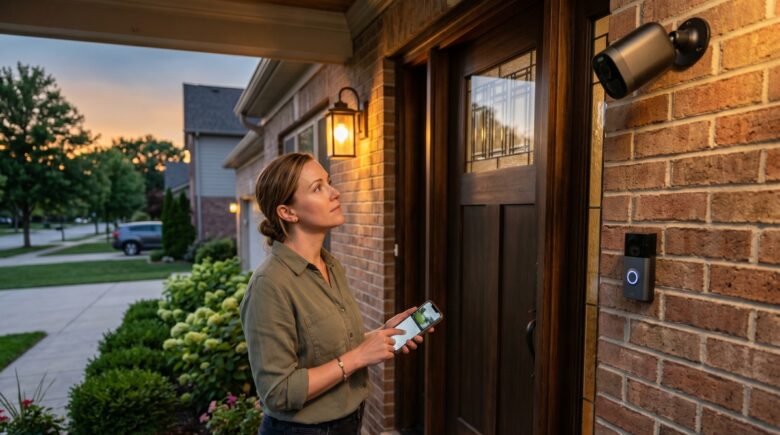
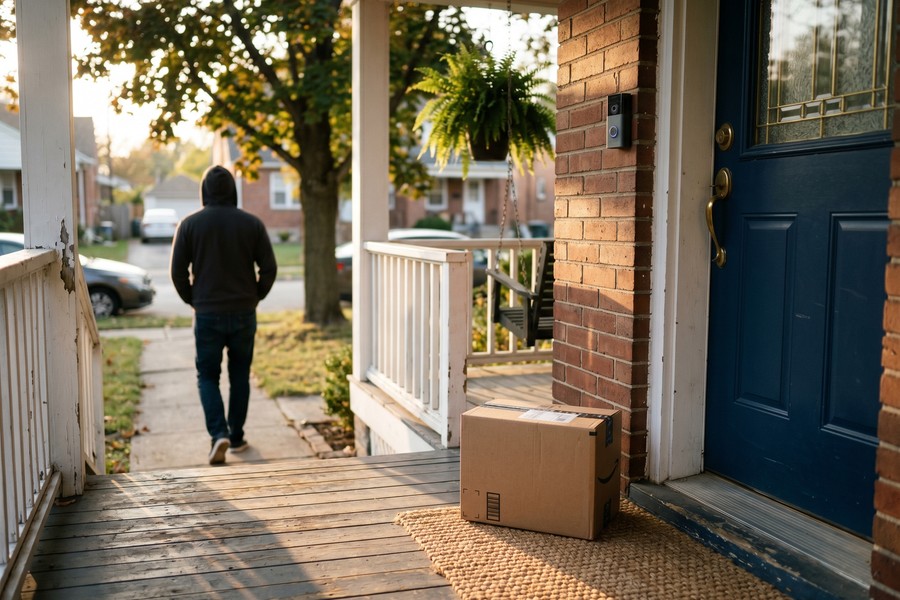
If porch piracy is your primary concern, a video doorbell is the right tool. It is visible, it sends real-time alerts when someone lingers at the door, and its two-way audio lets you address a delivery or an unexpected visitor without opening the door. A September 2024 ValuePenguin survey of 2,048 U.S. consumers found that 41% of Americans have had a package stolen at least once, up from 35% in 2022. That is the specific threat doorbells are designed for.
The deterrence and verification distinction is worth naming clearly because it changes which device helps most. Deterrence peace of mind comes from a visible device that signals to a potential intruder that they are being watched. Verification peace of mind comes from having recorded footage you can actually use after an incident. A doorbell provides both at the front door. A security camera provides both across broader zones, but it has less deterrence value for a porch pirate who is grabbing a package and leaving in under 20 seconds.
Joshua Lee, an active-duty police sergeant and former detective with a municipal police department in Arizona, puts the front-door value plainly:
“Having a doorbell camera is a great way to protect your home from burglars, home invaders, and package thieves. There are a couple of different tactics criminals use. Some like to knock or ring the doorbell to make sure no one is home. These burglars typically don’t want to be seen. They want to get in and out quickly without detection. While another tactic, usually used for home invasions, is to knock or ring the doorbell hoping someone will answer. Once the homeowner opens the door, they will push their way into the home and hold everyone inside captive while they conduct their crime. Knowing who is at your door with a doorbell camera is a good way not to fall victim to these crimes.”
For households where the anxiety is more diffuse, covering a whole yard or monitoring children arriving home from school or tracking whether an elderly parent left the house, the reactive, visitor-triggered model of a doorbell is genuinely less useful than a camera with continuous or motion-based wide-area recording. If you are in a caregiving situation, the broader awareness a multi-camera setup provides tends to be more grounding than the doorbell’s single focal point. You may also find it useful to know how criminals use social engineering tactics at the doorstep, since that context shapes how you position and use any device you buy.
Who Should and Who Should Not
Good candidates for a video doorbell
A video doorbell is the clear choice in these specific situations.
- Renters in apartments or condos where drilling for a multi-camera system violates the lease, and where the front door is the only independently controllable entry point.
- Homeowners whose package theft rate has increased and who want real-time two-way audio to redirect couriers to a safe drop zone or deter porch pirates in the moment.
- People who live alone and experience doorstep anxiety, where seeing who is outside before deciding to answer resolves the specific trigger.
- First-time security device buyers who want a single, low-friction device before deciding whether a broader camera system makes sense.
Who should skip it (or not stop there)
A doorbell alone is a poor fit for these situations.
- Single-family homeowners with a detached garage, rear yard, or side entrance, where rear and side break-ins are statistically significant and a doorbell’s field of view cannot reach those zones.
- Households monitoring elderly parents or tracking children’s safe arrival home, where the doorbell’s reactive visitor model does not provide the continuous location awareness that actually reduces caregiver anxiety.
- Privacy-sensitive buyers who are uncomfortable with cloud-stored footage and manufacturer data retention, unless they specifically choose a local-storage doorbell model.
- Anyone who has experienced a prior break-in through a non-front-door entry point, where a doorbell reinforces coverage of the wrong zone and leaves the actual vulnerability unwatched.
Frequently Asked Questions
Is a video doorbell enough security for a house?
No, not for most single-family homes. A video doorbell covers the front door effectively, but FBI entry-point data show that 66% of residential break-ins happen at locations other than the front door, including rear entries, side windows, and garages. For a full house, at least one or two additional cameras are needed to address those zones.
Do I need a monthly subscription for a smart security camera to work?
Not necessarily. Brands like Eufy, Reolink, and TP-Link Tapo offer cameras that record locally to an SD card or network-attached storage with no mandatory monthly fee. Major brands like Ring and Arlo do require a subscription for video recording, reverting to live-view-only if you cancel, which means no saved footage for evidence after an incident.
Can a video doorbell camera see at night?
Yes, virtually all current video doorbells include infrared night vision, with a typical effective range of 15 to 25 feet. Premium models from Ring, Google Nest, and Arlo offer color night vision using ambient light, which produces more identifiable footage than standard black-and-white infrared. Effective range drops in heavy rain or dense fog regardless of the technology used.
What is the difference between a security camera and a video doorbell?
A video doorbell is technically a type of security camera, but it is designed specifically for front-door visitor interaction, including motion alerts, two-way audio, and visitor deterrence. A standalone security camera prioritizes wide-area or zone monitoring, often with a broader field of view and flexible mounting positions. The practical difference is scope: a doorbell watches one entry point, a camera system watches many.
Does having a security camera actually deter burglars?
Visible cameras do provide deterrence. Research cited in peer-reviewed studies indexed by PMC confirms that residential security technologies reduce the perceived risk of victimization and lower stress associated with break-in fears. However, the deterrence effect is strongest when cameras are visible and well-placed; a camera hidden inside a window or aimed primarily at the street has less behavioral impact on a would-be intruder than one mounted prominently at an entry point.
Is it worth getting both a video doorbell and security cameras?
For most single-family homeowners, yes. The practical combination is a video doorbell handling front-door visitor interaction and package monitoring, paired with one or two cameras covering the rear of the property and any secondary entries. This setup avoids the false security of relying on a single device and stays within a reasonable budget. Just be mindful of notification fatigue: too many overlapping motion alerts across multiple devices can themselves become a source of low-grade stress. Setting smart motion zones and scheduled quiet hours for alerts is the straightforward fix, and reviewing how push notifications work on your phone can help you configure those alerts more intentionally.
Sources
- Federal Bureau of Investigation, Uniform Crime Reporting: Burglary Entry Points
- Federal Trade Commission, Consumer Advice: How to Secure Your Home Security Cameras
- Federal Trade Commission, Enforcement Action: TRENDnet Internet-Connected Home Security Cameras
- SafeHome.org, 2026 Home Security Market Report
- Parks Associates, Smart Camera and Video Doorbell Ownership Research (2024)
- ValuePenguin, Porch Pirates Report (2024)
- Insurify, Home Security Statistics and Burglary Rate Data (2025)
- Federal Trade Commission, Securing Your Internet-Connected Devices at Home