
Fact-checked by the SnapMessages editorial team
Quick Answer
College students can avoid debt spirals by using financial wellness apps built around their actual income pattern: large, irregular disbursements rather than monthly paychecks. Start by dividing each financial aid refund into weekly “paychecks” inside a zero-based budgeting app like YNAB (free for one year with enrollment proof), track any Buy Now, Pay Later obligations manually, and check whether your university already provides free access to platforms like iGrad or Banzai.
Using financial wellness apps for students is one of the most direct ways to interrupt a debt spiral before it starts, and the window to act is narrower than most 18-to-24-year-olds realize. According to Education Northwest’s April 2025 financial literacy report, only 25% of college students could correctly answer three basic financial literacy questions, which means the problem is rarely a lack of motivation to manage money, it is the absence of the right tools and frameworks.
The timing matters because the habits formed between ages 18 and 24 compound. Student loans accumulate interest from day one on unsubsidized balances, credit card minimums train the brain to treat revolving debt as normal, and Buy Now, Pay Later services add obligations that most budgeting apps never even see. Research published in the Journal of Consumer Affairs using data from more than 25,000 students confirmed that higher loan balances and lower emergency savings independently predict greater financial stress, and that financial stress is associated with forgoing medical care and food insecurity. This is a health issue, not just a money issue.
This guide is written for enrolled students and recent graduates who want to stop reacting to their finances and start building a system that actually fits a college income structure. By the end, you will know which apps match your specific situation, how to budget around semester disbursements, how to neutralize the BNPL threat, and what three habits to lock in before graduation day.
Key Takeaways
- Only 25% of college students can answer three basic financial literacy questions correctly, per Education Northwest (2025), making financial tools a practical substitute for knowledge gaps, not just a convenience.
- 39% of Gen Z Buy Now, Pay Later users have already missed at least one payment, nearly double the overall BNPL user rate of 24%, according to Motley Fool Money’s 2025 BNPL survey.
- The average public-university borrower graduates with roughly $32,000 in federal loan debt, yet most budgeting frameworks assume monthly income, a structural mismatch this guide specifically addresses.
- YNAB is free for one full year for enrolled students with proof of enrollment, Goodbudget has a functional free tier with no bank-linking required, and millions of students already have free institutional access to platforms like iGrad, Banzai, or CashCourse through their university.
- Students with higher financial self-efficacy, the belief that they can manage their money, report significantly less financial stress even when carrying the same debt load as peers with lower self-efficacy, according to research cited by YourMoneyLine.
- Purely retrospective tracking apps can produce the opposite of the intended effect by making users feel they have addressed their finances without changing behavior, a documented limitation this guide factors into every app recommendation.
In This Guide
- Why Your Twenties Are the Riskiest Decade for Debt, and Why It Starts in College
- What Does a Financial Wellness App Actually Do vs. What Most Students Think?
- Which Financial Wellness Apps Are College Students Actually Using in 2025?
- How Buy Now, Pay Later Is Quietly Feeding Debt Spirals for Gen Z
- How Do I Budget With an App When My Income Arrives in Lump Sums?
- Financial Wellness vs. Financial Anxiety: The Psychological Case for These Tools
- What Financial Habits Should I Build Before I Graduate?
- Frequently Asked Questions
Step 1: Why Your Twenties Are the Riskiest Decade for Debt, and Why It Starts in College
The debt patterns that define a person’s thirties are almost always set in motion before they leave campus. According to the Federal Student Aid data center, the average public-university borrower exits with roughly $32,000 in federal loan debt, and that number does not include credit card balances or the growing weight of Buy Now, Pay Later obligations that never appear on a credit report.
How a Debt Spiral Actually Forms
The sequence is predictable once you see it. A student takes on federal loans to cover tuition. The financial aid refund arrives and gets spent faster than anticipated. By mid-semester, a credit card covers groceries. The minimum payment becomes a habit. A BNPL installment on a laptop gets missed. Late fees compound. By the time the student graduates, the monthly payment obligations on several separate balances eat into the starting salary before rent is even considered.
What makes this spiral specifically dangerous in the twenties is that the early balances are small enough to feel manageable. A $2,000 credit card balance at 22 feels different from the same balance at 35, but the compounding interest treats them identically, and the habits formed to ignore the first balance are the same habits that allow a larger one to grow quietly in the background.
The Mental Health Dimension
Financial stress is not a side effect of debt; for many students, it is a daily cognitive load that directly impairs academic performance. Research published in the Journal of Consumer Affairs (2024) found that financial stress is associated with forgoing medical care, food insecurity, and negative mental health outcomes across a sample of more than 25,000 students. Nearly half of financially stressed students report that money concerns affect their ability to concentrate on coursework.
This is why financial wellness belongs in the same category as sleep, nutrition, and stress management, not in a separate finance silo.
According to Education Northwest’s April 2025 report, only 25% of college students could correctly answer three basic financial literacy questions, confirming that knowledge gaps, not character flaws, drive poor financial outcomes for this age group.
Step 2: What Does a Financial Wellness App Actually Do vs. What Most Students Think?
Most students who download a financial app expect it to solve the problem automatically. The honest answer is that apps fall into two meaningfully different categories, and choosing the wrong one can make things worse rather than better.
Passive Trackers vs. Proactive Tools
Passive trackers pull in transaction data after spending has already occurred and show you a categorized history. They build awareness. But research cited by YourMoneyLine points to a documented risk: retrospective-only apps can produce the opposite of the intended effect by giving users the feeling that they have “dealt with” their finances, when all they have done is reviewed them. The behavior does not change because there was no pre-commitment.
Proactive apps, most notably zero-based budgeting tools, require you to assign every dollar a job before it gets spent. The psychological mechanism is different: you are making a decision in advance, not rationalizing a decision after the fact. For students trying to break or prevent a debt spiral, that distinction is the difference between a fitness tracker that counts steps and a trainer who sets a specific workout schedule.
The Three Functional Categories
Before picking any app, students should identify which of three needs is most urgent:
- Budgeting and tracking: Assigning spending limits by category and monitoring them in real time (YNAB, Goodbudget, PocketGuard).
- Debt payoff planning: Mapping out loan balances, interest rates, and payoff timelines to choose between avalanche and snowball strategies (Undebt.it, some features inside Monarch Money).
- Automated saving: Moving money into savings goals without requiring active decision-making each week (Qapital, the goals feature in many checking apps).
No single app does all three equally well. The honest answer is that most students need a budgeting tool as a foundation and can add a debt payoff planner separately once they have stabilized their monthly spending picture.
A passive tracking app that shows your spending history can feel productive without producing any actual change. If your app does not prompt you to set spending limits before the month starts, you are reviewing the past, not managing the future.
Step 3: Which Financial Wellness Apps Are College Students Actually Using in 2025?
The best approach here is situation-based rather than a ranked list. Different student situations call for fundamentally different tools, and the wrong fit causes abandonment within weeks.

Situation-Based App Matching
YNAB (You Need a Budget) is the strongest option for students with irregular, semester-disbursed income who want a zero-based methodology. The app normally costs $14.99 per month but is free for a full year with proof of enrollment. Its core mechanic, giving every dollar a specific job before it gets spent, is exactly what prevents a large financial aid refund from disappearing in six weeks. The learning curve is real, but the payoff for students who commit is documented: YNAB reports that new users save an average of $600 in their first two months.
Goodbudget suits students who distrust bank-linking and want envelope-style manual control. There is no connection to a bank account; you enter amounts manually. This removes the data-sharing concern entirely, which matters to students who are just starting to think about building a personal digital security routine. The free tier allows up to 10 envelopes, enough to cover most student budget categories.
PocketGuard is the right choice for a student who wants a single “safe to spend” number without the setup complexity of YNAB. It connects to accounts, subtracts bills and savings goals, and tells you what is left. The tradeoff is that it is a passive tool, it describes what is happening, but it does not enforce pre-commitment.
Monarch Money serves students who are juggling loans, investment accounts, and part-time income across multiple institutions. At $14.99 per month, it is the most expensive option here, but its multi-account dashboard is the most capable for financial complexity.
The Post-Mint Gap
Mint shut down in early 2024, leaving millions of student users without their primary free budgeting tool. Many migrated to Credit Karma (which acquired some Mint features) or to PocketGuard, but neither replicates Mint’s free loan-tracking and credit score monitoring in one place. Students who used Mint primarily for credit score monitoring may find that Credit Karma handles that function adequately, while those who depended on Mint’s budget categories are better served by YNAB or Goodbudget’s more structured approach.
University-Provided Platforms Most Students Never Use
This is the gap that almost every competitor article misses entirely. Platforms including iGrad/Enrich, Banzai, CashCourse, and SUNY SmartTrack (for State University of New York students) are licensed by hundreds of institutions and available to enrolled students at no cost. Your university’s financial aid office or student wellness center is the right place to ask. Many students are paying for a third-party app while their school already covers an institutional equivalent.
Before downloading any paid app, email your financial aid office and ask: “Does our school provide free access to any financial wellness platforms for students?” Schools that license iGrad or Banzai rarely advertise it prominently, and the answer takes one email to find out.
| App | Best For | Cost for Students | Bank Linking Required | Handles Lump-Sum Income |
|---|---|---|---|---|
| YNAB | Zero-based budgeting, irregular income | Free for 1 year (enrollment proof) | Optional | Yes, designed for it |
| Goodbudget | Privacy-conscious, envelope method | Free (10 envelopes) / $8/mo Plus | No | Yes, manual entry |
| PocketGuard | Simple “safe to spend” number | Free / $12.99/mo Plus | Yes | Limited |
| Monarch Money | Multi-account complexity, loans + investments | $14.99/mo (no student discount) | Yes | Yes, net worth view |
| iGrad / Enrich | Students with free university access | Free through institution | Optional | Yes, aid-focused modules |
Step 4: How Buy Now, Pay Later Is Quietly Feeding Debt Spirals for Gen Z
Buy Now, Pay Later services, Afterpay, Klarna, Affirm, and their competitors, present themselves as interest-free convenience. For a significant portion of student users, they function as something closer to invisible debt with compounding consequences.
The Scale of the Problem
According to Motley Fool Money’s 2025 BNPL survey, 39% of Gen Z BNPL users have already missed at least one payment. That rate is nearly double the overall BNPL user late-payment rate of 24%. Perhaps more alarming: 33% of Gen Z report using BNPL to afford groceries, a clear signal of financial distress dressed up as a payment option.
Why BNPL Is Uniquely Dangerous for Students
Three structural features make BNPL more hazardous for students than for older consumers. First, most BNPL loans are not reported to the major credit bureaus, which means the debt is invisible, to the student, to future lenders, and to any budgeting app connected to bank accounts. A student can appear to have a clean financial picture while carrying several hundred dollars in outstanding installment obligations that no app will ever surface automatically.
Second, the “interest-free” promise is conditional. The moment a payment is missed, late fees and, in many cases, deferred interest kick in. Third, the frictionless checkout design is not accidental. It is engineered to reduce the psychological weight of a purchase decision, which is precisely the opposite of what a student trying to stay solvent needs at checkout.
How Financial Wellness Apps Can Counter This
The fix is manual but effective. When a BNPL purchase is made, add each upcoming installment payment as a line item in your budgeting app, even if the app cannot pull it automatically. In YNAB, this means creating a dedicated BNPL category and funding it from the current budget period. In Goodbudget, it means reducing an existing envelope by the installment amount. The goal is to make deferred costs visible, because until they appear in your budget, they do not psychologically register as real money going out the door.
Students who are also thinking about how their financial apps handle data and account security may find it useful to review building a personal digital security routine before connecting multiple financial accounts to any third-party platform.
Because most BNPL debt is not reported to credit bureaus, future lenders, including landlords running credit checks before approving a lease, will not see these obligations. This creates a gap between what your credit report says and what your actual monthly obligations are, which can lead to overextension when a mortgage or car loan is eventually calculated.
Step 5: How Do I Budget With an App When My Income Arrives in Lump Sums?
This is the structural problem that almost no mainstream budgeting guide addresses: financial aid refunds, parental transfers, and summer job savings do not arrive in neat monthly increments. They arrive in large lump sums at irregular intervals, and every standard budgeting framework assumes a monthly paycheck.
The Weekly Paycheck Method
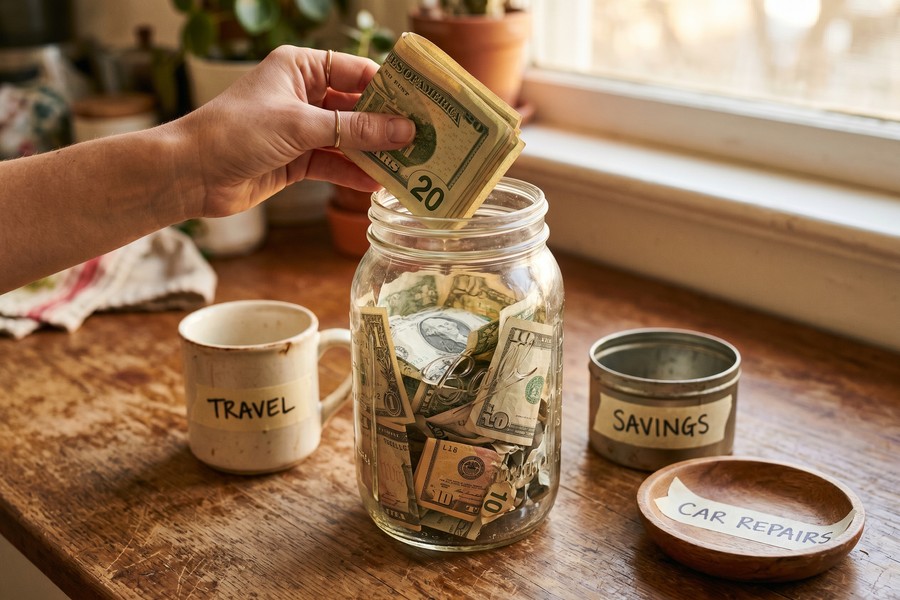
The practical solution is to turn a large disbursement into a series of artificial weekly “paychecks” inside your budgeting app. The math is straightforward: if a financial aid refund of $4,000 arrives in late August and your fall semester runs for 16 weeks, your weekly paycheck is $250. In YNAB, you enter that $250 as available to budget each Sunday, even though the full $4,000 sits in your checking account. The full balance is visible, but spending is governed by the weekly allocation.
This approach replicates the psychological constraint of a paycheck cycle without requiring a part-time job to produce one. It is also the mechanism that prevents the classic student mistake of spending freely in September because the balance “looks fine” and panicking in November when the semester is not yet over but the money is gone.
Sinking Funds for Known Irregular Expenses
Set up separate budget categories, sinking funds, for expenses you know are coming but that don’t arrive monthly. Textbooks, holiday travel, subscription renewals, and car registration all qualify. If you know you will spend $300 on textbooks at the start of each semester, divide that by your weekly paycheck count and earmark that portion from week one. By the time the expense arrives, the money has been reserved rather than spent on something else.
Identifying Funding Gaps Early
The most valuable function of this system is early-warning detection. When your weekly allocations are mapped out against the full semester, it becomes clear in week two whether the disbursement is large enough to cover every known expense. Discovering a shortfall in week two allows time to adjust spending, pick up extra work hours, or apply for an emergency aid fund through the financial aid office. Discovering it in week twelve leaves no good options.
If you are managing multiple financial goals alongside your semester budget, say, tracking hydration, sleep, and financial wellness as part of a broader health practice, you might find parallels in how habit-tracking apps work. The same daily-check-in discipline that makes water tracking apps effective applies to weekly budget reviews: the act of checking in matters more than perfection.
Set a recurring 15-minute calendar block every Sunday night to reconcile your budget app. Students who do a weekly review catch overspending in a single category before it cascades into borrowing from another. The specific day matters less than the consistency.
Step 6: Financial Wellness vs. Financial Anxiety: The Psychological Case for These Tools
The relationship between financial stress and debt is not simply that more debt produces more stress. The research points to something more specific and more actionable: it is financial self-efficacy, the belief that you are capable of managing your money, that most strongly predicts stress levels, independent of how much debt you actually carry.
What the Research Says
Students with higher financial self-efficacy report significantly lower financial stress even when holding the same debt load as peers with lower self-efficacy, according to research cited by YourMoneyLine. The implication is direct: the act of using a budgeting tool, seeing your numbers clearly, making a plan, following through on it, reduces anxiety through a mechanism that is partly independent of the dollars saved. You are building a belief system about your own competence at the same time you are building a budget.
This is why financial wellness apps belong in a conversation about health, not just personal finance. The chronic low-grade stress of not knowing where your money is, what researchers sometimes call financial ambiguity, is measurably correlated with worse physical health outcomes, including reduced sleep quality and a higher likelihood of forgoing preventive medical care.
The Money Shame Barrier
Nearly 40% of college students report being more comfortable discussing sex or politics with family than money, according to surveys conducted by financial wellness platforms including iGrad. This avoidance behavior is the real first barrier, not picking the right app, but overcoming the reluctance to open a banking app at all.
For students who recognize that avoidance in themselves, the most effective entry point is often the least threatening one: a simple expense log for one week, with no judgment and no action plan attached. The goal in week one is only to see the numbers. The plan comes after. Some campuses now integrate financial wellness consultations into their counseling centers and student health services, framing money management as part of overall wellbeing rather than a separate financial aid conversation. That framing is worth seeking out.
Research published in the Journal of Consumer Affairs found that financial stress independently predicts students forgoing needed medical care, making financial instability a direct pathway to physical health decline, not just an economic inconvenience.
Step 7: What Financial Habits Should I Build Before I Graduate?
Apps create structure, but they cannot internalize habits for you. The goal before graduation is to build three specific behaviors that will hold even when the app’s free trial ends, the loan grace period expires, and the student-specific scaffolding disappears.

The Three Non-Negotiable Habits
First: maintain a small emergency fund. Even $500 in a separate savings account breaks the cycle of turning to a credit card for every unexpected expense. A blown tire, an urgent prescription, or a last-minute textbook purchase should not require borrowing. The specific amount matters less than the habit of keeping the fund replenished, which is where your sinking fund discipline from Step 5 directly transfers.
Second: understand your loan types and their grace periods. Subsidized federal loans do not accrue interest while you are enrolled; unsubsidized loans do. Both grant a six-month grace period after graduation before repayment begins, but interest continues accruing on unsubsidized balances during that grace period. Students who understand this make different choices about whether to make small voluntary payments during school. Those who don’t discover the balance has grown before they’ve made a single payment.
Third: establish at least one positive credit history line. A secured credit card with a low limit, paid in full every month, begins building the credit file that will eventually determine your rental eligibility, car loan rate, and in some cases your job prospects. The first credit card you use responsibly matters more to your eventual credit score than any other single action at this age.
The Graduation Cliff
YNAB’s free student year ends at graduation. Loan grace periods expire six months later. Apartment rentals require credit checks. The students who built app-supported habits during school transition to paid tools or free alternatives with their systems intact. Those who relied on a free trial without internalizing the underlying methodology find themselves facing the full weight of their financial obligations without a framework in place, which is precisely the moment a debt spiral accelerates rather than stops.
The honest concession for any reader who has not followed every step of this guide perfectly: financial wellness is not about achieving a perfect budget. It is about reducing the chronic stress of financial ambiguity. Even imperfect, inconsistent use of a tracking app provides meaningful anxiety relief compared to complete avoidance. Starting is more important than starting correctly.
For students building broader digital wellness habits alongside their financial practice, the discipline of daily check-ins also applies to mental health tools. Apps reviewed in guides like best journaling apps for daily reflection and beginner meditation apps work on similar principles: consistent small actions compound into structural change over time.
Three months before graduation, audit your subscriptions, free student accounts, and app trials, including YNAB, Spotify, Amazon Prime Student, and any institutional platform tied to your .edu email. Set calendar reminders for their expiration dates. The cost of these transitions hits all at once and can destabilize a tight post-graduation budget if you are not ready for them.
Frequently Asked Questions
What is the best free budgeting app for college students who don’t have a regular income?
YNAB is the strongest free option for students with irregular income because it is free for one full year with proof of enrollment and is built around zero-based budgeting, a method specifically designed to work with lump-sum and unpredictable cash flow. Goodbudget is the best alternative if you prefer not to link bank accounts, as it uses manual envelope-based tracking with no bank connection required.
Should I use a financial wellness app if I already have significant student loan debt?
Yes, in fact, students with existing debt have the most to gain from structured tracking. A budgeting app helps you see exactly how much discretionary spending is available after fixed obligations, which prevents the “minimum payment trap” of treating a credit card balance as a permanent fixture rather than a debt to eliminate. Apps like Monarch Money include debt payoff planning tools that let you compare avalanche versus snowball repayment strategies with your actual balances.
Can a budgeting app actually help me stop using Buy Now, Pay Later so much?
A budgeting app does not block BNPL purchases, but it creates a friction point that changes behavior. When you manually add every BNPL installment as a line item in your budget, you see the full cost of a purchase spread across future weeks, which shifts the psychological experience from “I can afford this because I’m paying in four parts” to “I need to reduce my grocery envelope to cover this payment in three weeks.” That reframe is often enough to stop impulsive BNPL use.
How do I know if my college already provides a free financial wellness platform?
Email your financial aid office, student wellness center, or advising office and ask specifically whether the school provides access to iGrad, Enrich, Banzai, CashCourse, or any student financial wellness platform. Many universities license these tools and never prominently advertise them. SUNY students can also check directly for SmartTrack access. The query takes one email and could save you the cost of a third-party subscription.
Is it safe to link my bank account to a budgeting app?
The major budgeting apps use read-only bank connections, meaning the app can see your transactions but cannot move money. The connection is typically handled by a third-party data aggregator such as Plaid, which is used by thousands of financial applications and regulated under U.S. financial data standards. That said, if you are wary of sharing account credentials, Goodbudget’s manual entry approach requires no bank connection at all. Students who want to think through data sharing more broadly may find it helpful to review how to build a personal digital security routine before connecting accounts.
What happened to Mint, and what should former Mint users switch to?
Mint shut down in early 2024. Former Mint users who primarily used it for free budget tracking and credit score monitoring have migrated in two directions: those who want a free passive tracker have moved to Credit Karma (which absorbed some Mint infrastructure) or PocketGuard; those who want a more structured, proactive tool have moved to YNAB or Goodbudget. The key difference is that Mint-style passive tracking does not produce the pre-commitment behavioral change that prevents overspending, so the migration is also a good opportunity to choose a more proactive methodology.
How much of my financial aid refund should I set aside for emergencies?
A practical target is $500 as a minimum emergency reserve, enough to cover a single unexpected expense without reaching for a credit card. Beyond that, financial planning guidelines generally suggest three to six months of living expenses, but that target is more realistic to pursue after graduation. During school, keeping even a small dedicated savings buffer in a separate account from your main spending account is the single highest-leverage financial action a student can take.
Can using a budgeting app actually reduce financial stress, or is it just about saving money?
The stress-reduction benefit of tracking apps is documented independently of the dollars saved. Research cited by YourMoneyLine shows that financial self-efficacy, the belief that you can manage your money, is the primary predictor of financial stress levels, separate from actual debt amounts. Students who consistently engage with a budgeting app build that self-efficacy through repeated evidence that they understand and can influence their financial position, which reduces anxiety even in periods when the budget is tight.
What are the signs that I am already in a debt spiral as a student?
The clearest signs are: making only minimum payments on a credit card balance that never shrinks; using one debt instrument (a BNPL installment, a new credit card, a personal loan) to cover payments on another; regularly running out of money before the end of the month with no clear understanding of where it went; and feeling a persistent anxiety about checking your bank balance. Any one of these patterns, caught early, is addressable with the tools in this guide. The spiral becomes harder to exit when multiple patterns compound simultaneously.
Sources
- Education Northwest, Financial Literacy Report, April 2025
- Motley Fool Money, Gen Z Buy Now, Pay Later Survey (2025)
- YourMoneyLine, Financial Self-Efficacy and Tracking App Research
- YNAB, Free Year for College Students Program
- Goodbudget, Envelope Budgeting App, Free Tier Details
- Consumer Financial Protection Bureau, Student Loan Tools and Resources
- Federal Reserve, Consumer Credit Statistical Release (G.19)






