Fact-checked by the SnapMessages editorial team
Quick Answer
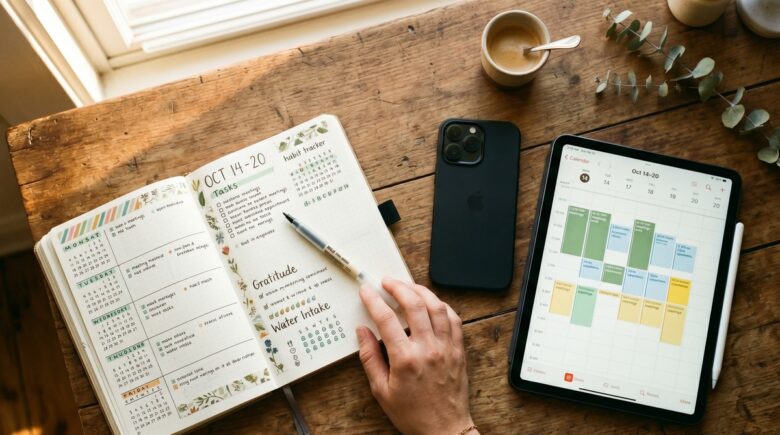
Choosing between analog vs digital planning for long-term habit formation comes down to three factors: cognitive encoding, consistency, and your personal tolerance for screen time. Research shows handwriting activates significantly more brain regions than typing, while 70% of digital planning app users quit within 100 days. Most people sustain planning long-term with a hybrid system that uses paper for goals and reflection, and digital tools for appointments and reminders.
The analog vs digital planning debate has real stakes for your health and wellbeing, not just your productivity. The medium you choose shapes how deeply you encode your goals, how much cognitive load you carry through the day, and whether healthy habits compound over weeks and months or quietly fade. A 2018 survey by calendar platform ECAL found that 70% of adults rely primarily on a digital calendar to manage their daily schedule, yet the same research revealed that nearly 28.3% still reach for a paper diary or planner first.
That split matters because we are asking more of our planning systems than ever before. In May 2026, the average person navigates hybrid work schedules, multiple wellness goals, and a notification-saturated environment that competes for the same attention they need to plan well. The choice of planning medium is no longer a stationery preference. It is a digital wellness decision.
This guide is for anyone who has tried a planning system, watched it collapse, and wondered why. Whether you have cycled through apps or filled half a planner and abandoned it, the sections below will help you understand what the science actually says, where each format genuinely excels, and how to build a system you will still be using six months from now.
Key Takeaways
- Handwriting activates a broader network of brain regions than typing, according to a 2022 peer-reviewed review in Frontiers indexed on PubMed, giving analog planning a measurable edge for goal internalization.
- 70% of lifestyle and behavior-change app users quit within 100 days, based on a scoped review of 18 studies and 525,824 participants, making long-term digital-only planning a statistically difficult proposition.
- 28.3% of adults still rely primarily on a paper diary or planner, according to ECAL’s survey of 1,000 respondents, proving analog planning has not been displaced despite the smartphone era.
- The global paper notebook market is projected to reach USD 76.28 billion in 2025, growing to USD 89.72 billion by 2030, per Mordor Intelligence, reflecting sustained and growing demand for analog writing tools.
- A hybrid framework, paper for encoding-heavy tasks like goal-setting and reflection, digital for retrieval-heavy tasks like appointments, is both scientifically grounded and the most commonly sustainable long-term approach.
- Running two full planning systems simultaneously is documented as the primary reason hybrid setups fail; a clean boundary between the two systems is essential for the approach to work.
In This Guide
- Step 1: Why Your Planning Method Affects More Than Just Productivity
- Step 2: What the Science Says About Writing by Hand vs. Typing
- Step 3: The Hidden Mental Health Cost of Planning on a Screen
- Step 4: Where Digital Planning Genuinely Wins (And Shouldn’t Be Skipped)
- Step 5: How Personality and Cognitive Style Predict Which Method Sticks
- Step 6: How to Build a Hybrid Planning System With a Clear Boundary
- Step 7: How to Know Which Planning Method Is Actually Working for Your Health
- Frequently Asked Questions
Step 1: Why Your Planning Method Affects More Than Just Productivity
Most people treat planning as a time-management problem, but the tool you use to plan has a direct effect on your cognitive load, stress levels, and the durability of your health habits. Planning is a health behavior, and the medium matters as much as the method.
How to Think About This
When researchers study what makes a wellness habit stick, the consistent finding is not willpower or motivation. It is cognitive encoding: how deeply the brain registers and stores an intention. A goal you write on paper is processed differently than one you type into an app, and that difference has measurable consequences for follow-through over weeks and months, not just days.
Habit researchers distinguish between outcome-based goals (“I want to lose 10 pounds”) and identity-based habits (“I am someone who plans their day”). The medium you use signals something to your own brain about which category your planning falls into. A physical planner sitting on your desk is a persistent environmental cue. An app notification is a momentary prompt that disappears the moment you swipe it away.
What to Watch Out For
The biggest mistake at this stage is treating planning as a neutral activity where the tool has no effect on the outcome. If you pick a planning method purely based on convenience and ignore how it interacts with your cognitive style, stress patterns, and screen habits, you are likely to repeat the same abandonment cycle you have already experienced.
Psychologists call the brain’s tendency to assign more meaning to goals that are physically written down the “generation effect.” The act of forming words by hand, rather than selecting keys, makes those words more memorable and more motivating, a mechanism directly relevant to health goal-setting.
Step 2: What the Science Says About Writing by Hand vs. Typing
Handwriting has a measurable cognitive advantage over typing for goal retention and memory encoding, and the evidence is strong enough to shift the default recommendation for anyone whose primary goal is building lasting health habits.
How to Do This
Understanding the neuroscience helps you make a deliberate choice rather than a habitual one. Research published in Frontiers and indexed on PubMed Central confirms that handwriting engages more complex neural circuits than typing and remains an important tool for learning and memory retention. The mechanism is specific: when you write by hand, you cannot transcribe fast enough to record everything verbatim, so your brain is forced to summarize, prioritize, and process the information in real time. Typing, which most people do at near-conversational speed, allows verbatim capture with very little active processing.
Audrey van der Meer, Professor of Neuropsychology at the Norwegian University of Science and Technology (NTNU), has described the core finding from her lab’s research in interviews covered by NBC News Health: handwriting activates almost the whole brain compared to typewriting, which produces far less neural engagement. The practical implication for planning is direct. Pressing keys on a keyboard does not challenge the brain the way forming letters by hand does, and that difference in neural demand is precisely what produces stronger encoding of goals and intentions.
When you write your three priorities for the day in a paper planner, you are processing those priorities actively. When you type them into Notion or Todoist, the friction is lower and the encoding is shallower. Over time, shallower encoding produces goals that feel less real and commitments that are easier to ignore.
A 2024 meta-analysis review published by The Learning Scientists concluded that students who took notes by hand consistently outperformed those who typed, with benefits enhanced when notes were reviewed later. The caveat worth naming: most of this research comes from academic note-taking contexts, not personal planning for wellness. The transfer is plausible and supported by the underlying neuroscience, but the evidence is stronger for learning than for habit change specifically.
What to Watch Out For
Do not read this research as proof that digital tools have no cognitive value. The honest picture is more nuanced. Digital note-takers and planners complete logistical tasks faster and retrieve information more efficiently, with zero friction from illegible handwriting. The advantage of handwriting is concentrated in tasks that require deep encoding: setting goals, writing reflections, and processing emotionally significant intentions. For scheduling a dentist appointment, the encoding advantage of paper is zero.
Research cited by the Journalist’s Resource at Harvard Kennedy School advises that longhand notes produce better encoding and external storage for learning than laptop notes, even when laptops are used solely for note-taking with no other browser activity.
Step 3: The Hidden Mental Health Cost of Planning on a Screen
Adding a digital planning tool to an already screen-heavy day compounds a cognitive and stress burden that most people are carrying at or near capacity. This is the angle almost no productivity article addresses, and it matters specifically for health and wellness.
How to Do This
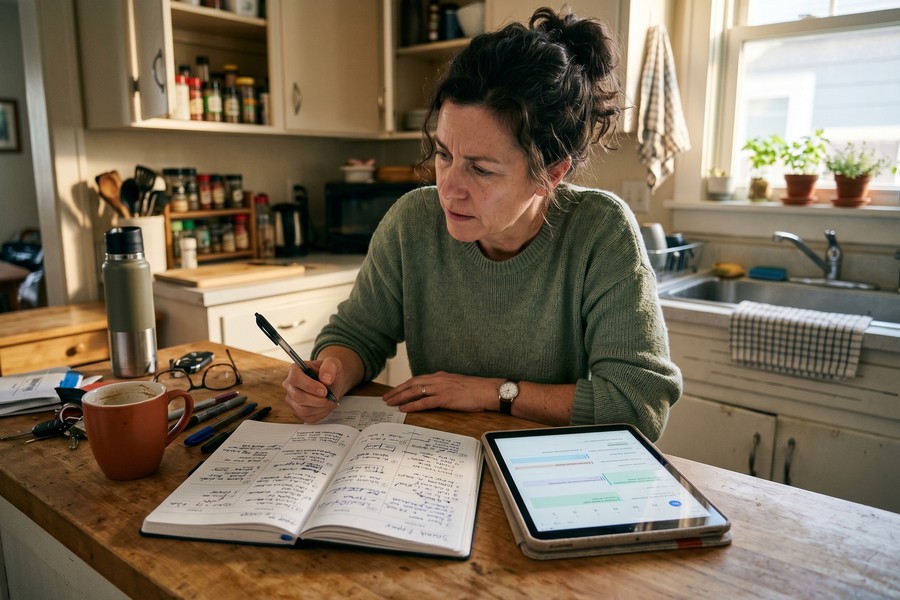
Start by auditing your current daily screen time honestly. The average adult in 2025 spends substantial hours on screens across work, entertainment, and communication. Picking up a phone to plan your wellness goals means opening the same device that delivers social media, work emails, and news alerts. The cognitive context switching is not neutral. Research consistently links high screen exposure to elevated cortisol, disrupted sleep architecture, and reduced mood over time.
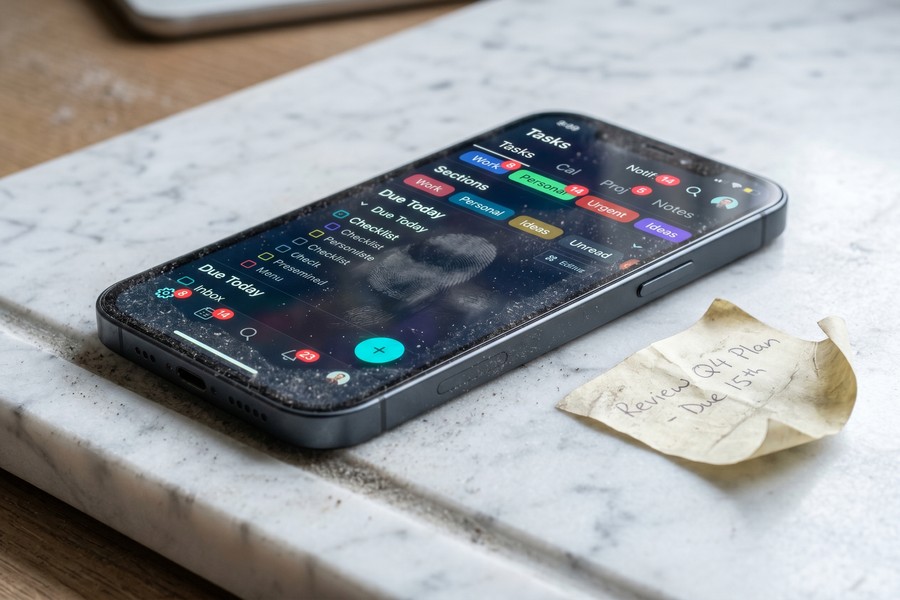
The abandonment problem is severe and worth understanding clearly. A scoped review of 18 studies covering 525,824 participants found that a median 70% of lifestyle and behavior-change app users quit within the first 100 days. The common assumption is that app dropoff reflects a lack of user motivation. The evidence points elsewhere: documented drivers include notification fatigue, interface friction, the burden of manual tracking, and the absence of any social accountability built into the tool. This is not a willpower failure. It is a product design problem that the user pays for.
Morning routines are especially relevant here. Avoiding screens in the first hour after waking is linked to lower morning cortisol and calmer psychological states throughout the day. A paper planner as a morning ritual fits naturally into this practice in a way that opening a planning app on a smartphone does not. For anyone building a digital-detox wellness routine alongside their planning habit, analog tools and screen-free mornings reinforce each other. You might also look at how dedicated journaling apps approach the same problem of sustained daily engagement, the parallels to planning apps are instructive.
What to Watch Out For
The risk here is overcorrecting. Dismissing all digital tools because of screen-time concerns ignores the genuine value they provide for scheduling, reminders, and collaboration. The goal is to assign the right job to the right medium, not to declare one format superior to the other.
If you are using a wellness or habit-tracking app and finding that the act of opening it feels like a chore rather than a natural behavior, that friction is a documented precursor to abandonment. It is not a sign to push harder, it is a sign to reconsider the tool or the system design.
Step 4: Where Digital Planning Genuinely Wins (And Shouldn’t Be Skipped)
Digital planning tools are objectively better than paper for a specific category of tasks, and anyone who ignores this in favor of an all-analog approach will face real consistency problems. The question is not which format is superior but which job each format is best built for.
How to Do This
Digital tools outperform paper in four specific areas: recurring reminders, shared calendars, time-sensitive alerts, and searchable archives. If you have a standing weekly appointment, a collaborative work schedule, or a deadline that requires a push notification to avoid missing it, paper cannot help you. Google Calendar, Apple Calendar, and tools like Fantastical handle these tasks in ways no paper system can replicate.
For people managing ADHD-related time blindness, a documented neurological difficulty with perceiving elapsed time, digital reminders are not a convenience preference. They are a functional accommodation. The all-or-nothing framing of analog vs digital planning is particularly unhelpful here because it implies choosing a side when what is actually needed is a clear allocation of functions. If managing multiple apps and digital tools feels overwhelming, the same skills used to automate repetitive tasks on iPhone using Shortcuts can reduce the friction of maintaining a digital calendar layer significantly.
The honest concession about paper is that it requires a pre-existing habit loop to be useful. Paper offers zero push notifications. A planner left in a bag is not planning. For anyone who has not yet built a consistent morning routine or who relies on external cues to initiate planning behavior, a purely analog system introduces a consistency dependency that the system itself cannot solve.
What to Watch Out For
The trap is believing that a feature-rich planning app will create discipline where none previously existed. Research does not support this. Digital tools enhance existing organizational habits; they do not build them from scratch. If you have never consistently maintained any planning system, starting with a complex digital tool is likely to produce the same 70-day abandonment curve that the data predicts.
Separate your calendar (digital, appointment-based, shared) from your planner (daily priorities, goals, reflection). Most people conflate these two functions and then wonder why neither feels satisfying. A shared Google Calendar for time-blocked appointments and a paper planner for daily intentions is a clean, defensible split that removes almost all the duplication anxiety from a hybrid system.
| Planning Task | Analog (Paper) | Digital (App/Calendar) |
|---|---|---|
| Goal Setting | Strong, deeper encoding, generation effect, tactile reinforcement | Weak, fast entry but shallow processing, easily ignored |
| Daily Priorities | Strong, visible, static, persistent on the page | Moderate, accessible anywhere but competes with notifications |
| Habit Tracking | Strong, visible streaks, satisfying physical completion | Moderate, automated, but 70% abandonment rate within 100 days |
| Recurring Reminders | Weak, zero push alerts, requires manual checking | Strong, automated, reliable, no habit dependency |
| Shared Calendars | Not possible | Strong, essential for team or family scheduling |
| Reflection / Journaling | Strong, linked to cortisol reduction and emotional regulation | Weak, screen context undermines reflective state |
| Search and Retrieval | Weak, no search, dependent on indexing or memory | Strong, instant, keyword-searchable archives |
| Long-term Abandonment Risk | Moderate, requires habit loop but re-entry is forgiving | High, 70% quit within 100 days across 18 studies |
Step 5: How Personality and Cognitive Style Predict Which Method Sticks
Cognitive style, not technology comfort or aesthetic preference, is the real predictor of whether an analog or digital planning system will survive past the first month. Understanding where you fall on this spectrum will save you from repeating an abandonment cycle.
How to Do This
Highly anxious individuals often find that paper planning reduces rumination more effectively than digital because there is no inbox to check, no red badge count, and no ambient connectivity. The act of writing a worry or a task on paper and then closing the planner has a psychological finality that closing an app tab does not replicate.
Tactile learners, people who process information more effectively through physical sensation, consistently report higher satisfaction and consistency with paper systems. This is not nostalgia. It maps to the neuroscience: the physical act of writing engages proprioceptive feedback loops that typing does not. The slowness of handwriting, which most productivity advice treats as a flaw, is precisely the feature that produces deeper encoding for this group.
People with ADHD represent a genuinely different case, and it is worth addressing directly rather than generalizing. Time blindness, a documented ADHD characteristic where the perception of elapsed time is impaired, makes paper systems particularly risky as a sole planning tool. A paper planner cannot interrupt a hyperfocus state. For this group, the honest recommendation is a digital layer for time-sensitive cues combined with paper for goal-setting and reflection, where the encoding advantage is valuable but the reminder dependency is absent.
What to Watch Out For
The all-or-nothing trap is especially dangerous for perfectionists and for people who have already tried multiple systems and failed. Missing one day in a rigid digital system, a streak broken in a habit app, a notification ignored, can spiral into complete abandonment because the digital system makes the failure visible and permanent. Paper systems are structurally more forgiving. You can pick up a paper planner after a two-week gap and continue from today without any record of the lapse sitting in your data. That re-entry ease is underrated as a long-term consistency factor.
Paper planner users tend to exhibit a more deliberate, intentional organizational style than their digital counterparts, not because they are less comfortable with technology, but because the slower pace of handwriting is the design feature they are specifically choosing. The friction is intentional.
Step 6: How to Build a Hybrid Planning System With a Clear Boundary
A hybrid system is the most defensible long-term approach, but it requires a hard, pre-specified boundary between the two formats. Without that boundary, most hybrid setups collapse within weeks from duplication anxiety and a loss of trust in both systems.
How to Do This
The framework is straightforward: use paper for encoding-heavy tasks and digital for retrieval-heavy tasks. Here is what that means in practice:
- Paper handles: daily top-three priorities, weekly goals, habit tracking, morning reflection, gratitude notes, and any goal that requires deep internalization.
- Digital handles: recurring appointments, shared family or work calendars, time-sensitive reminders, and any schedule that other people need to access.
The transition matters. If you are currently running a digital-only system and want to add a paper layer, do not attempt to run both systems fully in parallel for more than one week. Start at a natural boundary: the beginning of a month, the start of a new quarter, or a Monday after a planned break. Run both systems simultaneously for exactly seven days to transfer any live commitments. Then shut down the planning functions in your digital tool and use it only for its calendar and reminder functions going forward.
This transition structure reduces the trust anxiety that kills most hybrid attempts. The anxiety usually sounds like: “Did I put that in both places? Which one is the real one?” By assigning mutually exclusive jobs to each format, you eliminate that question. For readers who want to go further with automation on the digital side, the guide on automating repetitive iPhone tasks covers how to reduce manual entry significantly, which matters if digital friction is what drove you to paper in the first place.
What to Watch Out For
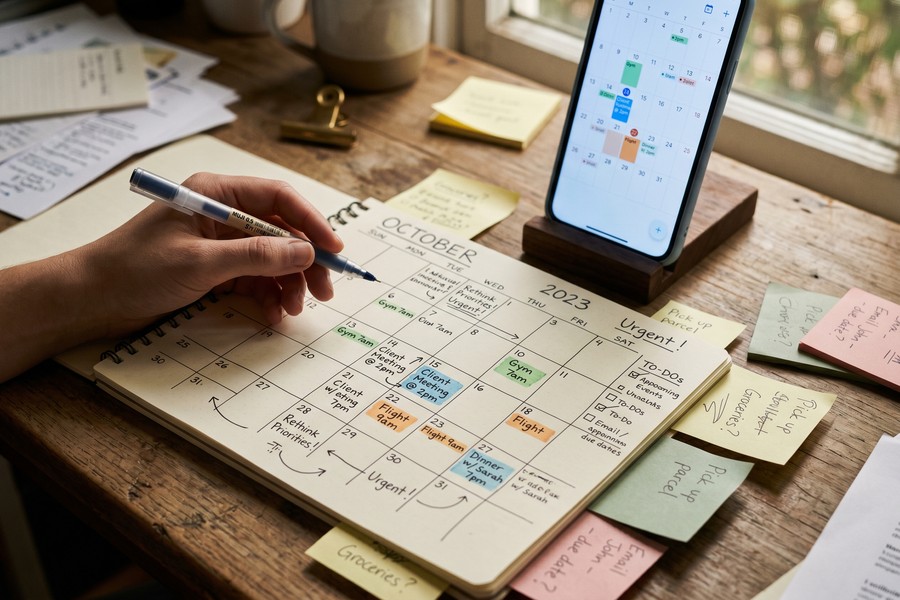
The most common hybrid failure is treating both systems as full planning systems. If your paper planner has a monthly calendar grid and your Google Calendar also has all the same appointments, you now have two sources of truth and a maintenance burden that will eventually cause one system to fall behind. At that point, neither system is trustworthy, and most people abandon both within a few weeks. One system owns each function. That is the only setup that works long-term.
Choose your paper planner format deliberately. An undated planner is more forgiving than a dated one because missing days does not produce blank pages that serve as visible evidence of failure. This small design choice meaningfully affects re-entry after a lapse, which is the real test of any long-term system.
Step 7: How to Know Which Planning Method Is Actually Working for Your Health
A planning system that is working for your health does not just complete tasks. It reduces cognitive load, supports calmer mornings, and reinforces the identity of being someone who follows through. Measuring task completion alone will give you a misleading picture.
How to Do This
Run a 30-day self-assessment using three metrics, not one. First, track task completion as your baseline. Second, rate your morning anxiety on a simple 1-to-5 scale before you open your planner and again after you have written your day’s priorities. If your planning session consistently reduces that number, the system is doing what it is supposed to do. Third, notice whether you are opening your planner because you want to or because you feel obligated to. Consistency driven by intrinsic pull, not external pressure, is the signal that a habit has actually formed.
A meaningful distinction exists between “I like this planner” and “this planner is making me healthier.” Aesthetically pleasing stationery and satisfying app interfaces can create a false positive. The real question is whether the system is reducing the mental chatter about undone tasks, supporting your sleep by giving you a clear close-of-day ritual, and reinforcing the identity-based habits that your wellness goals depend on.
If you are tracking health habits specifically, the approach parallels what good health apps attempt to do. Looking at how the best water tracking apps sustain daily engagement illustrates the same behavioral design principles at work: simplicity, visible progress, and minimal friction. A paper planner that you design deliberately can apply exactly those principles without requiring an app.
What to Watch Out For
Switching costs are real. Moving from one planning system to another involves an anxiety period where neither system is fully trusted. That cost is worth paying if the current system is actively failing you. It is not worth paying because a new planner looks appealing or because a new app launched this month. Make the decision based on your 30-day data, not on novelty.
The best planning system is the one you will open consistently six months from now. Neuroscience, productivity research, and behavior-change data all converge on the same conclusion: for most people, that system will have a paper layer at its core, supported by a minimal digital calendar layer that handles what paper structurally cannot. That is not an ideological position. It is what the evidence recommends.
The global paper notebook market is projected to reach USD 76.28 billion in 2025 and grow to USD 89.72 billion by 2030, according to Mordor Intelligence’s 2025 industry report. In a world of ubiquitous smartphone access, sustained market growth for analog writing products is itself evidence that paper planning is not a fading behavior.
Frequently Asked Questions
Is a paper planner or digital planner better for building long-term habits?
For long-term habit formation specifically, paper planners have a measurable edge because handwriting produces deeper cognitive encoding of goals and intentions than typing. A 2022 peer-reviewed review published in Frontiers confirms that handwriting engages more complex neural circuits than typing, which translates to stronger goal retention over time. That said, digital tools are more consistent for appointments and reminders, so most people sustain habits best with both formats serving different functions.
Why do I keep abandoning my digital planning app after a few weeks?
App abandonment at the rate you are experiencing is not unusual, it is statistically predicted. A scoped review of 18 studies covering over 525,000 participants found that a median 70% of behavior-change app users quit within 100 days. Documented causes include notification fatigue, the burden of manual tracking, interface friction, and the absence of social accountability. Before switching to a new app, consider whether the function you need is better served by a paper system where those failure modes do not exist.
Should I use a paper planner or an app if I have ADHD?
For people with ADHD, neither format alone is adequate. Time blindness, a documented ADHD trait where the perception of elapsed time is impaired, makes paper a risky sole system because it cannot interrupt a hyperfocus state or provide time-sensitive alerts. The most functional approach for ADHD is a digital calendar layer for time-based reminders combined with a paper system for goal-setting and reflection, where the handwriting advantage matters and the reminder dependency does not.
Can I use both a paper planner and a digital calendar without it becoming overwhelming?
Yes, but only if you assign each format a mutually exclusive job. The hybrid system fails when both formats contain the same information and compete as sources of truth, creating what researchers describe as trust anxiety in both systems. The clean boundary is: paper owns daily priorities, goals, and reflections; digital owns appointments, recurring reminders, and shared schedules. Run both in parallel for one week at a natural transition point, transfer all live commitments to their correct format, then stop using digital for planning functions and paper for calendar functions. If you want to reduce the manual overhead of the digital layer, building a structured digital routine can help you keep the technological side of your system lean and sustainable.
Does writing goals by hand actually make you more likely to achieve them?
The evidence supporting this is solid at the mechanistic level. Handwriting forces your brain to summarize and process rather than transcribe verbatim, producing deeper encoding of the goal, a process psychologists call the generation effect. Studies referenced by the Journalist’s Resource at Harvard Kennedy School confirm that longhand notes outperform typed notes for encoding and external storage. The causal chain connecting this to goal achievement is plausible, though the direct evidence for health goal attainment is stronger at the behavioral level than in controlled randomized trials.
What is the best way to switch from a digital planner to a paper planner without losing track of things?
Choose a natural transition boundary such as the first of a month or a Monday. For one full week before that date, run both systems simultaneously: write your daily priorities on paper while keeping digital active. Use that week to export or copy any recurring commitments, contacts, and deadlines into their permanent format. On the transition date, stop using your digital tool for daily planning functions and keep it only for calendar and reminder functions. Do not attempt a cold switch mid-week or mid-month; the resulting confusion is the primary reason transitions fail.
Are paper planners good for reducing anxiety and stress, or is that just marketing?
Genuine research supports the stress-reduction claim, though it is often overstated in planner marketing. Expressive writing, which includes the act of writing out your plan, worries, or intentions by hand, has been shown in peer-reviewed studies to lower cortisol and interrupt rumination patterns. The mechanism involves offloading mental content from working memory onto the page, reducing the cognitive load that sustains anxiety. A paper planner used as a morning ritual, away from screens, aligns with documented advice to avoid screens in the first hour after waking, a practice linked to lower morning cortisol. The mindfulness-adjacent benefits are real but are better described as a byproduct of consistent practice than as an immediate effect.
How do I know if my planning system is actually improving my health, not just my task list?
Track three things over 30 days rather than one. Task completion is the obvious metric but the least useful in isolation. Rate your morning anxiety before and after your planning session on a simple scale each day; if planning consistently reduces that rating, the system is doing real work. Third, notice whether you open your planner voluntarily or only when you feel obligated to. Intrinsic pull, the desire to use the system rather than the obligation to, is the behavioral signal that a habit has actually formed rather than just being maintained through willpower. The best tools for building a reflective daily practice, including gratitude apps that build a positive mindset, use identical behavioral design principles.
What are the real downsides of using only a paper planner?
Paper’s genuine limitations are worth naming clearly. A paper planner cannot send you a reminder. It cannot be shared with a partner, team, or family. It cannot be searched. It can be lost, left at home, or forgotten in a bag. Beyond those practical gaps, it requires a pre-existing habit loop to check consistently, meaning the system depends entirely on you initiating contact with it every day. For anyone who relies on external cues to begin planning behavior, a purely paper system will produce gaps that compound into abandonment over time. These are structural limitations, not user failures, and they make the case for a minimal digital calendar layer running alongside any paper-based system.
Should I use a productivity app or a habit tracker for wellness goals, or is that different from planning?
Habit trackers and productivity apps serve partially overlapping but distinct functions. A productivity app like Todoist or Notion manages tasks and projects, while a habit tracker like Streaks or Habitica manages repetitive behavioral commitments. Neither replaces intentional planning because both are retrieval and reminder tools, not encoding tools. For wellness goals specifically, where behavior change and identity reinforcement matter more than task throughput, the encoding advantage of handwriting makes paper-based habit tracking more sustainable than app-based tracking for most people. That said, apps like the best beginner meditation apps demonstrate that digital tools can support wellness practices effectively when the design minimizes friction and keeps the behavior extremely simple.
Sources
- ECAL, 70% of Adults Rely on Digital Calendar Survey (2018)
- Mordor Intelligence, Paper Notebook Market Report (2025)
- PubMed Central / Frontiers, Handwriting vs. Typing: Neural Complexity Review (2022)
- The Learning Scientists, 2024 Meta-Analysis Review: Handwritten vs. Typed Notes
- Journalist’s Resource (Harvard Kennedy School), Longhand vs. Laptop Note-Taking Evidence Summary
- NBC News Health, Writing by Hand May Increase Brain Connectivity (Audrey van der Meer, NTNU)
- SnapMessages, Best Journaling Apps to Build a Daily Reflection Habit
- SnapMessages, Best Water Tracking Apps to Hit Your Daily Hydration Goals
- SnapMessages, Best Meditation Apps for Beginners Who Have Never Tried Mindfulness
- SnapMessages, Best Gratitude Apps to Build a Positive Mindset in Minutes a Day






