Fact-checked by the SnapMessages editorial team
Quick Answer
A digital wallet app can fully replace your physical wallet by storing payment cards, IDs, loyalty cards, and transit passes in one secure app. As of July 2025, over 53% of U.S. consumers use mobile payments as their primary payment method, with top apps like Apple Pay, Google Pay, and PayPal accepted at more than 85 million merchants worldwide.
A digital wallet app can replace your physical wallet entirely, and for millions of people, it already has. According to the Federal Reserve’s 2024 consumer payments report, mobile wallet adoption in the U.S. grew by 12 percentage points in a single year, driven by contactless checkout, tap-to-pay transit, and in-app purchases. The case for ditching a leather wallet is no longer theoretical. It is measurable and real.
Understanding exactly how this switch works, and where the gaps still exist, saves you from a bad day at checkout.
Key Takeaways
- Mobile wallet adoption in the U.S. grew by 12 percentage points in a single year, according to the Federal Reserve’s 2024 consumer payments report.
- Over 53% of U.S. consumers now use mobile payments as their primary payment method, with Apple Pay, Google Pay, and PayPal accepted at more than 85 million merchant locations globally.
- Tokenization means your real card number is never transmitted to merchants, eliminating the most common point-of-sale fraud vector, per EMVCo’s tokenization specification.
- Mobile driver’s licenses are accepted at TSA checkpoints in 18 U.S. states as of 2025, per the TSA’s identification guidelines.
- A complete digital wallet setup takes under 20 minutes, and card additions carry the same federal consumer protections as physical cards, per the CFPB.
- Apple Pay and Google Pay both reach 80 to 85 million merchant locations, making either a viable full replacement for a physical card wallet for most U.S. consumers.
What Can a Digital Wallet App Actually Replace?
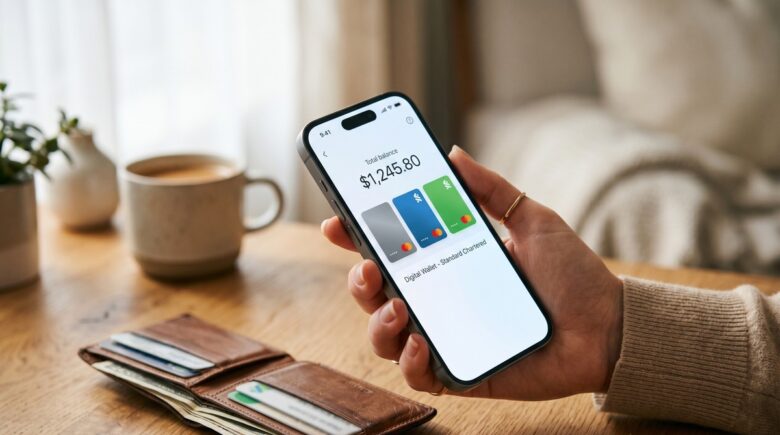
A digital wallet app can replace credit cards, debit cards, loyalty cards, boarding passes, event tickets, driver’s licenses, and transit cards, all from a single app on your phone. The coverage is broader than most people expect before they make the switch.
Apple Pay and Google Pay both support virtual card storage. Apps like PayPal and Samsung Wallet extend that to peer-to-peer payments and merchant rewards. According to the NFC Forum’s latest usage data, NFC-enabled contactless payments are now accepted at over 85 million global merchant locations, making tap-to-pay viable in nearly every retail environment.
What Physical Items Transfer Digitally
The following items move cleanly into a digital wallet with no loss of function:
- Credit and debit cards (Visa, Mastercard, Amex, Discover)
- Loyalty and rewards cards (Starbucks, Target Circle, airline programs)
- Transit passes (London Oyster, New York MTA, Chicago Ventra)
- Boarding passes and event tickets
- Mobile driver’s licenses (now accepted in 18 U.S. states as of 2025)
Cash remains the one item a digital wallet cannot replicate in every situation. Street vendors, some farmers markets, and certain small businesses still operate cash-only. Keeping a small emergency stash is a reasonable hedge, not a failure of the switch.
Just as AI is transforming what messaging apps can do, digital wallets are quietly redefining what a wallet itself needs to be: a convergence of identity, finance, and access in a single device.
Key Takeaway: A digital wallet app can replace every card category in a physical wallet, including loyalty cards and mobile IDs, with contactless payments now accepted at over 85 million merchant locations globally. Cash remains the only true gap.
Is a Digital Wallet App More Secure Than a Physical Wallet?
Yes. A digital wallet app is measurably more secure than a physical wallet in almost every fraud scenario. Physical wallets can be lost or stolen with no recovery mechanism; digital wallets use device-level biometrics, tokenization, and remote lock capabilities that a leather wallet cannot match.
Tokenization is the core security advantage. When you pay with Apple Pay or Google Pay, your actual card number is never transmitted. Instead, a unique, single-use token is sent to the merchant. According to EMVCo’s tokenization specification, this process makes intercepted payment data essentially worthless to attackers. Major card networks including Visa, Mastercard, and American Express all operate within this tokenization framework.
Biometric Authentication
Every major digital wallet requires Face ID, fingerprint, or PIN authentication before a transaction completes. If your phone is stolen, the thief cannot access your wallet without your biometric. A stolen physical wallet requires no authentication at all.
Remote wipe is the backup layer. If your phone is lost, Apple’s Find My and Google’s Find My Device both allow you to lock or erase your device, and therefore your wallet, within minutes. That capability does not exist for physical cards.
The CFPB notes that digital wallet transactions carry the same federal consumer protections as standard card payments, so a disputed charge on a Chase Visa stored in Apple Pay follows the same resolution process as a swipe at a terminal. If you are thinking about phone security more broadly, learning how to detect and remove spyware from your phone is a smart companion step.
Tokenized mobile payments eliminate the static card number as an attack surface entirely. The merchant never sees your real account data, which means a point-of-sale data breach cannot expose your card. This is not a theoretical claim: it reflects the core design principle behind EMVCo’s tokenization standard, which all major wallet providers implement.
Key Takeaway: Digital wallets use tokenization so your real card number is never shared with merchants, and biometric locks mean a stolen phone cannot be used for payments, security advantages that EMVCo confirms eliminate the most common card fraud vectors.
Which Digital Wallet App Should You Choose?
The best digital wallet app depends on your device, your spending habits, and whether you need peer-to-peer payments. Apple Pay, Google Pay, and PayPal cover the largest share of use cases for U.S. consumers.
Choosing the wrong app means missing merchant acceptance or losing rewards integrations. The table below compares the four most widely used options on the metrics that matter most for replacing a physical wallet.
| App | Platform | Merchant Acceptance | P2P Payments | ID Storage | Annual Fee |
|---|---|---|---|---|---|
| Apple Pay | iOS only | 85M+ locations | Apple Cash (U.S.) | Yes (18 states) | $0 |
| Google Pay | Android, iOS | 80M+ locations | Yes (U.S., India, Singapore) | Limited | $0 |
| Samsung Wallet | Samsung Android | 80M+ locations | No | Yes (select states) | $0 |
| PayPal | iOS, Android | 35M+ merchants | Yes (global) | No | $0 |
Apple Pay leads on in-store contactless coverage for iPhone users. Google Pay is the most versatile cross-platform option, working on both Android and iOS. PayPal wins for international peer-to-peer transfers and online checkout where NFC is not an option.
For consumers who carry a Chase, SoFi, or American Express card, all three issuers support instant tokenized provisioning into both Apple Pay and Google Pay, meaning your existing credit line and APR terms carry over without any changes to your account.
Key Takeaway: Apple Pay and Google Pay both reach 80 to 85 million merchant locations, making either a viable full replacement for a physical card wallet, with the choice driven by device ecosystem rather than coverage. See the CFPB’s digital payment consumer guide for rights and protections.
How Do You Actually Make a Digital Wallet App Replace Your Physical Wallet?
Making the switch takes about 20 minutes of setup and one deliberate week of habit change. The process has four steps: load your cards, migrate your loyalty programs, set a default payment method, and test before you ditch the wallet entirely.
Step 1, Load Your Cards
Open your wallet app and use the “Add Card” function. Most banks verify instantly via SMS or in-app approval. Visa, Mastercard, American Express, and Discover all support tokenized storage on both Apple Pay and Google Pay with no additional enrollment required. Issuers like Chase and SoFi also provide in-app prompts that push your card directly into Apple Wallet or Google Pay during onboarding.
Step 2, Migrate Loyalty Cards
Apps like Stocard and Wallet (iOS) let you scan physical loyalty barcodes so retailers can still read them at checkout. Many chains, including Target, Walgreens, and Starbucks, have their own apps that integrate directly with Apple Wallet or Google Pay passes.
Step 3, Set Your Default and Test
Set a primary card as default in your wallet settings. Then spend one week using only your phone for every payment. Keep the physical wallet in your bag but do not open it. After seven days, most people find they never touched it.
This also pairs well with managing your phone’s battery life. If you are going wallet-free, check out how to make your iPhone battery last all day so your payment method is always available.
The remaining friction point is forms that ask you to “show your card.” In those cases, your bank’s app typically displays your card number on screen, which satisfies most hotel check-ins and rental car counters. For financial management that complements your new cashless routine, the best budgeting apps can track every digital transaction automatically once your cards are linked. Some of these tools also pull in your FICO Score and flag changes to your credit utilization ratio, giving you a fuller picture of your financial health alongside your spending data.
Key Takeaway: A complete digital wallet setup takes under 20 minutes, load cards, migrate loyalty barcodes, set a default, and run a 7-day trial before removing your physical wallet. The CFPB confirms digital wallet card additions are protected under the same federal consumer payment rules as physical cards.
Where Does a Digital Wallet App Still Fall Short?
A digital wallet app still falls short in four specific scenarios: cash-only businesses, areas with no NFC infrastructure, states that do not accept mobile IDs, and situations where your phone battery is dead. These are real gaps, not hypothetical ones.
Mobile ID acceptance is the fastest-moving limitation. As of July 2025, the TSA accepts mobile driver’s licenses at select airports across 18 states, but coverage is not yet universal. International travel adds another layer, since most countries still require a physical passport and will not accept a digital equivalent. The Federal Reserve and CFPB have both noted that regulatory frameworks for mobile identity verification are still catching up to adoption rates.
Battery Dependency Risk
A dead phone means no payment. This is the most commonly cited objection, and it is valid. Express Mode on Apple Pay and Google Pay’s offline mode allow payments for a short period after your battery hits zero, but this window is narrow. Knowing how to manage your phone’s power when using data-heavy features reduces this risk significantly.
For high-stakes trips or rural areas with unreliable connectivity, carrying one backup card is still sensible. The goal is to make the phone your primary instrument and the card your emergency backup, not to achieve some kind of purity about never touching plastic again.
Key Takeaway: The four remaining gaps, cash-only vendors, non-NFC terminals, mobile ID acceptance in only 18 U.S. states, and battery dependency, are shrinking fast, but a single TSA-accepted backup card is still smart for travel until mobile ID coverage is universal.
Related reading: daily mental check.
Frequently Asked Questions
Can a digital wallet app replace my physical wallet completely right now?
For most urban and suburban U.S. residents, yes. Apple Pay and Google Pay are accepted at over 80 million merchant locations, and mobile IDs are valid at TSA checkpoints in 18 states. The only consistent gap is cash-only businesses and states without mobile ID acceptance.
Is it safe to use a digital wallet app instead of a physical card?
Digital wallets are safer than physical cards in most fraud scenarios. Tokenization means your real card number is never transmitted to merchants, and biometric locks prevent unauthorized use if your phone is stolen. The CFPB and EMVCo both confirm these protections exceed what physical cards offer.
What happens if my phone dies and I need to pay?
Apple Pay’s Express Mode and Google Pay’s offline mode allow a limited number of transactions after your battery reaches zero. Beyond that window, you need a backup payment method. Keeping a single card in a phone case is the most common solution among full-time digital wallet users.
Do digital wallet apps work internationally?
Apple Pay and Google Pay work in over 70 countries wherever contactless NFC terminals are present. However, mobile ID acceptance is currently limited to participating U.S. states, so a physical passport is still required for international travel and customs.
Which is the best digital wallet app to replace a physical wallet?
Apple Pay is the best choice for iPhone users due to its 85-million-location acceptance network and mobile ID support. Google Pay is the top pick for Android users and anyone needing cross-platform flexibility. PayPal is best for global peer-to-peer payments and online-only merchants.
Do digital wallet apps charge fees to use?
No. Apple Pay, Google Pay, Samsung Wallet, and PayPal’s basic wallet functions are all free to use. Your card’s existing transaction fees and foreign exchange rates still apply, but the wallet layer itself adds no cost.