Fact-checked by the SnapMessages editorial team
Quick Answer
To build a reliable wellness-focused smart home, choose Matter over Thread as your orchestration layer, layer in Zigbee sensors for affordable coverage, and reserve Z-Wave for reliability-critical devices with thick-wall range needs. Matter 1.4.2 (August 2025) added battery optimizations for sensors, and Zigbee bridges from Philips Hue, IKEA, and Aqara already expose Zigbee devices to Matter controllers today. Most hybrid setups take 2-4 hours to configure using a hub like Home Assistant or Aqara.
The Zigbee vs Z-Wave vs Matter question has a real answer in late 2025, and it’s not “use whichever your devices came with.” The protocol you build around determines whether your CO2 sensor fires a local alert at 2 AM or silently fails because a cloud server went down. For wellness-focused setups tracking air quality, sleep conditions, and circadian lighting, that distinction is a health infrastructure decision. The Connectivity Standards Alliance, which governs both Matter and Zigbee, requires every Matter-branded device to pass interoperability testing before certification, a baseline guarantee that older protocols never had.
Smart home technology has accelerated sharply in 2025. Matter 1.4.2 shipped in August with battery and sleep optimizations for sensors. Z-Wave’s 800-series chip now supports devices running up to 10 years on a single coin-cell battery. Thread 1.4 credential sharing is rolling out, which will eventually unify fragmented mesh networks across Apple, Google, and Amazon ecosystems. The protocol landscape has changed enough that advice from even 18 months ago is partially obsolete.
This guide is for anyone building or upgrading a health-oriented smart home: air quality monitoring setups, sleep environment automation, circadian lighting, and humidity control. By the end, you’ll have a clear decision framework, honest cost comparisons, and a specific recommendation for which protocol to buy around first.
Key Takeaways
- Matter is a software interoperability layer, not a radio protocol, it runs over Thread, Wi-Fi, or Ethernet. Buying a “Matter-compatible” device does not eliminate your dependency on Zigbee or Z-Wave radios, according to the Connectivity Standards Alliance’s Matter FAQ.
- The Z-Wave Alliance’s certified product catalog lists over 4,500 certified devices, each verified for interoperability, a mandatory certification standard no other protocol currently enforces at the same rigor.
- Z-Wave 800-series devices operate at sub-GHz frequencies (908 MHz in the US) that avoid the congested 2.4 GHz band shared by Zigbee, Wi-Fi, and Bluetooth, reducing interference for mission-critical wellness devices.
- Matter 1.4.2, released August 2025, introduced optimized sleeping device behavior to reduce energy consumption in battery-powered sensors, a direct improvement for wellness sensor deployments, per the CSA.
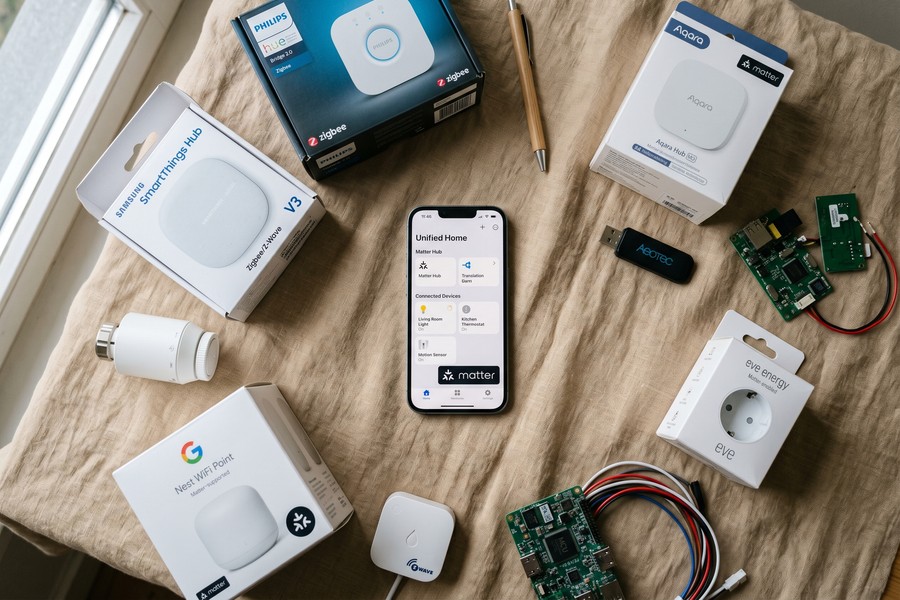
- Zigbee bridges to Matter are already mature and shipping: the Philips Hue Bridge, IKEA Dirigera, and Aqara hubs all expose Zigbee devices to Matter controllers today, making a hybrid strategy immediately actionable.
- The 2025 SmartThings Hub 2 dropped Z-Wave support entirely, a concrete reminder that building a health sensor network around a single hub manufacturer carries real long-term risk.
In This Guide
- Why Your Protocol Choice Is a Wellness Infrastructure Decision
- What Zigbee, Z-Wave, and Matter Actually Are (Without the Jargon)
- Which Protocol Serves Your Actual Wellness Devices Best?
- Local Control vs. Cloud Dependency: What This Means for Your Health Data
- Does Protocol Choice Affect EMF and RF Exposure?
- The Honest Trade-offs: Cost, Complexity, and the Hybrid Reality
- Which Protocol Should You Actually Build Around? A Decision Framework
Step 1: Why Your Protocol Choice Is a Wellness Infrastructure Decision
Protocol choice is not a hobbyist spec debate, it is a decision about whether your health automations execute reliably or fail silently when you need them most. A bedroom humidifier that doesn’t trigger because its cloud service was unreachable at 3 AM is not a minor inconvenience. For people using smart home sensors to manage asthma, sleep disorders, or chronic respiratory conditions, that failure has a direct physical cost.
The Wellness Use Case Has Specific Requirements
General smart home guides optimize for device count and ease of setup. Wellness setups have a different priority stack: low latency for air quality alerts, local execution for 24/7 reliability, long battery life for sensors in hard-to-reach locations, and data privacy for behavioral health information. A protocol that scores well on device variety but routes your sleep schedule data through a corporate cloud server is a poor fit for a health-conscious household. Understanding these requirements before choosing a protocol saves you from rebuilding your network around a better option a year later.
What to Watch Out For
The most common mistake at this stage is selecting a protocol based on the first compatible device you buy (a smart bulb, a lock, a thermostat) and then constraining your entire network around it. Buy the protocol strategy first, then choose devices that fit it.
Peer-reviewed research has documented that elevated indoor CO2 concentrations reduce cognitive performance in healthy adults. For wellness builders, this means a CO2 sensor that depends on cloud execution is not just a convenience device, it is a cognitive health monitor whose reliability actually matters.
Step 2: What Zigbee, Z-Wave, and Matter Actually Are (Without the Jargon)
These three protocols are not interchangeable options doing the same job at different price points. They operate at different layers of your smart home stack, and understanding that distinction prevents expensive purchasing mistakes.
Zigbee
Zigbee is a low-power, 2.4 GHz mesh protocol designed for battery-powered sensors and low-data devices. Devices form a self-healing mesh, meaning each mains-powered device repeats the signal for others. The 2.4 GHz band it shares with Wi-Fi and Bluetooth can create interference in signal-dense homes, though Zigbee’s frequency-hopping design mitigates this in most cases. Zigbee PRO 2023 added meaningful security improvements to an already mature standard. The ecosystem is large and device costs are low, Aqara, IKEA TRÅDFRI, Sonoff, and Philips Hue all run Zigbee.
Z-Wave
Z-Wave operates at sub-GHz frequencies: 908.42 MHz in the United States. That frequency avoids the congested 2.4 GHz band entirely, which is Z-Wave’s single biggest reliability advantage. It is an ITU standard (G.9959) governed by the Z-Wave Alliance, which maintains a mandatory certification program. Every Z-Wave device must pass that certification before it can carry the Z-Wave logo, a requirement that enforces interoperability in a way Zigbee’s voluntary certification does not. The trade-off: a smaller device catalog and higher per-device costs.
Matter
Matter is not a radio protocol. This is the most commonly misunderstood fact in the Zigbee vs Z-Wave vs Matter comparison. Matter is an application-layer interoperability standard that runs over existing radio transports: Wi-Fi, Ethernet, or Thread (a low-power mesh radio). When you buy a “Matter-certified” device, you are buying a device that speaks a common application language. The radio underneath it is still Thread, Wi-Fi, or sometimes a Zigbee-to-Matter bridge. Matter does not replace Zigbee or Z-Wave, it changes how devices are orchestrated across platforms.
, Matter 1.4.2 (released August 2025) includes battery-optimized sleeping device behavior. Thread 1.4 credential sharing is rolling out, which will eventually let Apple, Google, and Amazon Thread meshes share devices rather than each running a separate, isolated mesh.
Most Zigbee and Z-Wave devices manufactured before 2024 require a bridge to speak Matter. Purchasing a device because it claims “future Matter support” without verifying current certification on the CSA’s Matter-certified product registry is a reliable path to disappointment.
Step 3: Which Protocol Serves Your Actual Wellness Devices Best?
The right protocol depends heavily on the specific device category. Wellness-focused smart homes have a distinct device mix, and not every category has an obvious “best” option across all three protocols.
Air Quality Sensors (CO2, VOCs, PM2.5)
Zigbee and Matter over Thread are the strongest choices here. Zigbee air quality sensors from Aqara and third-party Zigbee devices compatible with Home Assistant offer local processing with no cloud dependency, meaning an alert fires even when your internet is down. Matter over Thread is catching up: Matter 1.4 added environmental sensing device types, and 1.4.2 improved battery behavior for always-on sensors. One concrete limitation to acknowledge: cameras and some environmental sensor types are only now being standardized in Matter 1.4–1.5. If you are buying a CO2 or VOC sensor today and the listing says “Matter support coming soon,” that is not a reliable purchase basis, verify certification on the CSA’s certified product search first.
Smart Thermostats and Humidity Controllers
For devices where reliable execution matters more than cost-per-unit, Z-Wave and Matter over Wi-Fi are the defensible choices. Z-Wave’s sub-GHz operation avoids interference from kitchen or utility room Wi-Fi congestion. Ecobee, Honeywell, and several other major thermostat brands support both Z-Wave and Matter. Apple Adaptive Lighting, now live in iOS 18, works over Matter, making circadian/adaptive lighting a genuine Matter strength for sleep environment control.
Locks and Safety Devices
Z-Wave dominates here on reliability and certification depth. Schlage, Yale, and Kwikset all manufacture Z-Wave locks certified through the Z-Wave Alliance’s product catalog. The sub-GHz range also penetrates thick walls and steel doors more consistently than 2.4 GHz signals. For smoke detectors and water leak sensors near health equipment, Z-Wave 800 series devices support battery life up to 10 years, an important maintenance consideration for devices that must be reliably active.
Lighting
Zigbee is the mature leader for large lighting deployments (Philips Hue’s entire ecosystem runs Zigbee), and the Hue Bridge exposes those devices to Matter controllers today. Matter over Thread is a strong choice for new lighting purchases in late 2025, particularly for circadian systems using Apple Adaptive Lighting or Google’s equivalent.
| Wellness Device Category | Best Protocol (Dec 2025) | Key Reason | Notable Products |
|---|---|---|---|
| CO2 / VOC / PM2.5 Sensors | Zigbee (local) or Matter over Thread | Local execution, no cloud dependency | Aqara TVOC Sensor, Eve Room (Matter) |
| Smart Thermostats / Humidity | Z-Wave or Matter over Wi-Fi | Interference avoidance, platform reliability | Ecobee SmartThermostat (Z-Wave + Matter) |
| Smart Locks | Z-Wave 800 series | Sub-GHz penetration, mandatory certification | Schlage Encode Plus, Yale Assure 2 |
| Circadian / Adaptive Lighting | Zigbee (Hue) or Matter over Thread | Mature ecosystem, Apple Adaptive Lighting (iOS 18) | Philips Hue, IKEA TRÅDFRI, Nanoleaf |
| Water Leak / Smoke Detectors | Z-Wave 800 series | Up to 10-year battery, sub-GHz reliability | Fibaro Flood Sensor, First Alert Z-Wave Combo |
| Occupancy / Motion Sensors | Zigbee or Matter over Thread | Low cost, high device density, local processing | Aqara FP2 (Matter), IKEA TRÅDFRI Motion |
“Matter brings important interoperability, but it takes a trained professional to architect true smart home systems that perform reliably and beautifully for years.”
Step 4: Local Control vs. Cloud Dependency: What This Means for Your Health Data
Health and behavioral data generated by smart home sensors, sleep schedules, room occupancy patterns, respiratory environment readings, is among the most sensitive information a device can collect. The question of whether that data stays in your home or routes through a corporate server is not a minor privacy footnote; it is a direct security and reliability concern.
Local-first architectures keep all automation logic and data on a hub in your home. Zigbee via Home Assistant, Z-Wave via Hubitat, and Matter’s local-first design all operate this way. When your internet connection drops, automations still fire. When a vendor’s cloud service closes, as has happened repeatedly in the smart home industry, your devices keep working. For anyone using a digital security routine that includes connected health devices, local control is the architectural choice that reduces your attack surface and eliminates cloud-breach exposure for sensitive behavioral data.
One nuance that most guides skip: Matter over Thread’s local reliability depends on a Thread border router staying online. If a HomePod mini or Nest Hub Max loses power, a power cut, a reboot, a firmware update, Thread devices in your bedroom can lose local connectivity entirely until it recovers. This is a concrete risk for nighttime wellness automations that must run whether or not every piece of infrastructure in your home is functioning perfectly. Z-Wave and Zigbee hubs (a dedicated USB stick or a standalone hub like Hubitat) do not share this single-point-of-failure architecture.
If you run Matter over Thread for bedroom wellness automation, connect your Thread border router (HomePod, Nest Hub, or similar) to a small UPS (uninterruptible power supply). A 20-minute battery backup costing under $40 eliminates the most common Thread border router failure mode: a brief power interruption at night.
Step 5: Does Protocol Choice Affect EMF and RF Exposure?
All three protocols use non-ionizing radio frequencies, and none produce the ionizing radiation associated with health risk in the scientific literature. The concern is worth addressing with actual numbers rather than dismissing it.
The Numbers in Context
Z-Wave devices operate at 908 MHz with a transmit power typically below 1 mW. Estimates comparing Z-Wave RF output to a standard mobile phone suggest Z-Wave devices emit roughly 4,000 times less radiation by transmit power. Zigbee devices transmit at 2.4 GHz, the same band as Wi-Fi, but at very low power (1–10 mW) in short, infrequent bursts lasting milliseconds per cycle. Matter over Thread uses the same 2.4 GHz band as Zigbee with similar duty cycles.
The bigger RF contributor in most homes is the Wi-Fi router running continuously at higher transmit power, often 100–200 mW, not the low-duty-cycle sensor mesh. Protocol choice matters far less for RF exposure than the number of always-on Wi-Fi devices in a home. For health-conscious buyers concerned about RF, switching from Zigbee to Z-Wave makes a negligible practical difference relative to the existing Wi-Fi environment.
What to Watch Out For
Some wellness-focused smart home forums promote Z-Wave specifically as a “low-EMF” choice, implying Zigbee poses meaningful health risk by comparison. The evidence does not support this framing. Both protocols are low-duty-cycle, low-power radios. The distinction matters for interference and reliability; it does not meaningfully change your household RF exposure profile.
A typical Z-Wave sensor transmits at under 1 mW. A standard smartphone transmits at up to 2,000 mW (2 W) during a voice call. For RF exposure context, the protocol choice in your sensor network is not the variable that moves the needle.
Step 6: The Honest Trade-offs: Cost, Complexity, and the Hybrid Reality
No single protocol wins across all wellness use cases in December 2025. That is not a hedge, it is the honest conclusion that experienced installers, including CEDIA-certified professionals, consistently reach. The practical answer for most wellness-focused builds is a hybrid approach: Zigbee for affordable, battery-powered sensors; Z-Wave for reliability-critical and penetration-dependent devices; Matter as the orchestration layer for new purchases and cross-platform control.
Cost Differences Are Significant
Zigbee sensors from Aqara and Sonoff typically cost $10–$25 per unit. Equivalent Z-Wave sensors from Fibaro, Aeotec, or Zooz run $30–$70, reflecting both the sub-GHz hardware cost and the mandatory certification overhead. Matter device pricing is converging with Zigbee as production volumes grow, though premium Thread-capable hardware still costs more than Zigbee-only equivalents at this stage. A full-home wellness sensor deployment, 15–25 nodes covering air quality, occupancy, and environment, costs materially more in Z-Wave than in Zigbee.
The SmartThings Warning
The 2025 SmartThings Hub 2’s removal of Z-Wave support is the clearest recent example of hub vendor risk. Anyone who built a Z-Wave wellness sensor network around that hub now faces a migration decision. Building a mission-critical health monitoring setup around any single hub manufacturer’s roadmap decisions is a structural vulnerability. Home Assistant with a dedicated Z-Wave USB stick (Zooz 800, Aeotec Z-Stick 7) or Hubitat Elevation avoids this dependency, the hub software is open, and the radio hardware is a commodity component you own outright.
The complexity cost also deserves honesty. Matter’s promise of universal compatibility has not fully delivered in practice: feature parity across Apple HomeKit, Google Home, and Amazon Alexa still varies by device class. Setting up a Home Assistant instance with a Zigbee coordinator and a Z-Wave stick takes an afternoon and requires comfort with networking basics. If you are looking for a genuinely simple setup and are starting from zero, a Matter-only approach using Thread devices is the lowest-friction option, with the tradeoff that your sensor catalog is narrower and costs are higher per device than a mature Zigbee deployment. Understanding how protocols like these interact with your broader tech stack is similar to understanding how push notifications work behind the scenes, the surface experience hides meaningful architectural decisions underneath.
“The Z-Wave 2024B update represents our continued efforts to enhance the Z-Wave ecosystem. By addressing critical regulatory challenges and introducing new tools for developers, we’re enabling the IoT industry to create innovative, future-ready solutions while simultaneously maintaining the high standards of interoperability and security that Z-Wave is known for.”
Step 7: Which Protocol Should You Actually Build Around? A Decision Framework
The right answer depends on where you are starting from, not on a universal ranking. Here is a direct recommendation matrix based on the evidence.
Starting From Scratch in Late 2025
Prioritize Matter over Thread as your orchestration layer. Buy a Thread border router (Apple HomePod mini, Google Nest Hub Max, or a dedicated Home Assistant Yellow) and populate it with Matter-certified Thread sensors where certified options exist. Layer Zigbee for the sensor categories where Matter’s device catalog is still thin, air quality, occupancy, and low-cost environment monitoring, using a Philips Hue Bridge, IKEA Dirigera, or Aqara hub to bridge Zigbee devices into your Matter controller. Reserve Z-Wave for thick-wall penetration, smart locks, and any device where 10-year battery life matters operationally.
Already Zigbee-Heavy
You do not need to migrate. The Philips Hue Bridge, IKEA Dirigera, and Aqara hubs all expose Zigbee devices to Matter controllers today. Add a Matter controller (Home Assistant, Apple Home, or Google Home) and your existing Zigbee investment becomes accessible cross-platform without replacing a single device. Add new purchases as Matter over Thread where certified options exist.
Already Z-Wave-Heavy
Stay on Hubitat or Home Assistant with a dedicated Z-Wave USB stick. Do not migrate to a hub that may drop Z-Wave support in a future revision. The Z-Wave ecosystem is well-maintained, the Z-Wave Alliance’s 2024B specification update confirmed ongoing development investment, and your existing devices are certified for interoperability. Add new sensor purchases as Zigbee or Matter where cost efficiency matters.
The Near-Term Signal to Watch
Thread 1.4 credential sharing, rolling out in late 2025 and into 2026, will unify fragmented Thread meshes across Apple, Google, and Amazon. Today, a HomePod and a Nest Hub each run separate Thread meshes that do not share devices. When credential sharing ships broadly, your whole-home Thread mesh becomes a single, more resilient fabric. For wellness automation reliability, this is the most meaningful near-term architectural improvement across all three protocol families, and the primary reason a forward-looking build should start with Thread-capable hardware now.
“With the release of the reimagined Z-Wave Certified Product Guide, we’re delivering so much more than a catalog, we’re giving the industry a roadmap to Z-Wave interoperability.”
Security is worth one final note. Smart home devices that collect behavioral health data are attack surfaces. A wellness sensor network that tracks sleep schedules, room occupancy, and respiratory patterns deserves the same threat-model thinking you would apply to your phone or laptop. The same principles that apply to building a personal digital security routine, local-first data, minimizing cloud exposure, auditing what devices have network access, apply directly to a protocol decision. Choosing Zigbee via Home Assistant or Z-Wave via Hubitat keeps that data inside your home. Choosing a cloud-dependent Matter implementation does not, unless you also configure local-only routing at the hub level. Separately, smart home devices that rely on modern authentication standards rather than simple passwords reduce the risk that a compromised account exposes your occupancy and health data to a third party.
Before buying any new wellness sensor, check the CSA’s Matter-certified product registry and the Z-Wave Alliance’s certified product catalog. Both are publicly searchable and free. A device that does not appear in the relevant registry has not passed interoperability testing, regardless of what the product page claims.
Frequently Asked Questions
Can I use Zigbee and Matter together in the same smart home, or do I have to pick one?
You can use both, and most well-designed wellness setups in late 2025 do. Zigbee bridges from Philips Hue, IKEA Dirigera, and Aqara expose Zigbee devices to Matter controllers, so your existing Zigbee sensors appear alongside Matter-native devices in Apple Home, Google Home, or Home Assistant without any protocol conflict. The bridge handles translation; you interact with a unified device list.
Is Z-Wave actually more reliable than Zigbee for smart home sensors?
In interference-heavy environments, yes. Z-Wave’s sub-GHz operation at 908 MHz avoids the congested 2.4 GHz band shared by Zigbee, Wi-Fi, and Bluetooth. In a typical apartment with several competing Wi-Fi networks, Z-Wave will generally show fewer missed commands than Zigbee. In a single-family home with a well-configured Zigbee mesh and few competing 2.4 GHz networks, the practical reliability gap is small. Z-Wave’s mandatory certification through the Z-Wave Alliance adds a device-level interoperability guarantee that Zigbee’s voluntary process does not.
Does Matter actually work offline without an internet connection?
Matter is designed as local-first, meaning automations should execute locally without internet access. The important caveat: Matter over Thread requires a Thread border router to stay powered and online. If a HomePod, Nest Hub, or other border router loses power, Thread-based Matter devices in that mesh can lose local connectivity. Wi-Fi-based Matter devices are less vulnerable to this single point of failure, since they connect directly to your router rather than through a border router.
I have thick concrete walls in my home, which protocol handles that best?
Z-Wave at sub-GHz frequencies penetrates dense building materials more reliably than 2.4 GHz signals. Zigbee and Thread both operate at 2.4 GHz, which attenuates more sharply through concrete and masonry. For thick-wall homes, Z-Wave Long Range (available on 800-series chips) extends range further still. If you are committed to Zigbee or Matter over Thread in a challenging building, adding mains-powered devices as mesh repeaters at strategic intervals can compensate, but Z-Wave is the straightforward answer for this specific constraint.
Is it safe to build a health monitoring setup around a protocol that could become obsolete?
Zigbee and Z-Wave are both mature standards with long track records, though the 2025 SmartThings Hub 2 dropping Z-Wave support illustrates that hub manufacturers can exit a protocol even when the protocol itself remains active. Mitigating this risk means choosing a hub whose software is open and not tied to a single vendor’s commercial roadmap, Home Assistant and Hubitat both fit this description. Matter’s backing by Apple, Google, Amazon, and Samsung makes outright obsolescence unlikely for new purchases, but feature parity gaps between platforms are real and worth verifying per device before buying.
How do I know if a device is genuinely Matter-certified and not just “Matter-compatible”?
Check the CSA’s official Matter-certified product registry. The CSA restricts use of the Matter logo to devices that have completed interoperability certification testing. A product page using the phrase “Matter-compatible” or “Matter support coming” without appearing in the registry has not passed certification. The registry is publicly searchable by product name, brand, and device type.
Should I avoid Zigbee devices because they share the 2.4 GHz band with my Wi-Fi?
Not as a blanket rule. Zigbee’s frequency-hopping and low duty cycle mean it coexists reasonably well with Wi-Fi in most home environments. The practical step is to assign your 2.4 GHz Wi-Fi network to channels 1, 6, or 11 and configure your Zigbee coordinator to use a channel that doesn’t overlap, channels 15, 20, or 25 in Zigbee’s channel numbering, which map to spectrum gaps between Wi-Fi channels. Home Assistant’s Zigbee integration (ZHA) and the Zigbee2MQTT project both surface channel configuration directly in their interfaces. If you are running a dense sensor deployment in a high-Wi-Fi environment, Z-Wave or Matter over Thread avoids the channel management exercise entirely.
Sources
- Connectivity Standards Alliance, Matter FAQ and Certification Overview
- Connectivity Standards Alliance, Matter Certified Products Registry
- Z-Wave Alliance, Certification Program and News
- Z-Wave Alliance, Certified Product Catalog
- Z-Wave Alliance, 2024B Specification Update Announcement
- Z-Wave Alliance, New Certified Product Guide Announcement
- CEDIA / Newswise, Making Sense of Matter: What It Means for Your Smart Home
- ITU, G.9959 Short Range Narrow-Band Digital Radiocommunication (Z-Wave Standard)






