Fact-checked by the SnapMessages editorial team
Quick Answer
The best gut health nutrition apps in 2025 track plant variety, fiber diversity, stool patterns, and symptom timing rather than calories. Apps like Cara Care, GutApp, and Bloom offer meaningfully different data models from calorie counters. The global diet and nutrition app market is valued at USD 2.14 billion, with gut-focused tools emerging as its fastest-growing segment.
Key Takeaways
- The U.S. claims-based prevalence of digestive disorders rose from 22.9% to 33.2% between 2007 and 2019, a 45% increase that explains much of the commercial momentum behind gut health apps, per NIDDK-published research in the American Journal of Gastroenterology.
- Approximately 73% of users with an eating disorder identified calorie-tracking apps as a contributor to their symptoms, according to peer-reviewed research cited in a 2025 PMC precision nutrition review.
- The “30 plants per week” target originates from the American Gut Project’s observational study of roughly 10,000 participants, which found measurably greater microbial diversity in people eating that variety versus fewer than 10 plant types, GMFH researchers stress it is a behavioral target, not a clinically validated threshold.
- Cara Care was acquired by Bayer in 2025 after being developed as a prescribed digital therapeutic for IBS in Germany, giving it a clinical lineage that purely consumer apps lack, see FTC Health Products Compliance Guidance for the standards all health apps must meet.
- No consumer gut health app gut score has been validated against clinical microbiome sequencing, a concern raised by University of Maryland School of Medicine researchers writing in Science in 2024.
- The global AI in personalized nutrition market was valued at USD 4.15 billion in 2024 and is forecast to reach USD 21.54 billion by 2034, per Precedence Research data via GlobeNewswire.
Gut health nutrition apps represent a structurally different category from calorie counters, not a cosmetic upgrade to them. Where MyFitnessPal records what you ate, apps like GutApp and Bloom record how your gut responded, tracking plant variety, fermented food servings, stool type via the Bristol Stool Scale, and symptom windows hours after eating. According to a 2025 PMC review on precision nutrition and diet-gut microbiome interactions, AI-driven mobile health applications hold significant clinical potential for personalized, microbiome-informed dietary guidance that goes well beyond calorie counting.
Digestive conditions are more prevalent than most people realize. Among private insurance enrollees in the U.S., the claims-based prevalence of digestive disorders rose from 22.9% to 33.2% between 2007 and 2019 according to NIDDK-published research in the American Journal of Gastroenterology. That 45% increase over 12 years explains much of the commercial momentum behind this category.
Why Calorie Counters Were Never Built for Gut Health
Mainstream apps like MyFitnessPal were engineered around energy balance, not the dietary signals gut research actually cares about. Total fiber intake, prebiotic food frequency, fermented food consumption, food additive exposure, and delayed symptom-to-meal correlation are simply not fields those apps were designed to capture. That is a structural limitation, not a minor gap that a gut-health category addition could fix.
There is also a well-documented psychological cost to calorie tracking. Published research has found that approximately 73% of users with an eating disorder identified calorie-tracking apps as a contributor to their symptoms. Separate peer-reviewed studies consistently show correlations between calorie app use and elevated disordered eating attitudes. Several gut-focused apps have made the deliberate product decision to exclude calorie counting entirely, treating that absence as a feature, not an oversight.
To be fair, calorie awareness still has legitimate uses. Managing specific chronic conditions or preparing for bariatric surgery are genuine contexts where calorie data matters. The argument here is not that calorie apps are harmful across the board, but that they are the wrong instrument for someone whose primary concern is digestive wellness. A thermometer is not a bad tool; it is just the wrong tool for measuring blood pressure.
Worth noting: Calorie-counting apps lack the data architecture to track gut health because they were not built for it. Research links calorie app use to disordered eating attitudes in roughly 73% of users with eating disorders, which is one reason microbiome-informed app design deliberately omits calorie fields.
What Gut Health Apps Actually Track Differently
Gut-focused apps collect a distinct constellation of data: stool type and frequency using the Bristol Stool Scale, symptom journals for bloating, gas, and heartburn, plant variety counts, fiber grams, fermented food servings, water intake, mood, and sleep. That combination matters because no single signal tells the full story. A high-fiber day with significant stress and poor sleep can still produce poor digestive outcomes, and calorie apps capture none of that context.
AI Photo Scanning as the Key Design Shift
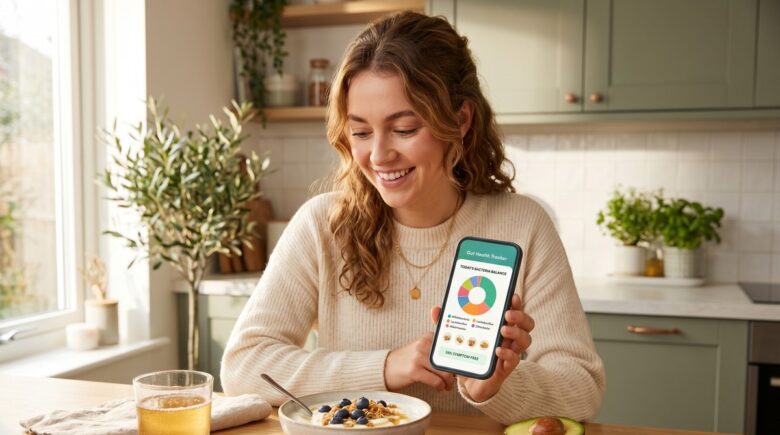
The most significant UX departure from traditional apps is AI-powered meal scanning. Apps including Bloom, GutApp, and SuperBiome let users photograph a meal for an instant gut-health score rather than manually searching a food database. That shift matters more than it sounds.
Manual food database searches inadvertently reward logging packaged foods with barcodes over whole-food meals, which are exactly the foods gut research identifies as most beneficial. Photo scanning removes that friction and bias at once.
Logging habits that connect to gut health extend beyond food. As covered in our guide to best water tracking apps to hit your daily hydration goals, consistent hydration tracking is a simple but meaningful input for digestive function, and several gut apps integrate hydration data directly into their scoring models.
The data difference is substantial: Gut health apps track 8 or more distinct data categories including stool type, plant variety, mood, and symptom timing, compared to calories and macros alone. AI-driven meal analysis is the key design feature making whole-food logging practical for everyday users.
The Science Behind the Metrics These Apps Prioritize
The “30 plants per week” metric that appears inside apps like Clove, GutApp, and Biomeo originates from the American Gut Project, a citizen-science study of approximately 10,000 participants across the U.S., UK, and Australia. Participants eating 30 or more different plant types weekly had measurably greater gut microbial diversity than those eating fewer than 10. That advantage held independent of whether participants identified as vegan or vegetarian. Plant variety, not dietary label, was the meaningful predictor.
That finding deserves honest framing. The American Gut Project was an observational study, not a randomized controlled trial. Thirty plants is a practical, evidence-informed target, not a clinically validated threshold with confirmed dose-response data. Apps that present it as established medical fact are overstating the research; apps that use it as a motivating behavioral scaffold are on firmer ground.
Fiber, SCFAs, and the Gut Lining
The biological mechanism connecting plant diversity to gut health runs through short-chain fatty acids (SCFAs). Gut bacteria ferment dietary fiber to produce SCFAs like butyrate, which support the intestinal lining, modulate immune function, and reduce systemic inflammation. This is why fiber diversity, not just total fiber quantity, is the meaningful unit. Ten grams of fiber from a single source feeds a narrower range of bacterial species than ten grams distributed across several plant types.
Several apps also track mood and sleep alongside food data, reflecting the bidirectional gut-brain axis. The 2025 GMFH World Summit from the European Society of Neurogastroenterology and Motility highlighted advances in microbiome-informed diagnostics and emphasized careful interpretation of these signals, noting the limitations of current testing alongside the genuine clinical potential.
On the evidence base: The “30 plants per week” goal from the American Gut Project’s 10,000-person observational study is a credible behavioral target, but it is not a clinically validated threshold. Leading microbiome researchers stress careful interpretation of these metrics rather than treating them as diagnostic benchmarks.
A Practical Rundown of the Leading Apps in 2025
The apps in this category differ more than their marketing suggests, and the most important distinction is rarely discussed: some are consumer wellness tools built from scratch, while others have clinical origins that most competitors ignore.
Cara Care sits at the clinical end of the spectrum. It was originally developed as a prescribed digital therapeutic for IBS in Germany and was acquired by Bayer in 2025, giving it a lineage no purely consumer app can match. It includes FODMAP guidance and gut-directed hypnotherapy protocols, and it is oriented toward people with diagnosed conditions rather than general wellness goals.
Bloom targets users managing IBS, IBD, SIBO, and GERD. Its AI vision scanner is designed to process real cooked meals, not just packaged foods, and it integrates with Android’s Health Connect for gut-brain axis tracking via mood and sleep data. GutApp centers on fiber and plant diversity with daily gut scoring and explicitly excludes calorie counting by design. Its pricing is $9.99 per month or $29.99 per year, making it one of the more affordable dedicated options.
Clove takes the most minimal approach: it is built directly on the 30-plants framework and reports collecting no user data at all. For users concerned about logging intimate health information into consumer apps, that distinction is material. SuperBiome uses gamified weekly gut score trends and photo-based meal logging but requires a paid subscription. Biomeo structures engagement as a four-week habit challenge. Biome focuses on mood-stool correlation and positions itself as a personal nutritionist tool.
| App | Primary Focus | Cost (as of Sept 2025) | Notable Feature |
|---|---|---|---|
| Cara Care | IBS / clinical digital therapeutic | Freemium + subscription | FODMAP + hypnotherapy; Bayer-backed |
| Bloom | IBS, IBD, SIBO, GERD | Freemium | AI vision scanner; gut-brain axis logging |
| GutApp | Fiber and plant diversity | $9.99/month or $29.99/year | Daily gut score; no calorie tracking |
| SuperBiome | General gut wellness | Paid subscription required | Gamified weekly gut score trends |
| Clove | 30-plants framework | Free | No data collected from users |
| Biomeo | Habit formation | Freemium | 4-week challenge; food trigger AI |
The clinical spectrum matters here: Gut health apps range from consumer wellness tools to clinically derived therapeutics. Cara Care’s acquisition by Bayer in 2025 and Clove’s zero-data-collection model represent opposite ends of a spectrum that FTC health product compliance rules require all app makers to represent accurately.
The Honest Limitations Worth Knowing Before You Subscribe
No consumer gut health app has had its gut score independently validated against clinical microbiome sequencing. A high in-app score reflects behavioral inputs: did you eat diverse plants and fiber today? It does not confirm anything about your actual microbiome composition. That distinction matters, and any app that implies otherwise is overstating what the science currently supports.
Researchers at the University of Maryland School of Medicine, writing in Science in 2024, called for greater federal regulation of direct-to-consumer microbiome testing services and warned that companies may overstate their ability to assess microbiome health. That same skepticism applies to the gut scores produced by consumer apps.
Data privacy is the concern most articles in this space skip entirely. These apps collect genuinely sensitive information: stool frequency, bowel patterns, symptom histories, and mood data. Privacy practices vary significantly by developer. Some apps explicitly state data may be shared with third parties. Clove reports collecting no data at all. Before logging intimate health details into any of these platforms, reading the privacy policy is not optional. The same diligence that applies to building a personal digital security routine applies to health data logged in wellness apps.
The subscription cost accumulation problem is real. Stacking a gut health app at $10 per month with a microbiome stool test at $150 to $230 per test and a probiotic supplement program adds up to several hundred dollars annually, and the evidence base supporting that specific combination is considerably thinner than the marketing for each individual product. The FTC’s Health Products Compliance Guidance requires that all health-related app claims be truthful, not misleading, and substantiated by prior evidence, a bar not every app in this category clearly clears.
Validation gaps are the core issue: No gut health app gut score has been validated against clinical stool sequencing. The global gut microbiota market exceeded USD 860.4 million in 2025 according to Research Nester, and commercial scale does not equal clinical validation. Privacy policies and subscription stacking deserve scrutiny before committing.
Who These Apps Are Actually For
Three user profiles genuinely benefit from gut-focused apps, and they need different things from the category.
- Generally health-conscious users who want to improve digestion and diversify their diet without clinical intervention. For this group, GutApp, Bloom’s free tier, and Clove offer a practical and low-cost starting point.
- People managing a diagnosed condition like IBS, IBD, or Celiac disease who need FODMAP guidance, flare-up logging, and structured elimination protocol support. Cara Care and Bloom’s condition-specific features are designed for this profile.
- Post-antibiotic or post-illness users trying to rebuild microbiome diversity through intentional dietary variety. The plant-diversity tracking in GutApp and Clove maps directly onto this goal.
These apps cannot diagnose dysbiosis, identify specific bacterial imbalances, or replace a gastroenterologist. For conditions like Bile Acid Malabsorption or Crohn’s disease, even dedicated gut apps can feel too surface-level for managing complex symptom patterns, and users in app store reviews have noted exactly that. The honest framing is that these tools function as awareness scaffolding and habit formation, not clinical assessment.
If you already use your phone to manage wellness habits, pairing a gut health app with tools like the best journaling apps for daily reflection or a meditation app for stress tracking creates a more complete picture of the gut-brain signals these apps are designed to surface.
The AI market underpinning these tools is growing fast. The global AI in personalized nutrition market was valued at USD 4.15 billion in 2024 and is forecast to reach USD 21.54 billion by 2034 according to Precedence Research data via GlobeNewswire, suggesting the underlying technology will keep improving regardless of which individual apps survive.
Matching app to user profile matters: Gut health apps serve 3 distinct user profiles with meaningfully different needs: general wellness, diagnosed GI conditions, and post-antibiotic recovery. Users with complex conditions like Crohn’s should treat these as supplement tools, not primary care. Grand View Research projects the broader market to reach USD 4.56 billion by 2030.
Frequently Asked Questions
What is the best gut health nutrition app in 2025?
Cara Care is the most clinically rigorous option, having been developed as a prescribed IBS digital therapeutic before its acquisition by Bayer in 2025. For general gut wellness without a diagnosis, GutApp offers the clearest fiber and plant diversity focus at $29.99 per year. The “best” app depends entirely on whether your goal is condition management or general microbiome improvement.
Do gut health apps actually work?
They work as behavioral tracking and habit scaffolding tools, not as diagnostic or therapeutic devices. Consistent logging over two to four weeks allows the AI pattern detection in apps like Bloom and Biomeo to surface food-symptom correlations that are genuinely useful. However, no app gut score has been validated against clinical microbiome testing, so treat in-app scores as behavioral metrics, not biological measurements.
How is a gut health app different from MyFitnessPal?
MyFitnessPal tracks calories and macronutrients; gut health apps track plant variety, fiber diversity, stool type, fermented food intake, mood, sleep, and symptom timing. The data models are structurally different. Gut-focused apps are built to capture the dietary patterns that microbiome research identifies as meaningful, which calorie apps were never designed to record.
Is it safe to log stool and symptom data in a health app?
The safety depends on the specific app’s privacy policy. Some apps explicitly permit third-party data sharing; others, like Clove, report collecting no user data at all. Before logging sensitive gut health information, read the privacy policy carefully. Applying the same scrutiny you would to any sensitive personal data is warranted given that stool patterns and symptom histories are genuinely intimate health details.
What does “30 plants per week” mean and where does it come from?
The target originates from the American Gut Project, an observational study of approximately 10,000 participants, which found that people eating 30 or more different plant types weekly had measurably greater gut microbial diversity than those eating fewer than 10. It is an evidence-informed behavioral goal, not a clinically validated threshold from a randomized controlled trial. Apps that use it as a motivating target are on reasonable scientific ground; apps that treat it as a definitive cutoff are overstating the evidence.
Can a gut health app replace seeing a gastroenterologist?
No. Gut health apps are wellness tools and explicitly disclaim any diagnostic function. They cannot confirm dysbiosis, identify specific bacterial imbalances, or assess structural GI conditions. For symptoms including blood in stool, significant unintentional weight loss, or persistent severe pain, a gastroenterologist is the appropriate first step, not an app download.
Sources
- NIH / PubMed Central, Precision Nutrition Through Diet-Gut Microbiome Interactions (2025 Review)
- NIDDK / American Journal of Gastroenterology, Prevalence of Digestive Disease Diagnoses in the U.S. (2024)
- Grand View Research, Diet and Nutrition Apps Market Report (2024)
- Gut Microbiota for Health (GMFH) / ESNM, Key Advances in Gut Microbiome Research During 2025
- U.S. Federal Trade Commission, Health Products Compliance Guidance
- University of Maryland, Researchers Call for Regulation of Direct-to-Consumer Microbiome Tests (2024)
- Research Nester, Global Gut Microbiota Market Report (2025)
- GlobeNewswire / Precedence Research, AI in Personalized Nutrition Market Forecast to 2034 (2025)






