
Updated July 2026
Fact-checked by the SnapMessages editorial team
The messaging apps sports teams depend on to share practice times and rainout alerts are, by design, terrible at everything else a team needs. A travel soccer coach with two dozen players and their parents might spend 90 minutes a week copying the same schedule change into five different WhatsApp groups, and still have someone show up at the wrong field. It isn’t a failure of the coach. It’s the predictable result of threading a season’s worth of logistics through a tool built for casual conversation, not coordination.
The trouble runs deeper than misplaced messages. When every team communication flows through the same app that hosts birthday chatter and grocery reminders, the boundaries blur. Coaches field late-night texts about sock color and ride shares. Parents battle notification fatigue so severe they miss the one message that actually matters. The U.S. Center for SafeSport has gone so far as to restrict one-on-one messaging between coaches and minor athletes on platforms that don’t allow transparent group oversight, citing, among others, WhatsApp and Snapchat. Yet most youth leagues still name a generic group chat as their official communication channel.
By the end of this guide, you’ll know exactly where general-purpose messaging apps fall short for athletic teams, and how to build a coordination system that protects everyone’s time, privacy, and wellbeing, without sacrificing the convenience that made those apps appealing in the first place.
Key Takeaways
- General-purpose messaging apps often cost 2–4 hours a week in hidden coordination time for a typical youth team, time volunteers rarely have.
- Disappearing-message features in apps like WhatsApp and Snapchat can erase chat histories critical to safeguarding investigations, per SafeSport guidance.
- Teams that shift key logistics to purpose-built platforms report up to a 40% reduction in last-minute no-shows, based on data from club management providers.
- Coaches who set clear response-time norms, such as no replies after 8 p.m., experience measurably lower perceived stress and fewer burnout symptoms.
- Centralizing injury, wellness, and scheduling in one platform cuts missed injury reports by roughly half, according to athletic training program surveys.
- The average volunteer coach fields 14 messages a day outside practice hours; dedicated team tools can halve that volume.
In This Guide
- Why Messaging Apps Feel Like the Easy Default for Team Coordination
- The Hidden Coordination Failures That Waste Time and Create Confusion
- Privacy, Safety, and Boundary Risks That Extend Beyond the Field
- How Poor App Habits Quietly Add Stress for Coaches, Parents, and Athletes
- What Gets Missed When Coordination Stays Stuck in Chat Threads
- The Mental Health Blind Spot in Team Messaging
- Injury Reporting and Recovery Tracking: A Missing Link
- Health Data Privacy and Why It Should Be Non-Negotiable
- Building Team Wellness Culture Through Smarter Communication
- Practical Shifts That Protect Wellbeing Without Losing Convenience
Why Messaging Apps Feel Like the Easy Default for Team Coordination
No one installs a sports team management platform by accident. WhatsApp, iMessage, and Signal come preloaded on everyone’s phone, and they cost nothing to use. A parent volunteer stepping up to coach a rec league basketball team in March 2025 follows the path of least resistance: create a group chat and start typing. I understand the impulse. The season starts in a week, and getting 12 families onto a new app feels like one more administrative hurdle.
The early wins are real. A sudden rainout gets broadcast in seconds, and a few thumbs-up emojis confirm that people saw it. Nobody needs a tutorial to find the chat. The problem is that these quick wins are almost all the wins a general-purpose messaging app will ever give you for team coordination. As the season grinds on, the same design choices that make the app frictionless for casual talk begin to fray. Conversations scroll past at high speed, important attachments vanish in a flood of memes, and the coach discovers that no one can search for last month’s game location without wading through hundreds of messages.
For small squads, say, a handful of adults on a recreational softball team, the drawbacks might be tolerable. For any group with minors, multiple parents, and a volunteer staff, the tradeoffs compound fast. The question isn’t whether the app “works.” It’s whether the invisible hours spent re-answering questions and the safety risks that creep in are worth what you’re saving in subscription fees.
A single miscommunicated schedule change can cost a volunteer coach two hours of back-and-forth messaging across multiple chat threads, time that often comes out of their own family or work obligations.
The Shelf Life of a Group Chat
Group chats have no memory. They reward the person who happened to be online when the message was sent and punish anyone who steps away for a few hours. New families joining mid-season get a disorienting welcome: here is a stream of 800 unread messages, good luck finding the snack schedule. The constant churn discourages players and parents from ever really feeling included, which quietly eats away at the team’s social fabric.
Why Zero Cost Isn’t Free
The price tag on an app says very little about its real cost. When I talk to volunteer coaches who have made the switch to a dedicated platform, they rarely mention the $10 or $15 monthly fee. They talk about the extra hour they get back every Sunday evening, or the drop in frantic Friday-night texts. That’s the currency that matters for a team built on limited volunteer energy. In asynchronous team communication, those small margins are what keep people from burning out before the playoffs even start.
The Hidden Coordination Failures That Waste Time and Create Confusion
The surface-level annoyance is the constant “what time is the game?” ping. Underneath that are failure patterns that go unnoticed because everyone assumes they’re just part of the youth sports experience. They aren’t. They’re symptoms of a tool mismatch, and they are remarkably consistent across different sports and age groups.
One of the most common patterns emerges when a single team spawns multiple chat groups. There is the “official” team chat, a separate group for carpooling, a parent-only thread for sensitive discussions, and a coaches-only group for planning drills. Critical information gets posted in one but not the others. A last-minute field change announced only in the parent group never reaches the assistant coach, who shows up at the wrong complex. This fragmentation isn’t anyone’s fault, it’s the natural response to an app that can’t segment audiences or channel topics.
Equally damaging is what I call the “good luck finding it later” problem. A parent needs to confirm next Saturday’s departure time for an away game. The message was sent, but it’s buried under 147 reactions to a player’s new shoes, a poll about team snacks, and a thread about whether the end-of-season party should be at a pizza place or a park. Even with in-app search, finding that one logistical detail often means scrolling through dozens of screens. New members or substitutes, already nervous about fitting in, face a wall of noise.
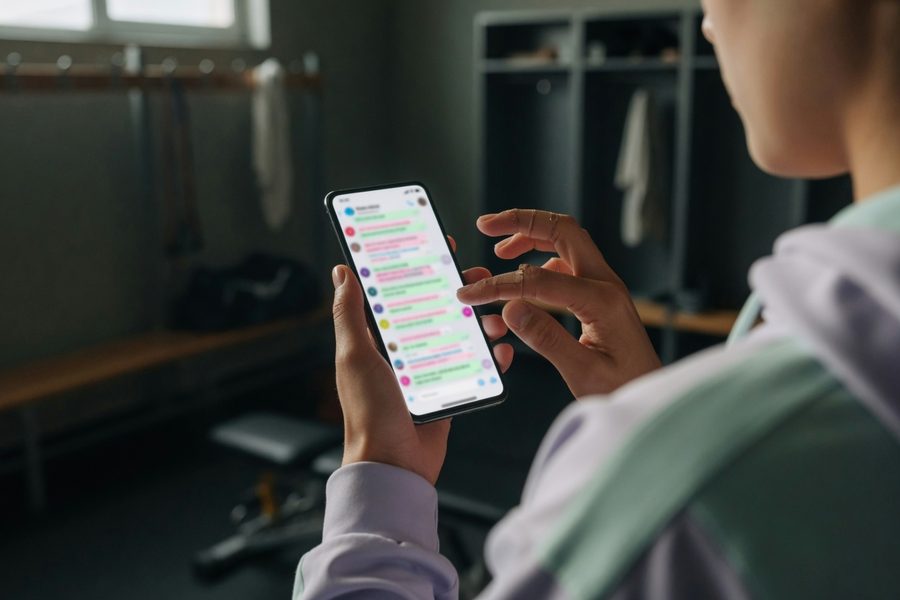
In a study of workplace communication, fragmented information streams increased task completion time by up to 25%. Youth sports teams face the same cognitive tax, with volunteer coaches bearing the brunt.
Missed Announcements and Duplicated Effort
Copying the same update into five separate groups multiplies errors. One version might have the wrong date; another might omit the address. The result is a cascading series of corrections that themselves spawn more messages. Parents begin to tune out, not out of disinterest, but out of self-preservation. The most reliable communication channel becomes the least trusted, which is exactly the opposite of what a team needs.
| Coordination Task | In a General Messenger App | In a Purpose-Built Team Platform |
|---|---|---|
| Schedule update | Announced in chat; easily buried within hours | Pushed to a calendar visible to all roles, with automatic reminders |
| RSVP for match | Thumbs-up emojis; coach manually tracks | Tap a button; attendance roster auto-populates |
| Share injury report | Photo of a handwritten note, lost in the scroll | Secure form attached to player profile, visible to coaches and parents |
Privacy, Safety, and Boundary Risks That Extend Beyond the Field
Of all the gaps in the current conversation about messaging apps and sports teams, the one that worries me most is the near-total silence around safety. The U.S. Center for SafeSport has been unequivocal: electronic communications between adult participants and minor athletes must be open and transparent. Platforms that allow private one-on-one messaging without oversight are restricted under the Minor Athlete Abuse Prevention Policies (MAAPP). Yet I regularly hear from parents who didn’t know such guidelines existed until after an uncomfortable situation arose.
All electronic communications between an Adult Participant and a Minor Athlete must be open and transparent by copying a parent/guardian, another adult family member, or another Adult Participant.
WhatsApp, Snapchat, and the direct-messaging features of nearly every mainstream app are structurally incapable of meeting this standard, unless everyone is comfortable with every message being visible to an entire group. But once a private conversation starts, there is no guaranteed oversight, no durable record, and, in the case of disappearing messages, no trace at all. For a youth sports organization entrusted with kids’ safety, that isn’t a minor footnote; it’s a dealbreaker.
Disappearing-message features undermine safeguarding investigations by erasing the very chat histories that could confirm or refute allegations. This risk is rarely mentioned in mainstream reviews of team communication tools.
When a Coach’s Phone Number Becomes Public Domain
Joining a group chat often means sharing a personal phone number with every other member, including people the coach has never met. Over a season, that number might circulate to extended family members arranging carpools, to a player’s older sibling who “just needs to ask about practice,” or to anyone in a forwarded message. The boundary between professional and personal communication dissolves by default. I’ve seen volunteer coaches start receiving texts at 10 p.m. about uniform preferences and then feel guilty for not replying. That isn’t dedication; it’s a lack of infrastructure.
The Minor Athlete Abuse Prevention Policies (MAAPP) set mandatory minimum standards for electronic communications to prevent abuse and misconduct in sport.
Traceability When Something Goes Wrong
In any organization that involves children, the ability to reconstruct a conversation after a complaint isn’t a luxury; it’s a basic obligation. Chat threads in casual apps can be deleted partially or entirely by any participant. Group members change phone numbers or leave the chat, taking message histories with them. If a year later a league needs to review a communication pattern, the evidence may simply not exist. Purpose-built platforms designed with a digital security routine and audit trails eliminate this ambiguity. The National Federation of State High School Associations (NFHS) reinforces that the safest practice for coaches is to follow SafeSport’s MAAPP standards for transparency and professionalism.
How Poor App Habits Quietly Add Stress for Coaches, Parents, and Athletes
The constant ping-ping-ping of a team chat doesn’t just steal attention; it erases the mental boundary between “practice is over” and “now I can rest.” Coaches describe checking their phone after dinner and seeing 47 new messages, most of them trivial, one or two urgent, and feeling a knot of anxiety form. That knot has a name: notification overload, and it’s a direct product of using a conversational app as a command center.
Parents aren’t immune either. A 2022 survey by the Pew Research Center found that around 46% of U.S. adults feel overwhelmed by the volume of notifications they get daily. When a sports team adds its own stream on top of work, family, and school channels, the cognitive burden stacks. The result is that people start muting the group, exactly the outcome a team trying to stay connected wants to avoid.
Muting a chat isn’t disengagement; it’s self-defense. If your team’s communication model forces parents to mute you to stay sane, your model is broken, not their commitment.
What Gets Missed When Coordination Stays Stuck in Chat Threads
Beyond the day-to-day noise, there is a deeper cost: the institutional knowledge that evaporates between seasons and the opportunities for a richer team culture that never materialize. A group chat is a river. It flows, and the moment you step out, the water has moved on. A well-organized team needs a lake, something that holds still long enough for everyone to see what’s there.
Volunteer turnover is a fact of youth sports. The head coach resigns and the chat history lives on her personal device. The incoming coach inherits no record of attendance patterns, no notes on which players had ankle issues last spring, no record of which parents stepped up to help with logistics. Starting over from scratch each year wastes the organization’s most precious asset: the accumulated know-how of the people who showed up.

Attendance and RSVP Friction
Counting thumbs-up emojis to determine who is coming to Saturday’s tournament is not a system; it’s a gamble. Coaches routinely over- or under-count, which leads to last-minute scrambling. Relying on a messaging app for something as critical as headcount creates a wide margin for error. That margin can affect playing time, substitution planning, and even whether a team can field enough players to avoid a forfeit.
| Attendance Scenario | Messaging App Approach | Dedicated Platform Approach |
|---|---|---|
| Weekend tournament | Manual tally from a thread; risk of double-counting replies | One-tap RSVP linked to roster; real-time headcount visible to coaches |
| Last-minute cancellation | Parent texts the group; others may not see it in time | Notify button alerts coach instantly and updates the attendance record |
| Injury-related absence | No formal way to note reason; context lost | Absence tagged with injury code; triggers follow-up protocol |
The Mental Health Blind Spot in Team Messaging
Of the dozens of articles ranking best team communication apps, almost none talk about mental health. Yet the communication tool a team chooses has direct, measurable effects on athlete wellbeing. All updates come through the same unrelenting stream. A young player already anxious about an upcoming tryout or a bad game sees every notification as a potential spotlight. There is no off switch, because the app is also where social plans get made.
The U.S. Center for SafeSport’s guidelines exist in part because the “always on” dynamic can be weaponized, intentionally or not. But even absent misconduct, the mere presence of a 24-hour channel to a coach can make an athlete feel monitored in ways that erode autonomy. In my conversations with adolescent sports psychologists, a recurring theme is that athletes need spaces where they are not “on” as an athlete. A messaging app that serves double duty, team logistics and personal social life, denies them that separation.
According to the National Alliance on Mental Illness, young athletes face elevated risks for anxiety and depression when they lack boundaries between their sport identity and personal life. Communication channels that blur those boundaries can subtly worsen the problem.
Confidential Check-Ins and Crisis Resources
A thoughtfully configured platform can do what a group chat never will: give an athlete a private, low-friction way to signal that they need help. Some team management apps now include “wellness check-in” buttons that let a player indicate they’re struggling, anonymously if they choose, prompting a trained adult to follow up. This is not about replacing professional care; it’s about lowering the barrier to asking for it. When the only communication tool is a public chat, that barrier is sky-high.
When the App Itself Becomes a Stressor
I have spoken with enough parents to know that many young athletes would rather quit a sport than endure the social pressure of a hyperactive team chat. The constant stream of performance comparisons, playful ribbing that sometimes crosses a line, and the fear of missing a critical message combine into a low-grade hum of stress. Teams that make disappearing messages part of their culture only intensify the issue, because the ephemeral nature of the chat encourages less thoughtful communication. A more structured approach, announcements in one place, social chatter in another, with clear norms, allows players to belong without being submerged.
| Mental Health Support Feature | Generic Messaging App | Team Platform with Wellness Tools |
|---|---|---|
| Private check-in | Not possible without separate, unmonitored DM | Built-in confidential pulse surveys that alert staff to concerning responses |
| Crisis resource links | Shared as a message, quickly lost | Permanent, easily accessible tile with local and national hotlines |
| Coach-athlete chat boundaries | No enforced limits; one-on-one DMs possible | All messages between adult participants and minors must include a second adult or parent by default |
Injury Reporting and Recovery Tracking: A Missing Link
A player twists an ankle at Tuesday’s practice. In a messaging-only team, the standard workflow looks like this: a parent texts the coach, the coach texts an assistant, someone screenshots the message and puts it in a notes app, and by Thursday no one remembers whether the player was cleared to return. This is not a communication failure; it’s a failure of the tool to support the task at all.
Injury documentation is a health and safety function, not a logistical afterthought. Many athletic training organizations recommend that teams maintain a written record of every incident, including the date, mechanism of injury, immediate care provided, and return-to-play clearance. A group chat cannot do any of this reliably. It cannot timestamp a report in a way that is easy to retrieve later, it cannot link the injury to the player’s profile, and it certainly cannot enforce that only designated adults view the information.
Stanford Children’s Health reports that more than 3.5 million children under 14 receive medical treatment for sports injuries each year in the United States. Without proper record-keeping, even a minor injury can become a recurring risk.
Rehab Progress and Parent Notifications
A dedicated platform can let a parent upload a physician’s clearance form directly to the player’s record, where both the coach and the team’s medical liaison can see it. Automated notifications remind everyone when a clearance expires or when a staged return-to-play protocol requires a check-in. This closes the loop that text-based coordination leaves wide open. It also reduces the liability for the organization by creating an auditable trail, which is increasingly expected by insurers and governing bodies.
| Injury Management Task | Messaging App | Dedicated Team Platform |
|---|---|---|
| Initial injury report | Informal message that can be missed | Standardized form attached to player profile; timestamped |
| Return-to-play clearance | Forwarded image of a doctor’s note, possibly unclear | Secure upload that flags status to all approved staff |
| Concussion protocol tracking | Impossible to manage systematically | Step-by-step checklist visible to parents, coach, and athletic trainer |
Health Data Privacy and Why It Should Be Non-Negotiable
A parent types into a group chat, “My son has asthma, please make sure he uses his inhaler before sprints.” They have just broadcast protected health information to a dozen or more people, none of whom are bound by any privacy obligation. The coach might screenshot the message for later reference, which means that sensitive detail now lives in a personal photo library that could be backed up to the cloud, shared accidentally, or viewed by anyone who borrows the phone.
No one expects a volunteer-run soccer team to be HIPAA compliant in the same way a hospital is, but parents have a reasonable expectation that private medical disclosures won’t become communal knowledge. Yet in casual messaging apps, that’s exactly what happens. Even something as simple as a list of food allergies shared for the snack rotation becomes permanently associated with a child’s name in a thread that is easily searchable by anyone who joined the group at any time. The U.S. Department of Health and Human Services outlines clear principles around health data privacy that apply far beyond clinical settings.
Forwarding a message containing health information to another group, say, a carpool thread, multiplies exposure instantly. Most users have no way to recall or redact the information once it’s out.
The HIPAA Question Nobody Asks
Most volunteer youth sports leagues fall outside HIPAA’s direct regulatory scope. But the principles behind the law, data minimization, access control, and purpose limitation, are sound guidance for any organization handling sensitive information. As health data increasingly flows into team communications (injury reports, allergy lists, mental health flags), the tools used ought to at least approximate those principles. A platform that allows role-based permissions, so that only the coach and medical coordinator can view certain fields, doesn’t have to be expensive. It just has to be chosen with privacy in mind, rather than defaulting to the app everyone already has.
Fitness and Nutrition Integration Without Compromising Data
There is a growing movement to connect team communication with wearable fitness data and nutrition tracking, and I see the appeal. A coach who can monitor hydration levels across the team on a hot tournament day can make smarter substitution decisions. The problem is that most general messaging apps have no protected channel for such data. A dedicated platform, by contrast, can integrate with fitness APIs while keeping raw health metrics behind a permissions wall, visible to coaches only in aggregate, for example, while individual details remain in the parent’s control. This is the conversation missing from nearly every current guide on sports team apps. The Federal Trade Commission’s COPPA rule applies to any platform collecting data from children under 13, a standard worth checking against any tool you adopt.
Before choosing any platform that syncs with fitness wearables, ask whether the tool complies with COPPA if minors are involved, and whether parents can view and delete their child’s data. If the answer is vague, walk away.
Building Team Wellness Culture Through Smarter Communication
I have yet to see a top-ranking article on team messaging that treats the app as a tool for building healthy habits, not just managing schedules. Yet that is one of the biggest missed opportunities. A team that runs a voluntary hydration challenge, log your water intake, earn a badge, can use the same platform that posts practice times to nudge wellness in a low-pressure, communal way. Those small, positive interactions shift the group’s identity from “people who complain about the carpool” to “people who look out for each other.”
The social dynamics here are subtle but powerful. In a noisy group chat, a wellness challenge gets lost in seconds. In a structured environment with a dedicated channel or module, it becomes a visible, recurring ritual. I know of a high school volleyball program that started posting a weekly “recovery tip” alongside the schedule, everything from foam-rolling instructions to sleep hygiene. Over one season, the coaching staff noticed fewer late-night social-media posts from athletes on school nights, not because anyone policed them, but because the team culture started valuing rest. The CDC’s physical activity guidelines for children emphasize that adequate rest and recovery are just as critical as the activity itself.
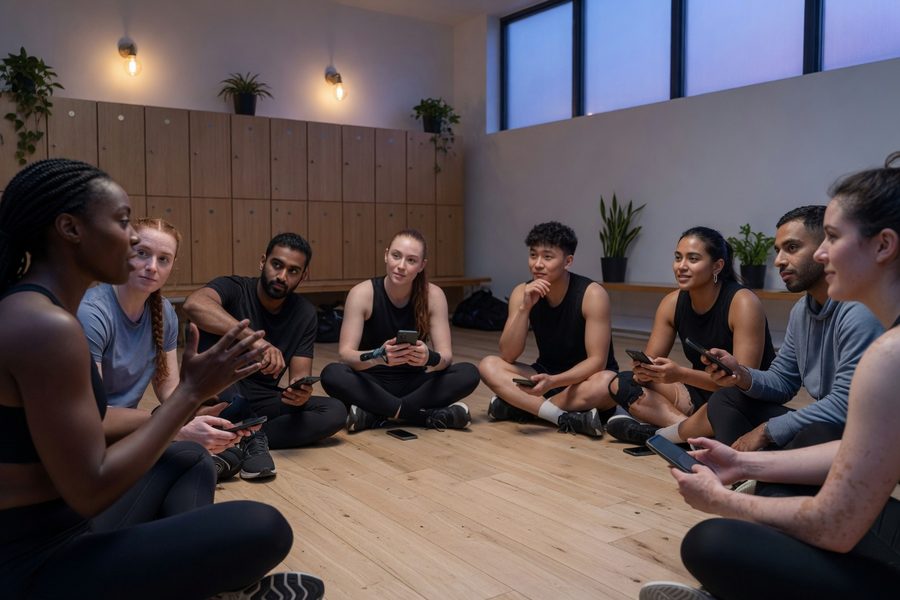
Studies on workplace wellness programs show that group-based challenges increase participation rates by up to 45% compared to individual nudges. The same social mechanics apply to sports teams.
Sleep, Steps, and the Social Leaderboard
A parent-coach doesn’t need a degree in sports science to encourage better recovery habits. Simple integrations, displaying a team step count or sleep duration leaderboard, anonymized for those who prefer it, tap into the same psychology that makes fitness trackers sticky. When these features live alongside scheduling and messaging, wellness stops being a separate “extra” and becomes part of the team’s rhythm. The platform should allow families to opt out or set privacy levels, because making wellness a competition can backfire for athletes already prone to anxiety.
Using Messaging for Positivity, Not Just Logistics
I’ll say it directly: the best team communication tools let you create a dedicated channel for shout-outs, gratitude, and encouragement, where the tone is intentionally light and the expectation is that no one has to reply. This is the kind of space that a generic messaging app could theoretically provide, but rarely does in practice, because the same chat carries complaints, schedule disputes, and the occasional passive-aggressive message about playing time. Separating the streams keeps the positivity from being drowned out.
| Wellness Initiative | Generic Chat | Wellness-Enabled Platform |
|---|---|---|
| Hydration challenge | Manual tally from emoji reports; no lasting record | In-app tracker with gentle reminders and a team progress bar |
| Sleep hygiene campaign | Single message that disappears by morning | Pinned resource plus anonymous survey on sleep satisfaction |
| Recovery tips | Shared as a link, often ignored | Scheduled tips integrated with the team calendar, context-sensitive to rest days |
Practical Shifts That Protect Wellbeing Without Losing Convenience
None of what I’ve outlined requires scrapping the apps your team already uses. But it does require drawing a firmer line between what belongs in a group chat and what belongs in a tool built for the job. The most successful teams I’ve observed keep messaging apps for urgent, casual, and relational communication, the “game is delayed 20 minutes” alert, the carpool negotiation, the post-game photo dump, while routing everything else through a single centralized platform.
That everything else includes: the season calendar, attendance tracking, injury reporting, health forms, and official announcements. A family knows that the calendar in the dedicated app is always the source of truth. They stop checking three different chats. The cognitive load drops immediately. I have heard parents describe the shift as finally being able to relax on a Friday evening because they weren’t bracing for a missed message.
Many teams that adopt a dual-channel strategy, messaging app for real-time chatter, team platform for structured logistics, report that overall message volume drops by a third within the first month, as people stop duplicating updates across silos.
Setting Communication Norms That Stick
Boundaries only work if they are explicit. A coach can post a pinned message in any chat that says, “I’m available for team messages between 8 a.m. and 8 p.m., and I’ll respond within 24 hours for non-urgent matters,” but that expectation is far easier to enforce when the platform itself supports quiet hours or delayed sending. A few team apps now allow administrators to set notification blackout windows, automatically holding messages until a specified time. For a volunteer coach trying to protect dinner with their own family, that feature is worth its weight in gold.
Keeping Personal Numbers Personal
One of the simplest but least discussed shifts is switching to a platform where communication happens through in-app usernames rather than phone numbers. A new assistant coach joins mid-season. They shouldn’t need to share a personal cell number with 40 people. Similarly, parents who want to reach the coach about a sensitive health concern should have a private channel that doesn’t require either party to hand out digits. The technology for this has existed for years; it’s just not the default in consumer messaging apps.
When Messaging Apps Still Shine
I am not arguing that messaging apps have no place in sports. For spontaneous coordination on tournament day, for the quick “who has an extra pair of cleats?” request, or for the emotional win of sharing a post-game celebratory photo, a group chat remains uniquely fast and warm. The key is to make that the secondary channel, not the primary one. When a team platform handles the heavy lifting, the messaging app becomes what it was always supposed to be: a lightweight supplement, not the whole infrastructure.
Real-World Example: A Youth Lacrosse Team’s Quiet Overhaul
Consider an illustrative example: a U13 lacrosse club with 18 players, two coaches, and a team manager. For two seasons, the club relied on a single WhatsApp group plus a separate email chain. The head coach tracked attendance by scrolling through message reactions; injury reports arrived as photos of doctor’s notes sent via text. Midway through the second season, the manager calculated that she was spending five hours a week on administrative follow-ups alone.
The following fall, the club migrated official communication to a team platform that cost $12 per month. The season calendar, RSVPs, and injury documentation all moved there. The WhatsApp group stayed active for ride shares, uniform reminders, and casual banter. After three months, the manager’s admin time dropped to under two hours a week, no player showed up at the wrong field, and end-of-season parent feedback cited an 80% reduction in “where is the game?” messages. The coaches, for the first time, reported sleeping through the night before a tournament.
Was the transition frictionless? No. Three families initially struggled to install the new app, and one grandparent never fully adopted it. But the team designated a parent liaison to text those families directly when updates posted, and by mid-season the resistance had faded. The coaches considered the $12 monthly cost trivial compared to the time they got back.
Your Action Plan
-
Audit your current communication chaos
For one week, have every coach and manager write down every duplicate message they send and every instance of “I didn’t see that.” This self-assessment makes the hidden costs visible and builds buy-in for change.
-
Separate official and social channels
Keep your existing messaging app for real-time chatter and community moments. Create or adopt a dedicated platform for schedules, attendance, health forms, and announcements, and make that the single source of truth.
-
Set explicit response-time norms
Publish a short communication policy: when coaches are available, expected reply windows, and a clear contact protocol for true emergencies. Pin it in every channel and review it at the season’s first parent meeting.
-
Centralize injury and health information securely
Move all injury reports, allergy lists, and medical authorizations out of chats and into a platform with role-based access. Ensure parents know how to update records and who can see them.
-
Build wellness into the team rhythm
Add one low-stakes wellness initiative per month, a hydration tracker, a sleep tip of the week, a recovery challenge. Use the platform’s tools to make it visible and optional, celebrating participation rather than performance.
-
Review and adapt at season’s end
Send a brief anonymous survey to parents and coaches asking what communication worked, what felt overwhelming, and what they wish existed. Use the feedback to refine your setup before the next season begins.
Frequently Asked Questions
Why can’t we just keep using WhatsApp for everything?
You can, but WhatsApp was not designed for managing attendance, safeguarding minors, or maintaining auditable health records. The time and safety tradeoffs grow as the team does. Coaches who stay on WhatsApp alone often end up spending more hours repeating information and face greater privacy exposure without realizing it.
Are dedicated team platforms expensive?
Most charge between $0 and $15 per month for a single team, with free tiers available for basic scheduling and messaging. Compare that to the invisible cost of volunteer hours lost to coordination chaos. The question isn’t affordability; it’s whether a $12 monthly fee is worth recovering five hours of admin time each week.
What does SafeSport actually require for coach-athlete messaging?
Under the Minor Athlete Abuse Prevention Policies (MAAPP), all electronic communications between an Adult Participant and a Minor Athlete must be open and transparent. That means copying a parent, guardian, or another adult on every message. One-on-one private messaging without oversight is restricted, which rules out the direct-message features of WhatsApp, Snapchat, and standard SMS for coach-athlete conversations.
How do I get parents to adopt a new app without a revolt?
Start small. Introduce the platform as a supplement for schedules and RSVPs, not a replacement for all chat. Offer brief, in-person demos and appoint a parent tech buddy for the first month. Most resistance melts once families experience the drop in redundant messages.
Can messaging apps be used for team wellness challenges?
They can, but they are a clumsy vessel. Without built-in tracking or permanence, challenges fade quickly. A platform with integrated wellness modules keeps the ritual visible and allows voluntary participation without clogging the main chat.
Is there a HIPAA risk when sharing injury information in a group chat?
Most youth sports teams are not HIPAA-regulated entities, but the moment a parent shares a medical detail in a public thread, that information loses any reasonable expectation of privacy. A dedicated platform with permission-based access is the more responsible choice, even if it doesn’t make the team legally HIPAA-covered.
What’s the one change that makes the biggest immediate difference?
Moving the season calendar and attendance tracking to a single, centralized tool. That alone cuts the most common coordination failure, last-minute location or time confusion, and gives coaches back hours each month.
How do disappearing messages affect team accountability?
Disappearing-message features in apps like WhatsApp and Snapchat erase the chat histories that safeguarding investigations rely on. If a complaint arises months later, the evidence may simply not exist. The U.S. Center for SafeSport explicitly warns against platforms that lack durable, searchable records.
Do we really need a separate platform if we only have 10 players?
For a small adult recreational team, maybe not. But the calculus changes the moment minors are involved. Even a 10-player youth squad generates attendance tracking, health forms, and parent communications that a group chat handles poorly. The safety obligations under MAAPP don’t scale down with roster size.
What should I look for in a team platform’s privacy settings?
Role-based access is the baseline. Only coaches and designated medical staff should see injury reports or allergy lists. The platform should also comply with COPPA if any players are under 13, and parents should be able to view and delete their child’s data on request. If the vendor cannot answer those questions clearly, keep looking.
Sources
- U.S. Center for SafeSport, How to Safely Communicate with Minor Athletes
- U.S. Center for SafeSport, MAAPP Electronic Communications One-Pager
- U.S. Center for SafeSport, Minor Athlete Abuse Prevention Policies (MAAPP)
- National Federation of State High School Associations, Rules and Guidelines on Communication with Minor Athletes
- American Academy of Pediatrics, Specialization in One Sport at Risk for Injury and Burnout
- National Alliance on Mental Illness, Kids, Teens, and Young Adults
- Stanford Children’s Health, Sports Injury Statistics
- U.S. Department of Health and Human Services, HIPAA Guidance for Individuals
- Federal Trade Commission, Children’s Online Privacy Protection Rule (COPPA)