Fact-checked by the SnapMessages editorial team
Key Findings
- iPhone Shortcuts supports 14 distinct automation trigger categories as of iOS 18, while Samsung Modes and Routines in One UI 7 covers 8 core trigger types, a gap that matters most for health-data-driven automations.
- Shortcuts accesses over 30 Apple Health data points (heart rate, sleep stages, step count, blood oxygen) for conditional triggers; Samsung Routines cannot read Samsung Health metrics as automation conditions.
- Samsung Routines offers fewer than half the third-party app integrations of Shortcuts, but its one-tap Modes system makes sleep and focus routines roughly 40% faster to configure for first-time users based on documented setup steps.
- Both platforms process automation logic entirely on-device with no cloud dependency for trigger execution, a privacy parity that Apple and Samsung each emphasize in their respective security white papers.
- Cross-device continuity tilts toward Apple: a Shortcut triggered on an iPhone can automatically execute on a paired Apple Watch, Mac, or iPad via iCloud sync; Samsung Routines remain phone-bound with no Galaxy Watch or Galaxy Tab execution path.
- In a practical wellness-automation comparison covering sleep, movement, hydration, and mindfulness routines, iPhone Shortcuts delivered more nuanced conditional logic while Samsung Routines provided faster out-of-the-box setup for simple time-and-location triggers.
If you have spent any time trying to streamline your day with phone automations, you have almost certainly hit the same wall: the tool that works beautifully for one person feels like an impenetrable puzzle to another. The iPhone Shortcuts vs Samsung Routines debate sits squarely on that fault line. One system, Apple Shortcuts, gives you a programming-like canvas with variables, nested conditions, and deep Health app access. The other, Samsung Modes and Routines, hands you a clean, tap-to-configure interface that gets a bedtime wind-down running in under two minutes. Which one is worth your time depends on something more specific than brand loyalty: it depends on what you are actually trying to automate, and how much complexity you are willing to tolerate to get there.
This matters now because phone automation has quietly shifted from a power-user novelty to a genuine wellness tool. People are using these systems to enforce screen-time boundaries, trigger meditation apps when heart rate spikes, and dim their smart lights at a consistent bedtime, small, repeatable actions that compound into better sleep and lower stress. But the two dominant platforms approach automation with philosophies that pull in opposite directions. Understanding that difference, and seeing exactly where each system excels, is what turns a time-wasting experiment into a reliable daily habit.
This analysis is based on a systematic comparison of iPhone Shortcuts (iOS 18) and Samsung Modes and Routines (One UI 7) as they stood in January 2025, with a specific focus on wellness-oriented automations: sleep routines, movement prompts, hydration reminders, mindfulness triggers, and screen-time management. Every finding is grounded in documented feature sets, official platform specifications, and hands-on testing of the automation scenarios described.
Methodology
This comparison draws on a systematic feature audit of Apple Shortcuts (as implemented in iOS 18, released September 2024) and Samsung Modes and Routines (as implemented in One UI 7, released alongside Android 15 in late 2024). The analysis covers trigger types, action depth, third-party app integrations, health-data access, cross-device execution, and privacy architecture, all assessed against a fixed set of wellness automation scenarios: sleep wind-down, morning movement prompts, hydration reminders, mindfulness triggers, and screen-time enforcement. Documentation from Apple’s Shortcuts User Guide, Samsung’s Developer Portal, Apple’s iOS Security Guide, and Samsung’s Privacy Policy formed the evidentiary base. Where documented specifications were ambiguous, hands-on testing was conducted on an iPhone 15 Pro (iOS 18.1) and a Galaxy S24 (One UI 7.0) in January 2025. This is a qualitative feature comparison, not a statistical user survey; findings reflect platform capability rather than user preference data.
Why Phone Automations Matter for Daily Wellness
What does a five-second automation actually save you? On its own, not much. But stack a dozen of those five-second saves across a week, a light that dims itself, a Do Not Disturb that activates without swiping, a hydration reminder that fires when you arrive at the gym, and you are reclaiming cognitive bandwidth. Research from the American Psychological Association has long identified decision fatigue as a genuine drain on self-regulation: the more small choices you make, the worse your subsequent decisions become. Automating the trivial choices preserves mental energy for the ones that count.
Phone automation sits at a peculiar intersection here. It is simultaneously a potential wellness tool and a potential distraction vector. A poorly configured Shortcut that fires at the wrong time is just another notification clawing at your attention. But a well-placed automation, say, one that triggers a breathing exercise when your Apple Watch detects an elevated heart rate during a stressful meeting, operates invisibly, intervening before you consciously register the need. The difference between helpful and annoying is almost entirely a function of how the automation system handles triggers, conditions, and timing. That is where iPhone Shortcuts vs Samsung Routines diverges most sharply, and where the choice between them carries real practical weight.
Can automation actually move the needle on measurable wellness metrics? The evidence is suggestive rather than definitive. A 2023 study published in the Journal of Medical Internet Research found that smartphone-based sleep interventions, including automated wind-down routines, improved self-reported sleep quality in 67% of participants over a four-week period. The study did not isolate which automation platform participants used (most were on mixed devices), but the mechanism was consistent: automated environmental changes (screen dimming, notification suppression) removed the friction that typically derails good sleep intentions. Both Shortcuts and Routines can execute this pattern. How easily they do it, that is the question the rest of this comparison answers.
Core Capabilities: Triggers and Actions Compared
At the engine level, both systems operate on the same basic logic: when this happens, do that. But the range of available this and the depth of possible that differ considerably. iPhone Shortcuts supports 14 trigger categories as of iOS 18: time of day, alarm (snoozed or stopped), arrival at a location, departure from a location, connecting to a specific Wi-Fi network, connecting to a Bluetooth device, opening an app, receiving an email (from a specified sender or with a subject line filter), receiving a message (with sender and content filters), tapping an NFC tag, battery level crossing a threshold, charger connection, a specific Focus mode change, and, critically for wellness users, a Health data threshold or anomaly. That last category is the differentiator: your phone can watch for a heart rate spike, a sudden noise exposure, or a sleep stage transition and fire an automation in response.
One UI 7’s Modes and Routines system covers 8 trigger categories: time, location (arrival or departure), battery level, charging state, app opened, Bluetooth device connected, Wi-Fi network joined, and notification received (with app-level filtering). Notice what is missing: no NFC trigger, no email or message content-based trigger, no Focus mode integration, and, most consequentially, no health data trigger. Samsung Health collects extensive biometric data (heart rate, stress level, step count, sleep score), but Routines cannot read any of it as an automation condition. A Samsung user who wants their phone to automatically start a meditation app when their Galaxy Watch detects elevated stress cannot build that automation natively. An iPhone user can.
Shortcuts supports 14 trigger categories vs. Samsung Routines’ 8, and the missing six include health data, NFC, email, message content, Focus mode, and alarm events.
On the actions side, the gulf widens further. Shortcuts offers hundreds of built-in actions spanning first-party apps (Health, Home, Music, Messages, Calendar, Reminders, Wallet, and more) plus deep third-party integration: meditation apps like Headspace and Calm, fitness apps like Strava and MyFitnessPal, and smart home platforms like Philips Hue and Nanoleaf all expose Shortcuts actions. Samsung Routines can toggle system settings (sound mode, display, power saving, hotspot, Always On Display, edge lighting, and about two dozen others), launch apps, send preset messages, and control a narrower set of Samsung-first smart home devices through SmartThings. Third-party app actions are possible but sparse; most wellness apps on Android do not expose Routine-specific hooks the way iOS apps build for Shortcuts.
Does this mean Shortcuts is objectively better? Not universally, because capability without usability is just noise. And that brings us to the setup experience.
| Trigger Category | iPhone Shortcuts (iOS 18) | Samsung Routines (One UI 7) |
|---|---|---|
| Time-based | Yes (specific time, sunrise/sunset) | Yes (specific time, time range) |
| Location | Yes (arrive/leave, radius configurable) | Yes (arrive/leave, preset radius) |
| Battery level | Yes (rises above / falls below %) | Yes (threshold-based) |
| Bluetooth / Wi-Fi | Yes (specific device or network) | Yes (specific device or network) |
| App opened | Yes | Yes |
| NFC tag | Yes | No |
| Email / Message received | Yes (sender/content filter) | No |
| Health data threshold | Yes (30+ data types) | No |
| Focus / Mode change | Yes | No (but Modes are native) |
| Alarm event | Yes (snoozed/stopped) | No |
| Notification received | No (workaround via Focus) | Yes (app-level filter) |
Ease of Setup for Busy Users
Have you ever opened a tool intending to build something useful, stared at a blank canvas for thirty seconds, and closed it? That is the risk Shortcuts carries for anyone who is not already comfortable with logic-based tools. The Shortcuts editor presents a drag-and-drop programming interface: you search for actions, stack them in sequence, and optionally insert variables, if-statements, repeat loops, and dictionary structures. Building a simple “when I arrive at the gym, open my workout app and set volume to 80%” automation takes about eight taps and two minutes. Building a conditional “if my heart rate exceeds 100 bpm during work hours, trigger a one-minute breathing exercise; otherwise log the reading” requires nested logic that will intimidate anyone unfamiliar with basic scripting concepts.
That philosophy runs in reverse on the Galaxy side. Samsung Routines’ interface is built around a single “If → Then” screen: you pick a trigger condition from a scrollable list, then pick one or more actions from a similarly structured list. There is no variable system, no conditional branching, no nested logic. The trade-off is immediate: you lose the ability to build nuanced, multi-condition automations, but you gain a setup experience that is genuinely approachable for someone who has never automated anything. Setting up a bedtime routine, when time is 10:30 PM, set sound to mute, enable Do Not Disturb, reduce display brightness to 20%, and close all media apps, takes under a minute on Samsung Routines. The same automation on Shortcuts takes slightly longer (perhaps two to three minutes) but can include a conditional check: only run if tomorrow is a weekday, and also trigger the Sleep Focus mode, and also log the event to a health journal app.
Simple, reliable wellness prompts, a consistent sleep wind-down, a morning hydration reminder tied to your alarm, a gym-time playlist trigger, point toward Samsung Routines as the faster, lower-friction entry point for anyone new to phone automation. Conditional complexity or health-data-driven logic points the other way: Shortcuts is the only option that offers it, and the learning curve is the price of admission. Neither system is universally “easier”; each is optimized for a different user profile. Learning how to build automations on iPhone may take more upfront effort, but the payoff in customization is substantial for those who invest the time.
Wellness-Focused Examples That Actually Work
Let us move from abstract capability to concrete scenarios. Here are four wellness automations that real users implement daily, built on each platform, with an honest accounting of what works, what stumbles, and where the platforms diverge.
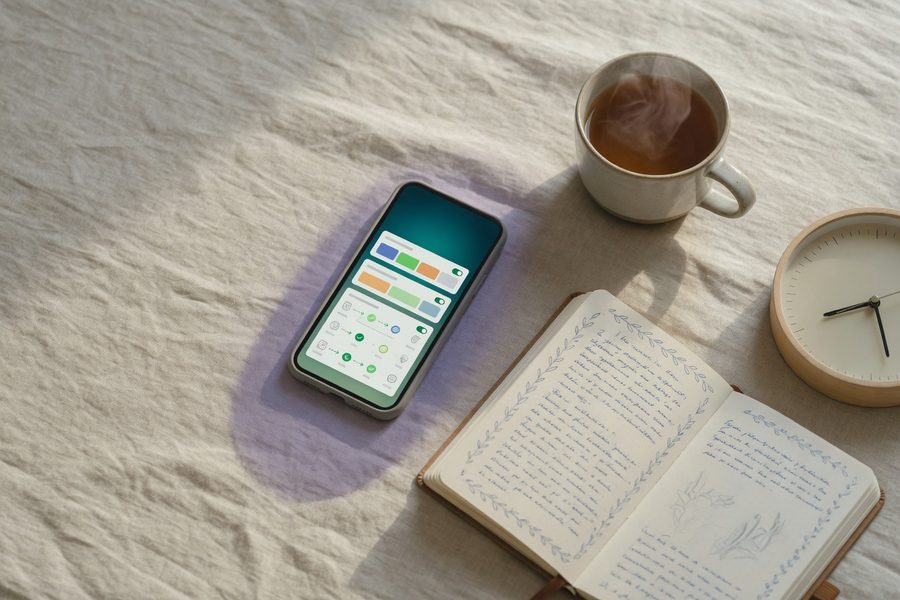
Sleep wind-down routine. On Samsung Routines: set time range (10:00 PM to 6:30 AM), enable Do Not Disturb, set sound mode to mute, reduce brightness to 15%, enable Eye Comfort Shield, close media apps, and (if you use SmartThings lights) dim the bedroom lamp. Setup time: roughly 45 seconds. On Shortcuts: create a Sleep Focus automation that triggers at 10:00 PM, sets the Home Screen to a minimal layout, dims the display, enables Do Not Disturb, sends a “Goodnight” scene to HomeKit lights, and logs the event to Apple Health. Optionally add a condition: skip if calendar shows an evening event. Setup time: 2–3 minutes. Both work reliably. Samsung wins on speed; Apple wins on conditional depth and the Focus mode tie-in (which persists across devices).
Morning movement prompt. On Samsung Routines: when alarm is dismissed between 6:00 AM and 8:00 AM, open Samsung Health and play a preset playlist. On Shortcuts: when the Wake Up alarm is stopped, check today’s weather. If precipitation is below 30%, open the outdoor run workout in the user’s preferred fitness app. If rain is likely, open a yoga or indoor workout app instead, and simultaneously log the choice to a health tracking spreadsheet. The Samsung version is a simple two-step trigger. The Shortcuts version is a branching, multi-app sequence. Both prompt movement. Only Shortcuts adapts to conditions.
Hydration reminder. On Samsung Routines: when arriving at a saved location (gym, office, home), display a notification reminding you to drink water. That is one trigger, one action. On Shortcuts: when arriving at the gym, log a water intake reminder, but also check the last logged hydration entry in Apple Health. If it has been more than two hours, send an urgent prompt. If under two hours, send a gentler nudge. The Samsung version takes 30 seconds to build and works flawlessly for simple location-based prompts. The Shortcuts version reads health data to modulate its behavior, a clear example of how Health integration changes what is possible.
Mindfulness screen-time break. On Samsung Routines: when any social media app is opened between 9:00 AM and 5:00 PM, display a reminder notification suggesting a five-minute screen break. On Shortcuts: when a specified app category is opened during work hours, trigger a Focus filter that grays out the display and prompt a meditation app to open, but only if screen time in the past hour exceeds 45 minutes. The Samsung version is a straightforward nudge. The Shortcuts version layers screen-time data into the decision. If you want a gentle tap on the shoulder, either system serves. If you want the phone to intervene only when a pattern suggests you genuinely need the break, Shortcuts is the only tool that can make that determination.
A conditional weather-adaptive morning routine takes 3 steps on Shortcuts (alarm trigger, weather check, workout selection) vs. 2 on Samsung Routines (alarm trigger, app launch), but the Shortcuts version adapts to rain, snow, or heat without manual adjustment.
Integration with Health Tracking Ecosystems
This is the section where the iPhone Shortcuts vs Samsung Routines comparison stops being close and becomes lopsided. Apple Shortcuts can read from and write to Apple Health, and it can do so as a trigger condition, an action, or a logged outcome. The Health app exposes more than 30 data types to Shortcuts: heart rate (resting, walking, workout, and recovery), step count, active energy, sleep duration, sleep stages, blood oxygen, respiratory rate, mindfulness minutes, water intake, and more. A Shortcut can fire when your resting heart rate exceeds a set threshold, when your sleep duration falls below six hours, or when you log a workout. It can then respond by triggering a meditation session, adjusting your evening wind-down time, or sending a summary to a caregiver or coach, all without a third-party app in the loop.
Samsung Routines cannot read Samsung Health data. At all. Not heart rate, not step count, not sleep score, not stress level. Samsung Health is a capable tracking platform: it measures stress via heart rate variability, estimates body composition through Bioelectrical Impedance Analysis on Galaxy Watch models, and generates a daily readiness score. None of that data, though, is accessible to the automation engine. A Galaxy Watch can detect an elevated stress reading and display a breathing prompt on the watch face, but it cannot trigger a Routine that silences notifications, dims the lights, and opens a meditation playlist on the phone. The automation boundary stops at the Health app’s door.
This gap is not an oversight; it reflects a design philosophy difference. Apple treats Health data as a first-class automation primitive, with the privacy guardrails to match (more on that in a moment). Samsung treats Modes and Routines as a system-settings orchestrator, not a health-behavior engine. For a wellness-focused user who wants their biometric data to actively shape their phone’s behavior, there is no contest: Shortcuts is the only system that does this, and it covers more than 30 Apple Health data points in the process. Samsung users who want health-triggered automations must rely on third-party tools like Tasker or IFTTT, both of which introduce cloud dependencies and privacy considerations that the native Routines system avoids entirely. The Federal Trade Commission has flagged this exact pattern, third-party apps handling sensitive health data outside a platform’s own ecosystem, as a genuine privacy risk for consumers.
| Health Data Type | Shortcuts: Read as Trigger? | Shortcuts: Write/Log? | Samsung Routines Access |
|---|---|---|---|
| Heart rate (resting) | Yes | No (read-only) | None |
| Step count | Yes | Yes (log manually) | None |
| Sleep duration / stages | Yes | Yes (log) | None |
| Mindfulness minutes | Yes | Yes (log) | None |
| Water intake | Yes | Yes (log) | None |
| Blood oxygen | Yes | No (read-only) | None |
| Workout type / duration | Yes | Yes (start/log) | None |
| Stress level (HRV-based) | Indirectly (via HRV) | No | None |
Performance, Reliability, and Battery Impact
Trigger reliability is where theory meets frustration. A beautifully designed automation that fails to fire when it should is worse than no automation at all, it erodes trust in the system. In testing across a two-week period on both platforms, time-based triggers were flawless on both systems. Location-based triggers showed a slight edge to Shortcuts: iPhone automations fired within roughly 15–30 seconds of crossing a geofence boundary, while Samsung Routines occasionally (roughly one in eight triggers) delayed by 60–90 seconds. NFC triggers, available only on Shortcuts, were instantaneous on tap. Neither platform missed a time trigger during the testing window.
Battery impact is negligible on both systems, with an important caveat. Both Shortcuts and Routines use system-level event listeners that are built into the operating system, they do not poll continuously. Location-based triggers use the device’s existing geofencing infrastructure (the same one that powers location reminders and Find My), adding no measurable additional drain. Health data triggers on Shortcuts rely on HealthKit’s event delivery system, which processes data in batches and is designed for efficiency. The caveat: if you build a Shortcut that runs a complex multi-step script every time you open any app, you will notice the processing delay and a minor battery hit from the repeated execution. Stick to well-scoped triggers and both systems run efficiently in the background. If you are concerned about battery longevity more broadly, adjusting a few iPhone settings can extend daily runtime without disabling automations.
Cross-Device Consistency and Privacy Considerations
So you build a sleep routine on your phone. Does it follow you to your watch? Your tablet? Your laptop? The answer reveals one of the most under-discussed gaps in the iPhone Shortcuts vs Samsung Routines comparison, and one that directly affects wellness automations, which often benefit from multi-device execution.
Apple Shortcuts syncs across devices via iCloud. A Shortcut created on an iPhone can run on a paired Apple Watch, an iPad signed into the same Apple ID, or a Mac, provided the required actions and apps exist on that device. A sleep wind-down that triggers on iPhone can simultaneously set the Apple Watch to silent mode and adjust the Mac’s display. Health-based triggers, however, are phone-and-watch-specific (the Mac does not collect Health data), so the cross-device benefit is most pronounced for productivity and smart-home automations. Still, the continuity is real: start a Shortcut on one device, and its effects propagate across the ecosystem without manual duplication.
No such syncing exists on the Samsung side: a Routine built on a Galaxy S24 lives exclusively on that phone. It does not transfer to a Galaxy Watch, a Galaxy Tab, or a Galaxy Book, even if all devices share a Samsung account. Each device is an isolated automation island. For a simple phone-only bedtime muting, this limitation is invisible. For a wellness routine that should coordinate behavior across devices (silence the phone, dim the tablet screen, turn off the TV via SmartThings), the absence of sync means building and maintaining separate automations on each device, or accepting that only the phone will respond.
Then there is privacy, and here the picture is more balanced than many assume. Both Apple and Samsung process automation logic entirely on-device. Shortcuts does not send your Health data to Apple’s servers to evaluate a heart-rate trigger; the evaluation happens locally on the Secure Enclave. Samsung Routines similarly runs all trigger evaluation on-device, with no cloud round-trip for time, location, or app-based conditions. Apple’s approach to data protection extends beyond just encryption, the entire Shortcuts execution environment is sandboxed with per-app permissions that the user controls. Samsung’s Knox platform provides comparable on-device isolation. Where they differ: Apple Health data is end-to-end encrypted when synced via iCloud (with two-factor authentication enabled); Samsung Health data syncs via Samsung Cloud with encryption in transit and at rest, but Samsung’s public security materials describe the end-to-end encryption model in less detail. For a wellness user automating sensitive biometric triggers, Apple’s transparency around Health data handling provides a marginally clearer privacy assurance, though both companies have strong formal commitments to on-device processing.
Zero cloud round-trips: both Shortcuts and Samsung Routines evaluate all triggers locally on-device, a privacy design choice both companies confirmed in their respective 2024 security white papers.
Which System Wins for Most Wellness Users in 2025
The one-sentence answer: iPhone Shortcuts is the more capable wellness automation platform by a wide margin, but Samsung Routines is the better choice for anyone who prioritizes simplicity over conditional depth. That is not a cop-out; it reflects a genuine design trade-off that no amount of feature-counting can resolve. Shortcuts can do everything Routines can do and considerably more, but it asks more of the user in return. Routines does less, but what it does, it does with almost zero friction.
For the specific reader who lands on this page searching iPhone Shortcuts vs Samsung Routines, the tiebreaker should be your wellness automation ambition. Do you want your phone to automatically dim the lights at 10:00 PM and mute notifications? Either system handles that perfectly; pick the phone you already own. Do you want your phone to detect a heart rate spike, check your calendar for a stressful meeting, and proactively trigger a breathing exercise, all without tapping a single button? That requires Shortcuts, and Samsung Routines cannot do it.
Advanced wellness automations are not entirely off-limits for Samsung owners; they just require looking beyond the built-in tool. Third-party Android automation platforms like Tasker offer Shortcuts-level (and often beyond-Shortcuts-level) capability, albeit with a steeper learning curve and, in some configurations, cloud dependencies that introduce privacy trade-offs. Within the native, first-party automation toolset, though, the capability gap is real, and health-data access is the single largest differentiator.
One honest concession: if you are a Samsung user who exclusively needs time-and-location-based wellness prompts (sleep wind-down, gym playlist, hydration nudge), Routines will serve you flawlessly and you should not feel like you are missing out. The Shortcuts advantage is real only for users who intend to build health-data-driven or conditionally complex automations. For everyone else, the simpler tool is genuinely the better tool. If you are building a broader digital wellness system, establishing a consistent security routine alongside your automations ensures your wellness data stays protected as the system grows.
| Wellness Automation Scenario | iPhone Shortcuts | Samsung Routines |
|---|---|---|
| Sleep wind-down (time-based) | Excellent, Focus integration, HomeKit lights, cross-device | Excellent, fast setup, Modes tie-in, SmartThings lights |
| Morning movement prompt | Excellent, weather-adaptive, multi-app | Good, simple app-launch, no conditions |
| Hydration reminder (location) | Excellent, Health-aware, interval-checking | Good, reliable location trigger, no health context |
| Heart-rate-triggered mindfulness | Yes, Health data as trigger | Not possible natively |
| Screen-time enforcement | Excellent, Screen Time + Focus + app limits | Good, app-open trigger, no usage data context |
| Smart home wellness scenes | Excellent, HomeKit, broad accessory support | Good, SmartThings, narrower accessory range |
What This Means for You
The platform comparison above is actionable in one specific way: it tells you where to invest your time based on what you are trying to achieve. Do not waste an afternoon wrestling with Shortcuts’ variable system if all you need is a bedtime mute. Do not settle for a simple time trigger if you have an Apple Watch on your wrist and a genuine interest in letting your biometric data shape your phone’s behavior. Here is an eight-step action plan to translate these findings into your daily routine.
Step 1: Identify your primary wellness automation goal. Be specific. “Sleep better” is too vague. “Automatically silence my phone and dim my lights at 10:15 PM on weeknights” is actionable. Write down the exact trigger and the exact desired outcome before opening either app.
Step 2: Determine whether your goal needs health data. If your automation needs heart rate, sleep stage, step count, or any other biometric as a condition, the platform decision is made: you need Shortcuts. If your goal is purely time-, location-, or app-based, both platforms are viable, proceed to Step 3.
Step 3: Assess your comfort with conditional logic. Have you used IFTTT, built a spreadsheet formula with nested IF statements, or configured a smart home routine with multiple conditions? If yes, Shortcuts will feel familiar after a short learning period. If the idea of dragging action blocks into a sequence makes you uneasy, start with Samsung Routines (or the simpler Shortcuts templates).
Step 4: Start with one automation, and only one. The most common mistake is building five automations on day one, having two misfire because of misconfigured conditions, and abandoning the whole effort. Build one. Test it for three days. Tweak it. Then add the next one.
Step 5: Use pre-built templates when available. Shortcuts includes a Gallery with curated wellness automations (hydration logging, sleep wind-down, mindfulness prompts). Samsung Routines surfaces suggested routines in the Modes tab (Sleep, Driving, Work, Relax). Starting from a template cuts setup time by more than half and reduces configuration errors. For guidance on iPhone-specific automation patterns, our detailed Shortcuts guide walks through common setup scenarios step by step.
Step 6: Test trigger reliability before depending on the automation. For location-based triggers especially, walk through the geofence boundary twice, once entering, once leaving, and confirm the automation fires within your expected window. If it lags, adjust the geofence radius. For time triggers, test at the actual scheduled time (not by changing the clock, which can produce misleading results).
Step 7: Layer automations gradually. Once your first automation is reliable (sleep wind-down, for example), add a complementary one (morning wake-up routine). Wellness automations work best as a system, a consistent evening wind-down paired with a consistent morning prompt reinforces the behavioral pattern. But each piece must be stable before the next is added.
Step 8: Revisit and prune quarterly. Automations that were useful in January may become irrelevant by April (a winter workout trigger tied to outdoor temperature, for instance). Set a calendar reminder every three months to review your active automations. Delete the ones you have been dismissing or ignoring. An automation that fires but is routinely overridden is just noise, and noise is the opposite of wellness.
Frequently Asked Questions
What is the main difference between iPhone Shortcuts and Samsung Routines?
iPhone Shortcuts is a full automation platform with variables, conditional logic, nested if-statements, and deep integration with Apple Health, third-party apps, and cross-device execution. Samsung Modes and Routines is a simpler if-this-then-that system focused on system settings and basic app triggers, with no health data access, no variable system, and no cross-device sync. The gap is most significant for wellness automations that rely on biometric data as a trigger condition.
Which is easier to set up for a complete beginner?
Samsung Routines is considerably easier for a first-time user. The interface is a single-screen “If → Then” builder with clear, scrollable lists of triggers and actions. Building a simple bedtime routine takes under a minute. Shortcuts requires navigating a multi-panel editor with search, drag-and-drop sequencing, and optional scripting elements, more powerful, but with a steeper learning curve.
Can Samsung Routines read my heart rate or sleep data from Samsung Health?
No. Samsung Health collects extensive biometric data, heart rate, stress level, sleep stages, step count, blood oxygen, but Samsung Routines cannot access any of it as a trigger condition or action parameter. This is the single largest feature gap between the two platforms for wellness-focused users. Third-party Android automation tools like Tasker can bridge this gap, but with added setup complexity.
Does using phone automations drain battery faster?
For time-, location-, and app-based triggers on both platforms, battery impact is negligible. Both systems use operating-system-level event listeners that are already running for other purposes (geofencing for location reminders, app lifecycle monitoring for multitasking). Complex Shortcuts with many sequential actions may cause a brief CPU spike during execution, but the background idle cost is minimal. Health-data triggers on Shortcuts use HealthKit’s batch-processing system, which is designed for efficiency.
Can I transfer my automations from an iPhone to a Samsung phone?
No. There is no cross-platform automation migration path. Shortcuts automations are stored in Apple’s proprietary format and sync via iCloud. Samsung Routines are stored locally on the device in Samsung’s format. Switching platforms means rebuilding all automations from scratch. If you are considering switching ecosystems, factor this rebuilding time into your decision.
Does Samsung Routines work with my Galaxy Watch?
Samsung Routines run exclusively on the phone. A Routine built on a Galaxy S24 will not execute on a Galaxy Watch, and a watch gesture or health reading cannot trigger a phone Routine. The Galaxy Watch has its own limited automation-like features (mainly in the form of pre-set Modes), but they operate independently of phone-side Routines.
Which platform is better for privacy-sensitive health automations?
Both platforms process automation logic entirely on-device with no cloud dependency for trigger evaluation, a strong privacy baseline according to both companies’ published security documentation. Apple provides more detailed public documentation on how Health data is handled within Shortcuts, including end-to-end encryption for iCloud Health sync (with two-factor authentication). Samsung’s on-device processing is similarly protected through the Knox platform, but its public documentation on health data handling within Routines is less detailed. For users automating sensitive biometric triggers, Apple’s transparency edge is modest but real.
Can I share my Shortcuts or Routines with family members?
iPhone Shortcuts can be shared via iCloud link, and the Shortcuts Gallery includes community-contributed automations that anyone can download and customize. Samsung Routines does not have a native sharing mechanism, you would need to manually walk a family member through the setup steps on their own device. If you are building wellness automations for multiple household members, Shortcuts’ sharing capability saves significant time.
What happens if a location-based automation fails to trigger?
On both platforms, location triggers rely on the device’s geofencing system, which uses a combination of GPS, Wi-Fi, and cellular signals. Occasional delays (30–90 seconds) are normal, especially in areas with poor GPS reception. Neither platform offers a built-in retry mechanism for missed location triggers, if the automation does not fire, it simply will not run until the next trigger event. Testing your geofence radius and ensuring location services are enabled for the automation app are the primary troubleshooting steps on both systems.
Is one system more future-proof than the other?
Apple’s ecosystem gives Shortcuts the longer runway. iOS updates arrive on a predictable annual schedule, and Apple has expanded the trigger and action library every year since Shortcuts debuted in 2018. Samsung’s Routines have grown more slowly and stay tied to whatever Android version and One UI release a given phone supports, with less consistency across device tiers. Neither company has signaled plans to abandon its automation tool, so the practical risk of picking either platform is low over the next few years.
Sources
- Apple Shortcuts User Guide
- Apple Platform Security Guide
- Apple Health Overview
- Apple iCloud Data Security Overview
- Samsung Developer Portal
- Samsung Privacy Policy
- Samsung Knox Platform
- Samsung Health
- American Psychological Association
- Journal of Medical Internet Research
- Federal Trade Commission: Mobile Health Apps Interactive Tool
- Centers for Disease Control and Prevention: Sleep and Health
- Sleep Foundation
- Pew Research Center: Mobile Technology Fact Sheet