Fact-checked by the SnapMessages editorial team
Quick Answer
Caregivers of aging parents use caregiver lifestyle apps across two distinct categories: care-management tools (like Medisafe and Caring Village) to reduce cognitive load, and self-care apps (like Calm and BetterHelp) to protect mental health. With over 60% of family caregivers experiencing burnout symptoms, according to the Cleveland Clinic, these tools offer a practical first line of defense before professional intervention becomes necessary.
Updated July 2026
Caregiver lifestyle apps have moved from a niche convenience to a genuine health intervention. 63 million Americans provide ongoing care for an older adult or someone with a serious illness, according to the AARP and National Alliance for Caregiving’s 2025 caregiving report, a figure that has grown by 45% since 2015. The mental and physical toll of that role is not abstract: burnout is the predictable outcome of years of accumulating, unrelieved stress.
Key Takeaways
- Over 60% of caregivers experience symptoms of burnout, making the condition common and measurable (Cleveland Clinic).
- The average caregiver spends 27 hours per week providing care, a burden that often compounds with paid employment and family duties (AARP/John A. Hartford Foundation).
- Caregiver apps fall into two categories: care-management tools that offload logistics and self-care apps that protect the caregiver’s mental health; matching the tool to the stressor matters more than any single app.
- Just 51% of individuals accessed a patient portal on behalf of someone they cared for in 2024, meaning many families still rely on fragmented, high-friction coordination methods (ONC Data Brief).
- Apps reduce cognitive overload but cannot replace respite care or professional therapy; they are most effective when used as an early intervention before burnout deepens.
- Privacy is a practical issue: verify an app’s HIPAA compliance and data-sharing policies before storing any protected health information.
Why Caregiver Burnout Is at a Breaking Point Right Now
Caregiver burnout is not simply feeling tired. It is the kind of fatigue that sleep does not repair. It shows up as forgotten personal doctor appointments and social withdrawal. A creeping emotional numbness toward the person being cared for is another common sign. According to the Cleveland Clinic, more than 60% of family caregivers report symptoms of burnout, and many describe it as a weekly or daily occurrence.
The time burden alone is staggering. Caregivers spend an average of 27 hours per week providing care, with many spending more than 30 hours weekly, based on data from the AARP/National Alliance for Caregiving 2025 report as cited by the John A. Hartford Foundation. For those who live with the person they are caring for, that figure climbs toward a full second job. The majority of these caregivers are also employed and, in many cases, simultaneously raising children of their own.
The demographic reality is specific. Over 60% of family caregivers are women. The average caregiver is 50.1 years old. Many experience high emotional stress as a direct result of their caregiving role, per AARP’s state-by-state caregiving analysis. This is not a vague wellness audience. It is a defined, overextended group for whom any friction-reducing tool carries real weight.
Key Takeaway: Caregiver burnout is both widespread and measurable. Research from the Cleveland Clinic and AARP shows that over 60% of caregivers experience burnout symptoms, with the average caregiver spending 27 hours per week on care, making early, app-assisted intervention a practical priority rather than an optional upgrade.
What ‘Lifestyle App’ Actually Means for a Caregiver
The most important distinction in this space is one that most articles skip entirely: there are two distinct categories of apps serving caregivers, and confusing them leads to picking the wrong tool for the actual problem.
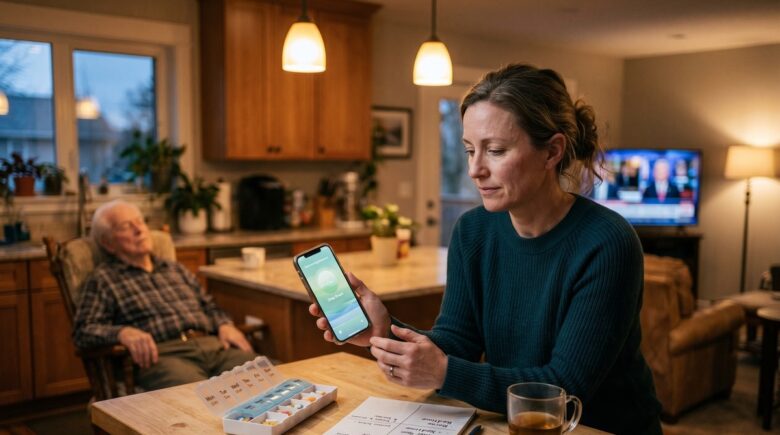
Care-management apps like Caring Village, CareZone, and Medisafe reduce the logistical burden of the role itself. They handle medication schedules, shared family task lists, appointment tracking, and real-time care updates. Their primary benefit is cognitive offload: moving information out of working memory and into a system that does not forget.
Self-care and lifestyle apps like Calm, Headspace, Sanvello, and BetterHelp address the caregiver’s own mental and physical health. These are separate from the care recipient’s needs. They exist to protect the person doing the caring, not to manage the logistics of care delivery.
Both categories matter, but they address different problems. A caregiver drowning in medication schedules and family coordination does not need a meditation app first. Conversely, someone already near emotional collapse needs a self-care tool before optimizing a shared calendar. Setting the right priority is the actual value of understanding this distinction. If you are building good daily habits into a high-stress routine, the principles in guides on building a daily journaling habit translate directly to the caregiver context.
One honest concession worth making early: apps reduce friction, but they are not a substitute for respite care, formal counseling, or structural support. Acknowledging that ceiling is not pessimistic. It is accurate, and it helps caregivers allocate their limited energy correctly.
Key Takeaway: Caregiver apps fall into two distinct categories: logistical tools that reduce cognitive load and self-care apps that protect the caregiver’s own mental health. Matching the right category to the right problem is more important than downloading any specific app, and peer-reviewed NIH research confirms apps provide meaningful support only when aligned with the caregiver’s specific stressor.
How Apps Ease Cognitive Overload
Most caregivers do not burn out from the physical demands first. They burn out from holding everything in their heads simultaneously: medication schedules, specialist appointments, insurance call-backs, sibling updates, and tomorrow’s grocery run for someone else’s restricted diet. That mental inventory never empties.
This is cognitive overload, and it is the mechanism by which caregiving stress accumulates before physical exhaustion even registers. A single centralized care-management app breaks this cycle by externalizing the information load. When a shared app sends a medication reminder and logs a completed task, it automatically notifies the family about a doctor visit. The caregiver stops being the human relay station for the entire care team.
AI-Assisted Caregiving Apps
A newer development worth tracking is the integration of AI assistants into care-management platforms. Caring Village’s built-in AI tool, Julia, can summarize care updates, flag missed tasks, and surface patterns in care logs that a fatigued caregiver might miss. This shifts the category from passive organization to something closer to a proactive alert system. The shift is meaningful: a tool that tells you something is wrong before you notice it failing is categorically different from one that simply stores your notes.
According to a peer-reviewed content analysis published in JMIR mHealth and uHealth via PubMed Central, mobile apps for caregivers of older adults show strong potential to deliver just-in-time information and stress-reduction strategies that reduce overall caregiver burden. The mechanism is not emotional support. It is structured information delivery at the moment it is needed.
For caregivers who are already managing their phone efficiently, the principles behind automating repetitive tasks on iPhone using Shortcuts can extend what a care-management app does natively, particularly for recurring reminders and check-in messages.
Key Takeaway: The strongest honest claim for caregiver apps is cognitive offload, not emotional relief. NIH-published research confirms apps reduce caregiver burden by delivering structured, just-in-time information. AI-assisted tools like Caring Village’s Julia extend this by proactively flagging missed tasks, adding a layer of early-warning value that passive organizers cannot match.
| App | Category | Primary Burnout Benefit | Free Tier Available | HIPAA-Compliant |
|---|---|---|---|---|
| Caring Village | Care Management | Shared task lists, AI summaries, care journal | Yes (core features) | Yes |
| Medisafe | Medication Tracking | Reduces missed-dose stress and family coordination calls | Yes (limited) | Yes |
| Lotsa Helping Hands | Task Delegation | Community calendar for meals, rides, errands | Yes | No |
| Calm | Self-Care / Mindfulness | Short guided sessions for stress reduction between care shifts | Limited (7-day trial) | No |
| BetterHelp | On-Demand Therapy | Flexible therapy for caregivers without fixed weekly schedules | No (paid only) | Yes |
| Sanvello | CBT / Anxiety Management | Evidence-based anxiety tools usable in under 10 minutes | Yes (core CBT tools) | Yes |
Apps can allow caregivers to monitor a loved one’s care from a distance, offering a flexibility that phone calls and paper logs cannot match. Research consistently points to convenience and just-in-time access as the core advantages digital tools bring to the caregiving dynamic, as noted in the 2025 NIH meta-synthesis on caregiver mobile apps.
Self-Care Apps That Are Actually Worth a Caregiver’s 10 Minutes
The honest answer about self-care apps is that most caregivers do not have an hour. They have a ten-minute window between a phone call with a home health aide and picking up a prescription. Apps designed for that constraint are categorically more useful than those built around long, uninterrupted sessions.
Headspace and Calm both offer short guided meditations of three to five minutes, specifically designed for high-stress moments. Research supports even brief daily practice: a 2025 meta-synthesis of qualitative research on caregiver mobile apps found that self-care apps can act as psychological stabilizers, helping caregivers cognitively restructure stress and build social support networks over time.
For anxiety management specifically, Sanvello applies cognitive behavioral therapy techniques in short, self-directed modules. Unlike therapy, it does not require scheduling. BetterHelp offers licensed therapist access on a flexible basis, which matters for caregivers who cannot commit to a weekly standing appointment. Both require a paid subscription to access their most effective features, which is a real consideration for a population that already spends an average of $7,242 out of pocket annually on care-related costs.
Wellness tracking within care apps is an underused resource. Caring Village’s Wellness Journal lets caregivers log their own energy levels and mood alongside care notes. Spotting a four-week downward trend in your own recorded energy is a more reliable early warning than waiting to feel depleted.
Caregivers already using mindfulness as part of their routine may find value in pairing a self-care app with a structured reflection habit. The guidance in this review of beginner meditation apps is a practical starting point for those who have not tried digital mindfulness tools before. For those who respond better to written reflection, the best gratitude apps for building a daily positive mindset offer a low-commitment alternative that takes under five minutes.
Key Takeaway: Self-care apps are most effective for caregivers when sessions are short and evidence-based. A 2025 NIH meta-synthesis found mobile apps serve as psychological stabilizers for caregivers, but complex interfaces remain a barrier, meaning simple apps with under-10-minute sessions have the highest real-world adoption among this group.
Apps That Help Share the Caregiving Load
One of the most reliable patterns in caregiver burnout is the primary caregiver who does everything because asking for help feels harder than doing the task. Apps like Lotsa Helping Hands and ianacare work by reframing the request: instead of asking someone to help, you are posting a task to a shared care community calendar, and people opt in to what they can manage.
The structural shift is meaningful. A direct request carries the weight of a potential refusal and the guilt of burdening someone. A shared calendar with specific, optional tasks (Tuesday afternoon pharmacy run, Thursday meal drop-off) removes that dynamic entirely. Family members, neighbors, and volunteers can see what is needed and claim what they can actually do.
Only about half of caregivers currently use digital tools to coordinate care. The Office of the National Coordinator for Health IT (ONC) 2025 data brief found that 51% of individuals accessed a patient portal on behalf of someone they cared for in 2024, a sharp increase from 24% in 2020 but still leaving half of caregivers outside the digital coordination loop. The rest are coordinating through scattered text threads and phone calls, which adds friction, misses tasks, and keeps the mental load concentrated in one person.
Task-delegation apps do have a real limitation: they require buy-in from the care circle. An app that a less tech-savvy sibling refuses to use is only a partial solution. Interface simplicity matters as much as features when the care team spans a wide age range or tech literacy gap. The 2025 meta-synthesis specifically noted that complex interfaces and limited tech literacy remain the most consistent adoption barriers in caregiver app research. Choosing an app that the whole team can actually use, rather than the one with the most features, is frequently the better decision.
For care teams coordinating across distances, video tools are often part of the coordination stack alongside task apps. The comparison of Zoom versus Google Meet for video calls is relevant if the care team holds regular family check-ins remotely.
Key Takeaway: Task-delegation apps like Lotsa Helping Hands reduce primary caregiver burden by distributing specific tasks across a shared care community. Yet only about half of caregivers use any digital coordination tool, and the ONC data shows just 51% accessed a patient portal for a loved one in 2024. The majority still rely on fragmented text threads that concentrate the mental load on one person.
Privacy, Data, and What to Check Before Committing to Any App
Caregiving apps frequently collect sensitive, continuous streams of health data: medication schedules, physician names, behavioral patterns, and in some cases location data for GPS monitoring. Most articles in this space ignore what happens to that data. That omission is a disservice to caregivers who are handing over a parent’s medical history to a private company.
Two concrete checks are worth making before committing to any app that stores medical or behavioral data. First, confirm whether the app is HIPAA-compliant for protected health information storage. Apps like Medisafe, BetterHelp, and Sanvello publish their HIPAA status clearly. Others, including Lotsa Helping Hands, are social coordination tools and are not designed for protected medical data storage. That is not disqualifying, but it does define what information belongs in each tool.
Second, read the privacy policy’s data-sharing section, specifically whether the company shares data with third-party advertisers or analytics platforms. A policy that was last updated several years ago, or that uses vague language about “trusted partners,” warrants scrutiny before you enter any care recipient’s health details.
For caregivers who are already attentive to their digital security more broadly, the framework in this guide on building a personal digital security routine applies directly to evaluating app permissions and data exposure in caregiving tools.
A growing number of caregivers are using digital tools to track a loved one’s health records. The ONC data brief reports that 51% of individuals accessed a patient portal on behalf of someone else in 2024, up from just 24% in 2020. That growth makes the privacy question more urgent, not less.
Key Takeaway: Before entering sensitive health data into any caregiving app, verify HIPAA compliance and review the data-sharing section of the privacy policy. With 51% of caregivers now using digital health tools to access a loved one’s records, per the ONC, data hygiene is a practical caregiving issue, not just a technical one.
A Real-World Example: The Cost of Digital Coordination
Consider the practical impact of digital coordination in real terms. The ONC data shows that 51% of individuals accessed a patient portal on behalf of someone they cared for in 2024, and 57% used an app to access those records. That means nearly 6 out of 10 caregivers are already using digital tools, but still over 40% are not. For a caregiver managing a parent’s complex medication schedule, this gap has measurable consequences.
Take the average caregiver spending 27 hours per week on care. At 27 hours, that’s 1,404 hours annually, nearly two full workweeks. If a care-management app reduces that by just three hours per week, that’s 156 hours saved each year. At a modest $25 hourly rate for informal help, that translates to a potential savings of $3,900 annually in avoided labor costs. Even without direct payment, that time saved can mean fewer missed appointments, less stress, and more mental bandwidth for self-care.
A Specific Caregiver Scenario: Managing Time and Stress with Limited Resources
If you have a 620 credit score and need about $8,000 to cover long-term care costs for your mother with early-stage dementia, you’re already under financial strain. You work part-time, earn $3,800 monthly, and spend 27 hours a week managing her care, more than half your non-sleep hours. A medication error or missed doctor’s visit could lead to a hospitalization that costs ten times more than your current budget. You’re using text threads to track tasks, but you’ve missed two follow-ups in the last month. You’re emotionally drained, and your doctor’s appointment is now three weeks overdue.
Adding a care-management app like Medisafe or Caring Village wouldn’t replace your need for respite care or counseling. But it could reduce the mental load by automating medication reminders and logging appointments. If you use Caring Village’s free tier to set up a shared calendar with your sister and brother, you’d stop manually checking in with them every day. That’s just two hours a week saved. Over a year, that’s 104 hours, enough time to schedule your own doctor’s visit and even begin exploring low-credit financing options. The real value isn’t in the app itself. It’s in reclaiming time to protect your own health and financial well-being.
Frequently Asked Questions
What are the best caregiver lifestyle apps to prevent burnout in 2025?
The most effective combination addresses two separate needs: a care-management app like Caring Village or Medisafe to reduce logistical cognitive load, and a self-care app like Calm, Sanvello, or BetterHelp to protect the caregiver’s own mental health. Matching the app category to your primary stressor matters more than picking any specific tool. Start with one app targeting your biggest daily pressure point before adding others.
Are caregiver apps actually effective at reducing burnout or are they overhyped?
Apps are effective for reducing cognitive overload and logistical friction, but they are not a substitute for professional support. A 2025 NIH meta-synthesis found mobile apps help caregivers cognitively restructure stress and build social support, but also flagged that complex interfaces limit adoption. Apps work best as an early-intervention tool; caregivers already experiencing severe burnout likely need respite care or counseling alongside any app use.
How many hours a week do family caregivers typically spend providing care?
Family caregivers spend an average of 27 hours per week providing care, with many spending more than 30 hours weekly, based on the AARP/National Alliance for Caregiving 2025 report. These hours are in addition to paid employment and other household responsibilities for the majority of caregivers.
Do caregiving apps have to be HIPAA-compliant?
Not all caregiving apps are HIPAA-compliant, and compliance requirements depend on what type of data the app stores. Apps that handle protected health information (medications, diagnoses, physician details) should be HIPAA-compliant. Social coordination apps like Lotsa Helping Hands are not designed for protected medical data and should not be used to store it. Always check a specific app’s stated compliance status before entering health-related information.
What is the difference between a care-management app and a caregiver self-care app?
Care-management apps such as Caring Village, Medisafe, and CareZone help manage the logistics of caregiving: medication schedules, family task lists, appointment tracking, and care notes. Self-care apps such as Calm, Headspace, and BetterHelp are designed to protect the caregiver’s own mental and physical health. Most competing app lists combine both categories, but the two serve different problems and should be evaluated separately.
How do I know when a caregiving app is not enough and I need professional help?
App-based tools are not sufficient when burnout symptoms (emotional exhaustion, isolation, cognitive fog, resentment toward the care recipient) persist despite consistent use of self-care tools. Caregivers logging more than 40 hours per week with no scheduled breaks, or those experiencing declining physical health alongside emotional exhaustion, are at the threshold where respite care, professional counseling, or a licensed caregiver aide is the appropriate next step. Apps are a first line of defense, not a ceiling.
What are the early warning signs of caregiver burnout?
Early signs include chronic fatigue that sleep doesn’t resolve, withdrawal from social activities, and irritability or frequent resentment toward the care recipient. Neglecting one’s own medical or mental health needs is another red flag. Physical symptoms such as headaches or lowered immunity often appear before emotional exhaustion is consciously felt. Recognizing these changes early is crucial because burnout becomes harder to reverse once it is deeply established.
Can caregiving apps completely replace in-person support?
No. Apps can reduce the daily friction of caregiving, but they cannot replace human respite care, professional therapy, or a reliable support network. Digital tools are most effective when used as part of a broader care strategy that includes scheduled breaks and, when necessary, formal mental health support. Viewing them as a supplement rather than a substitute helps caregivers avoid over-reliance on technology alone.
How do I choose between a care-management app and a self-care app if I need both?
Start with the category that addresses your most immediate source of stress. If medication tracking and family coordination consume most of your mental bandwidth, a care-management app like Medisafe or Caring Village is the right first step. If you are emotionally drained and finding it hard to function, pick a self-care tool like Calm or Sanvello. You can add the second category once the primary pressure point is more manageable.
Sources
- AARP & National Alliance for Caregiving (2025) – Caregiving in the U.S. 2025
- Cleveland Clinic – Caregiver Burnout
- John A. Hartford Foundation / NAC (2025) – Caregiving in the U.S. 2025 Report
- ONC Data Brief (2025) – Individuals’ Access and Use of Patient Portals and Smartphone Health Apps, 2024
- JMIR mHealth and uHealth (2018) – Mobile Apps for Caregivers of Older Adults: A Content Analysis
- PMC (2025) – A Meta-Synthesis of Qualitative Research on Mobile Apps for Caregivers
- AARP – State Caregiver Report 2025
- AARP (2025) – 2025 Technology Trends and Older Adults
- Aging and Health Technology Watch (2025) – Caregiving in the U.S. 2025: More Tech, Not Much Caregivers Could Use
- A Place for Mom (2025) – Family Caregiver Burnout Statistics






