Fact-checked by the SnapMessages editorial team
Quick Answer
Biometric login is technically harder to brute-force remotely: Apple’s Face ID has a false acceptance rate of roughly 1 in 1,000,000, compared to 1 in 10,000 for a random 4-digit PIN. But biometrics are only as secure as their PIN fallback, and compromised biometric data can never be reset, making layered authentication the only genuinely secure approach.
Biometric login security is measurably stronger than a PIN in controlled conditions, but the gap shrinks considerably in real-world use. Apple’s Face ID achieves a false acceptance rate of approximately 1 in 1,000,000 according to Apple’s Face ID security documentation, while a standard 4-digit PIN offers only 10,000 possible combinations, and most people never choose randomly. Over 35% of people surveyed globally had at least one account compromised due to password vulnerabilities in the past year, according to the FIDO Alliance’s 2025 research.
This comparison matters especially for anyone using health and wellness apps, where the data being protected goes far beyond a bank balance. This guide breaks down how each method actually works, where each one genuinely fails, and which combination gives your most sensitive personal data the protection it deserves.
Key Takeaways
- A 4-digit PIN has only 10,000 possible combinations, but real-world security is far worse because people predictably choose birth years and repeating digits (according to Apple’s authentication documentation).
- Apple’s Face ID has a false acceptance rate of approximately 1 in 1,000,000, making it statistically harder to guess than any common PIN (Apple).
- Traditional identity fraud losses reached $27.2 billion in 2024, a 19% increase from the prior year, driven largely by compromised credentials (Javelin Strategy & Research via iProov, 2025).
- Passkey and biometric login support reached 48% of the world’s top 100 websites as of May 2025, more than double the 2022 figure (FIDO Alliance, 2025).
- 87% of businesses surveyed in September 2024 had successfully deployed or were actively deploying passkeys, up 14 percentage points from the prior survey (HID / FIDO Alliance, 2025).
In This Guide
- Why Health and Wellness Apps Are Asking for Your Face or Finger
- How Biometric Login Security Actually Works Under the Hood
- How PINs Work, and Why a 4-Digit Code Is Weaker Than It Looks
- The Hidden Loophole: Why Biometrics Are Only as Strong as Their PIN Fallback
- What Happens When Your Biometrics Are Stolen?
- Which One Is Actually Harder to Hack? The Honest Answer
- Practical Steps to Lock Down Your Health Apps Right Now
- Frequently Asked Questions
Why Health and Wellness Apps Are Asking for Your Face or Finger
Health apps are adopting biometric login faster than almost any other app category, and the reason is straightforward: the data they hold is among the most sensitive a device can carry. Telehealth portals, mental health platforms, meditation apps, and fitness trackers all store records that users rightly expect to be protected at least as well as their banking credentials, the kind of data that, if exposed, Experian and other credit reporting agencies note can fuel identity fraud for years.
For users already comfortable sharing physiological data, heart rate, sleep cycles, menstrual health, emotional state, using a fingerprint or face to unlock an app feels like a natural extension of that relationship with their own body. There is a continuity there that a four-digit PIN simply does not offer.
Biometric Login vs PIN: The Two Methods You See Daily
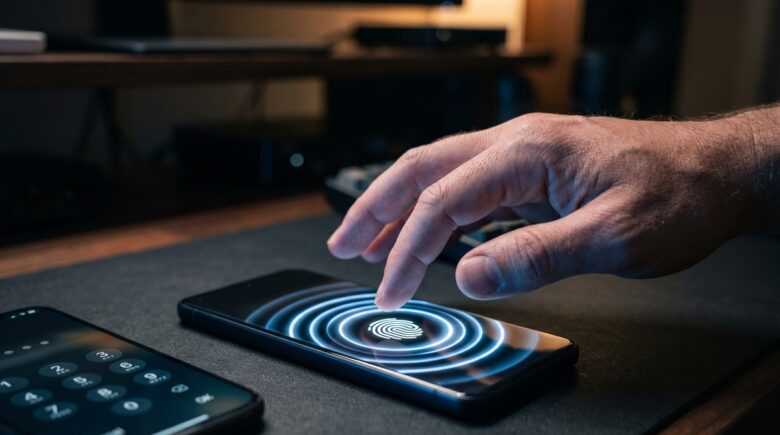
A biometric login uses a physical characteristic, a fingerprint, face geometry, or iris pattern, to verify identity. A PIN (Personal Identification Number) uses a secret sequence of digits that only the user is supposed to know. Both are forms of device authentication, but they operate on different principles: something you are versus something you know. That distinction is the starting point for any honest comparison.
Passkey and biometric-based login support reached 48% of the world’s top 100 websites by May 2025, according to the FIDO Alliance’s 2025 World Passkey Day research, more than double the adoption rate recorded in 2022. If you want to understand where this technology is heading, our guide on what passkeys are and why apps are switching to them covers the full picture.
How Biometric Login Security Actually Works Under the Hood
Modern biometric authentication follows three steps: capture, storage, and matching. When you first enroll your fingerprint or face, the device creates a mathematical template from the scan. On every subsequent login attempt, a new scan is compared against that stored template. If the match score exceeds a defined threshold, access is granted.
Where that template lives matters enormously for health app users. On Apple devices, biometric data is stored in the Secure Enclave, a dedicated chip isolated from the main processor and never exposed to the operating system, apps, or Apple’s own servers. Android devices use a comparable architecture called the Trusted Execution Environment (TEE). This on-device storage model means a remote server breach cannot expose your fingerprint the way it can expose a password database, a point that financial institutions like Chase and SoFi have cited when explaining their own biometric login rollouts.
False Acceptance Rate and False Rejection Rate
Two error rates define how reliable a biometric system is. The False Acceptance Rate (FAR) measures how often the system lets an unauthorized person in. The False Rejection Rate (FRR) measures how often it locks out the legitimate user. These rates exist in tension: tuning a system to be more inclusive (lower FRR) almost always raises the FAR.
According to NIST’s Biometric Standards Program, biometric technologies used alongside other authentication methods can provide higher degrees of security than either method employed alone, a finding that points directly toward layered authentication rather than a single-method approach.
How PINs Work, and Why a 4-Digit Code Is Weaker Than It Looks
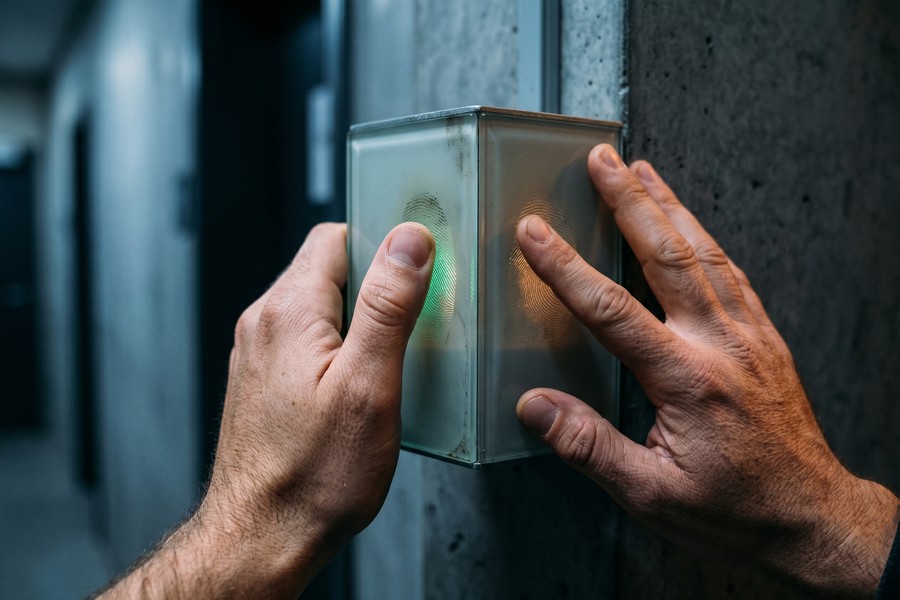
A 4-digit PIN has exactly 10,000 possible combinations, which sounds like a reasonable number until you account for human behavior. Studies of leaked PIN datasets consistently show that a small set of sequences, 1234, 0000, 1111, birth years, and repeating patterns, account for a disproportionate share of real-world choices. The theoretical 1-in-10,000 odds become much more favorable for an attacker who simply works through the most common options first.
A 6-digit PIN expands the space to one million combinations, and an alphanumeric PIN can reach billions. Length matters far less than most people assume, though, if that PIN can be observed.
Shoulder Surfing: The Attack That Bypasses Technical Strength Entirely
Shoulder surfing, watching someone type their PIN in a public space, is one of the oldest and most effective attacks in use. It requires no technical skill and no specialized equipment. In shared wellness spaces like gyms, clinics, or yoga studios, people routinely unlock their phones and apps without thinking about who might be watching.
A six-character alphanumeric PIN that no brute-force algorithm could crack in a lifetime is fully compromised the moment someone watches it being typed. This low-tech vulnerability is one reason that authentication researchers have consistently argued for moving away from knowledge-based credentials altogether, as documented in CISA and NSA’s joint Identity and Access Management guidance, which recommends phishing-resistant authentication methods for exactly this reason.
New account fraud, where attackers use stolen credentials to open fraudulent accounts, reached $6.2 billion in losses in 2024, up from $5.3 billion in 2023, according to Javelin Strategy & Research data compiled by iProov. PIN and password compromises are a primary driver of these figures.
The Hidden Loophole: Why Biometrics Are Only as Strong as Their PIN Fallback
Here is the structural vulnerability that almost no mainstream comparison covers: every biometric system requires a PIN or password as a fallback, and an attacker can deliberately trigger that fallback. On most smartphones, five consecutive failed biometric attempts force the device into PIN-entry mode. An attacker who engineers this situation, perhaps by covering the sensor or interfering with the scan, then only needs to observe the PIN the victim types to gain full access, without ever successfully spoofing the biometric sensor.
This is not a theoretical edge case. It is a documented attack pattern that completely inverts the narrative about biometrics being the stronger option. Because the two methods are not independent, the security of the entire system is capped by the weaker of the two.
When Implementation Quality Is the Real Weak Point
The 2025 Windows Hello for Business bypass illustrated another dimension of this problem. Researchers with local administrative access were able to tamper with stored biometric templates, gaining entry without a legitimate biometric scan. Separately, Kaspersky uncovered dozens of vulnerabilities in ZKTeco biometric terminals in 2024, including flaws that allowed attackers to extract biometric data directly from the hardware.
These incidents reinforce a point that security professionals repeat often: “biometric” does not automatically mean “secure.” A well-configured PIN on a hardened device can outperform a poorly implemented biometric system in practice. The NIST SP 800-63 digital identity guidelines reflect this reality by requiring that biometrics be used only when strongly bound to a physical authenticator, not as a standalone credential, and that using two authentication factors is adequate to meet the highest security requirements.
What Happens When Your Biometrics Are Stolen?
The single most important difference between biometrics and PINs is not which is harder to steal, it is what happens after the theft. A compromised PIN is replaced in seconds. A compromised fingerprint or face scan cannot be changed. Ever.
This irreversibility is not abstract. The Suprema Biostar 2 breach exposed the fingerprint records of over one million people, and those individuals have no remedy. Their biometric identity was permanently compromised. Deepfake fraud incidents rose 1,300% in 2024 according to reporting cited by iProov, and synthetic identity attacks increasingly use stolen biometric data rather than just stolen credentials.
The Stakes for Health and Wellness App Users
For anyone using a health platform, the risk compounds. Healthcare data breaches now routinely include biometric data alongside medical records. The NYC Health and Hospitals breach affected approximately 1.8 million people and included fingerprint and palm print records, not just demographic information. Research published in Neuron in 2024 warns that cognitive biometric data collected by wearables, including heart rate variability and gait patterns, can be used to infer mental states.
When the app asking for your face at login is also recording your emotional state, sleep quality, and mental health journal entries, the combination creates a data profile with no real parallel in a PIN compromise. Regulators are starting to catch up: the CFPB has flagged biometric data collection by financial apps as a supervisory concern, and the Federal Reserve has noted the authentication risks that come with health-adjacent financial products. The European Union Agency for Cybersecurity (ENISA) addresses exactly this compounded risk in its Remote ID Proofing report, which details requirements for presentation attack detection and risk management specifically for identity providers handling biometric data at scale.
For users concerned about how their health apps handle sensitive authentication data, it is worth understanding how a personal digital security routine can reduce exposure across all the platforms you use regularly.
Consumer concern about biometric identity theft jumped from 69% to 86% between 2022 and 2024, according to research cited by iProov, reflecting growing public awareness that biometric breaches are categorically more damaging than password breaches because they cannot be undone.
Which One Is Actually Harder to Hack? The Honest Answer
Biometric login is harder to attack remotely and at scale. A one-in-a-million false acceptance rate cannot be replicated by guessing, and phishing attacks that harvest passwords have no direct equivalent for stealing a live fingerprint. For the vast majority of threat scenarios, credential stuffing, phishing, database breaches, biometrics offer a meaningful advantage.
PINs hold one advantage that biometrics cannot match: they are revocable. That asymmetry matters more than most people realize, and it is the honest concession any credible analysis has to make. If your FICO Score or financial records are exposed because a stolen PIN unlocked the wrong app, you can change the PIN and move on. Stolen biometric data follows you permanently.
The Comparison in Practice
| Feature | Biometric Login | PIN (4-digit) | PIN (6-digit alphanumeric) |
|---|---|---|---|
| Possible combinations | ~1 in 1,000,000 (Face ID FAR) | 10,000 | 2.8 billion+ |
| Brute-force resistant | Yes (rate-limited, liveness required) | No (low entropy, predictable choices) | Yes (with lockout policies) |
| Shoulder surf resistant | Yes (no visible input) | No | No |
| Revocable after breach | No, permanent liability | Yes, change in seconds | Yes, change in seconds |
| Requires fallback credential | Yes, PIN always required as backup | No | No |
| Remote phishing risk | Low | High | High |
| Data storage location | On-device (Secure Enclave / TEE) | Hashed on-device | Hashed on-device |
The FIDO Alliance’s position on this trade-off is clear. Its Executive Director Andrew Shikiar has stated that eliminating reliance on passwords is now a major objective for everyone offering online services, both to deliver more secure access to consumer services and to address the growing threat from sophisticated attacks targeting distributed workforces and systems. The FIDO Alliance’s Biometric Certification Requirements (v4.1) define mandatory performance standards, including presentation attack detection requirements, that certified biometric authenticators must meet before deployment. These standards exist because the industry recognized early that a biometric concept is only as good as the implementation behind it.
Social engineering attacks, which exploit human behavior rather than technical flaws, represent a meaningful threat to both methods. Understanding how hackers use social engineering to extract credentials helps put the technical comparison in its proper context: an attacker who manipulates a person into voluntarily unlocking their device bypasses both biometrics and PINs entirely.
Practical Steps to Lock Down Your Health Apps Right Now
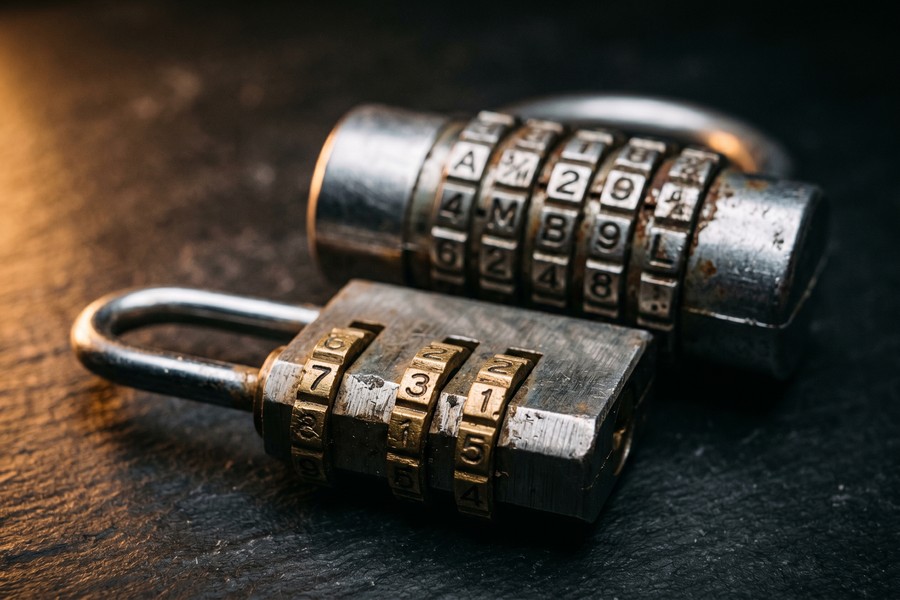
The correct answer to “biometric or PIN?” is not one or the other, it is both, configured properly. Use biometrics for daily convenience, and treat your PIN as the security foundation that it actually is. A six-character alphanumeric PIN that avoids birth years, repeating digits, and predictable sequences is meaningfully stronger than the default four-digit option most devices push during setup.
What to Do Specifically
- Enable biometric login on any health app that offers it, but switch your fallback PIN from 4 to 6 digits minimum, and use an alphanumeric option if the device supports it.
- Enable multi-factor authentication on any platform that stores health records, lab results, or mental health data. A second factor, ideally a hardware key or an authenticator app, means a stolen PIN alone is not enough for an attacker.
- Check your health app’s privacy policy for the phrase “biometric data” and verify whether the app stores your authentication template on-device or transmits it to a remote server. On-device storage is the safer architecture.
- Be aware of your surroundings when entering any PIN in a clinical or shared wellness environment. Shoulder surfing remains one of the simplest and most effective real-world attacks.
- Audit which apps have biometric access enabled on your device. Many users grant fingerprint or Face ID access to apps that do not actually need it, expanding the attack surface unnecessarily.
If you want to go further, consider a hardware security key for your most sensitive accounts, a physical authenticator that cannot be phished or shoulder-surfed. For anyone who travels and accesses health data internationally, securing your apps before crossing borders adds another layer of protection that many people overlook until it is too late.
Before granting any health or wellness app biometric access, open your device’s privacy settings and verify that the app stores authentication data locally rather than uploading it to a remote server. Apps using Apple’s Face ID or Android’s TEE architecture keep biometric templates on-device by design, third-party apps that build their own biometric storage systems may not offer the same guarantee. If the app’s privacy policy is vague on this point, treat it as a red flag.
Frequently Asked Questions
Is biometric login safer than a PIN for health apps?
Biometric login is harder to brute-force remotely, with Apple’s Face ID reporting a false acceptance rate of roughly 1 in 1,000,000 compared to 1 in 10,000 for a random 4-digit PIN. However, biometrics always require a PIN fallback, so the two methods are interdependent, the overall security of the system depends on the strength of both. For health apps specifically, using biometrics alongside a strong PIN and multi-factor authentication is the most defensible approach.
Can someone hack your biometrics using a photo or 3D model of your face?
Modern systems are designed to resist this type of presentation attack. Apple’s Face ID uses infrared dot projection to detect depth and liveness, making a printed photo or a basic 3D model insufficient. The FIDO Alliance’s Biometric Certification Requirements mandate presentation attack detection for all certified authenticators. That said, highly sophisticated spoofing attempts using detailed 3D-printed replicas or deepfake video have demonstrated success against older or less rigorous implementations.
What happens if my fingerprint data is stolen from an app?
Unlike a stolen password, a compromised fingerprint cannot be changed or revoked. The Suprema Biostar 2 breach exposed over one million fingerprint records, and those individuals have no recourse. This irreversibility is the most significant long-term risk associated with biometric authentication, particularly when health platforms store biometric data alongside sensitive medical records.
Is a 6-digit PIN meaningfully more secure than a 4-digit PIN?
A 6-digit PIN expands the combination space from 10,000 to one million, which is a significant improvement against brute-force attacks. An alphanumeric PIN of similar length raises that number to billions. The practical caveat is that PIN strength matters far less if the PIN can be observed, shoulder surfing defeats any PIN regardless of its complexity.
Do biometrics work offline, without an internet connection?
Yes. On devices using Apple’s Secure Enclave or Android’s Trusted Execution Environment, biometric matching happens entirely on the device and does not require a network connection. This is one of the architectural advantages of on-device storage: there is no server to breach and no network transmission to intercept.
Can I use both biometrics and a PIN together for better security?
Yes, and this combination is what security frameworks recommend. NIST SP 800-63 explicitly states that using two authentication factors is adequate to meet the highest security requirements. Using biometrics for convenience and a strong PIN as the fallback, not a weak one, is the right configuration for anyone protecting sensitive health data.
Are there psychological downsides to using biometric authentication on wellness apps?
Peer-reviewed research links widespread biometric authentication to heightened anxiety, fear of identity theft, and a persistent sense of surveillance among some users. For people using mental health or emotional wellness apps, the combination of biometric login and in-app emotional or physiological data collection creates a uniquely sensitive profile. This is a real dimension of the biometric discussion that pure technical comparisons tend to ignore entirely.
Sources
- Apple, Face ID Security Overview
- FIDO Alliance, World Passkey Day 2025 Consumer Research
- NIST, Biometric Standards Program and Resource Center
- CISA and NSA, Joint Guidance on Identity and Access Management
- ENISA, Remote ID Proofing Report
- FIDO Alliance, Biometric Certification Requirements v4.1
- iProov, Biometric Statistics 2025 (citing Javelin Strategy & Research)
- HID Global, Passkey Adoption in the Workforce: What the Numbers Say
- Biometric Update, FIDO Updates UX and Standards for Biometric Authentication






