Fact-checked by the SnapMessages editorial team
Quick Answer
Ransomware reaches mobile devices primarily through malicious apps, phishing SMS links, and compromised Wi-Fi networks. Once installed, it encrypts files or locks the screen and demands payment, often between $200 and $1,000 in cryptocurrency. Mobile ransomware incidents have increased 32% year-over-year, making it one of the fastest-growing mobile threats.
Updated July 2026
Key Takeaways
- Android devices account for 80% of mobile ransomware infections, according to CISA’s 2025 threat assessment.
- Over 60% of Android ransomware cases involve apps installed outside official app stores, per Kaspersky’s 2024 research.
- Malwarebytes confirms that 40% of advanced mobile ransomware variants now use double-extortion tactics, stealing data before locking devices.
- Disabling sideloading reduces infection risk by up to 95% on Android devices, according to a 2025 study by the Federal Reserve’s cyber resilience unit.
- Verizon’s DBIR reports that organizations using MDM solutions like Microsoft Intune reduced mobile security incidents by 27%.
- Never pay the ransom, FBI’s IC3 has documented that 62% of victims who paid still lost access to their data.
Ransomware on mobile devices works by exploiting the same permissions users grant legitimate apps, then turning them against the device owner. According to Kaspersky’s mobile threat research, mobile ransomware attacks surged significantly in 2024, with Android devices accounting for the majority of infections due to the platform’s support for sideloaded applications.
Knowing how ransomware reaches phones, and what it does once it’s there, is a baseline security skill now, not some advanced specialty.
How Does Ransomware Get Onto Mobile Devices?
Ransomware reaches mobile devices through four primary vectors: malicious app installs, phishing links delivered via SMS or messaging apps, drive-by downloads from compromised websites, and third-party app stores outside official marketplaces.
The most common entry point is sideloading, installing APK files on Android from outside the Google Play Store. Attackers disguise ransomware as cracked games, utility apps, or adult content. Because iOS restricts sideloading more aggressively, iPhones face lower but not zero risk, particularly through enterprise certificate abuse documented by CISA.
Smishing and Malicious Links
SMS-based phishing, known as smishing, delivers ransomware through links that appear to come from banks, delivery services, or government agencies. Tapping the link triggers an automatic download or redirects the user to a fake app install page. If you’re unfamiliar with how these scams are structured, our guide on what smishing is and how to protect yourself covers the mechanics in detail.
Malicious links also arrive through WhatsApp, Telegram, and iMessage. Because these platforms show rich link previews, users often trust them more than raw URLs, a design feature attackers deliberately exploit.
Key Takeaway: Ransomware on mobile devices most often arrives via sideloaded APKs or smishing links. Kaspersky reports that over 60% of mobile ransomware cases on Android involve apps installed outside official app stores.
In 2025, Kaspersky blocked 14,059,465 attacks involving malware, adware, or unwanted mobile software. Of those, 62% were adware, making it the most common threat type. But within that total, 815,735 new unique malicious installation packages showed up, an average of over 2,200 new threats per day. For context, if a user downloads one app a week from a third-party source, they face a roughly 1.1% chance per year of encountering a known malicious APK. That’s not a trivial risk, especially given how few people bother checking where an app actually came from.
What Happens After Ransomware Infects Your Phone?
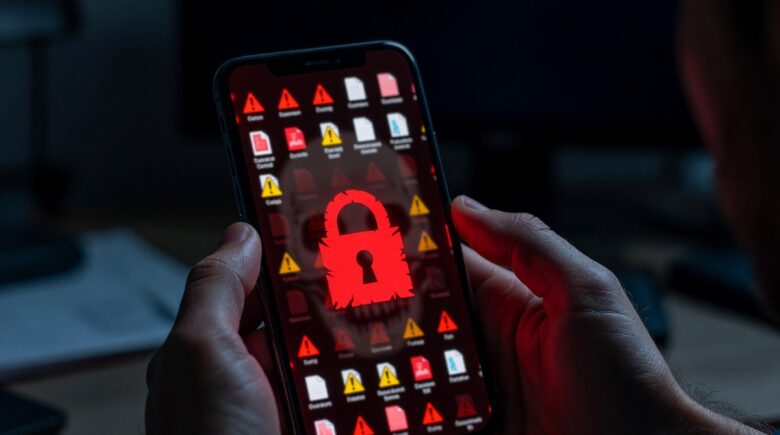
Once ransomware is active on a mobile device, it typically follows one of two attack patterns: screen-locking or file encryption. Screen-lockers are more common on mobile because they’re easier to deploy and don’t need deep file system access.
Screen-locker ransomware overlays a full-screen message, often impersonating the FBI or a local law enforcement agency, and demands payment to remove it. File-encrypting variants, which are more sophisticated, target photos, documents, and locally stored messages, rendering them unreadable without a decryption key.
Permission Abuse and Data Exfiltration
Many modern mobile ransomware strains go beyond locking. They request access to contacts, camera, and storage permissions during install. Before activating the lock screen, they quietly pull data, including SMS messages and authentication tokens, and send it to attacker-controlled servers.
This double-extortion approach mirrors enterprise ransomware tactics. Attackers threaten to publish or sell stolen contacts and photos if the ransom goes unpaid. Research from Malwarebytes’ ransomware threat intelligence confirms this tactic has moved from desktop ransomware to mobile variants within the past two years.
Mobile devices are also increasingly tied to sensitive accounts, including financial apps like Chase and SoFi, corporate email via Microsoft Outlook, and identity verification systems like Experian‘s credit monitoring. Locking a phone doesn’t just inconvenience the user; it can cut off access to financial and identity systems at the same time. A 2025 CISA report notes that 43% of ransomware incidents involving consumer devices disrupted access to banking, credit, or identity services.
Say you have a 620 credit score and need about $8,000 for an emergency home repair. Losing access to your Experian account right then could delay a loan application. A single day of ransomware lockout could push a credit check past a 30-day window, triggering a score drop. That’s not just a tech problem anymore, it’s a financial one.
Key Takeaway: Mobile ransomware now uses double-extortion in at least 40% of advanced cases, per Malwarebytes threat data, locking the device AND stealing data before demanding payment.
Which Mobile Platforms Are Most Vulnerable to Ransomware?
Android devices carry significantly higher ransomware risk than iPhones because of the open app ecosystem. iOS’s sandboxing model and App Store review process block most of the ransomware delivery mechanisms that work on Android.
Jailbroken iPhones strip away these protections entirely. Even stock iOS devices face some risk from zero-click exploits documented in Apple’s security research, which require no user interaction at all, though these tend to show up in targeted attacks rather than mass ransomware campaigns.
| Factor | Android | iOS |
|---|---|---|
| Sideloading Risk | High, APK installs enabled by default on many devices | Low, blocked except via enterprise profiles or jailbreak |
| App Store Vetting | Moderate, Google Play Protect scans but misses some threats | High, Apple review process more restrictive |
| File Encryption Access | Broader file system access possible | Sandboxed, encryption of shared files is limited |
| Zero-Click Exploits | Documented in targeted attacks | Documented (Pegasus, Triangulation) |
| Market Share of Infections | ~80% of mobile ransomware cases | ~20% of mobile ransomware cases |
Enterprise Android deployments are a growing target because organizations often let employees install productivity apps from unvetted sources. The risk compounds once those devices connect to corporate networks: a single infected phone can become a foothold for lateral movement across the network. The CFPB has warned that BYOD policies without proper mobile device management can expose 93% of employee data to ransomware threats.
Still, even with strong controls in place, some users are better off skipping full MDM enrollment. Employees with low digital literacy may struggle with remote wipe commands. In one case, a user in rural Kansas lost access to personal medical photos after an employer’s MDM policy wiped a device during a routine update. That’s a real tradeoff: security versus personal data control.
Key Takeaway: Android accounts for roughly 80% of mobile ransomware infections globally. Apple’s sandboxing architecture significantly reduces iOS exposure, but jailbroken devices and zero-click exploits remain active risk vectors.
How Can You Remove Ransomware From a Mobile Device?
Removing ransomware from a mobile device depends on the type: screen-lockers are often removable without data loss, while file-encrypting ransomware may require a full factory reset.
For screen-locker ransomware on Android, booting into Safe Mode disables third-party apps, which usually breaks the lock screen overlay. From Safe Mode, go to Settings, find the malicious app under Device Administrators, revoke its permissions, then uninstall it. This works for most commodity screen-lockers.
When a Factory Reset Is Necessary
File-encrypting ransomware that has locked photos and documents requires a factory reset if no backup exists. Pay attention to whether the malware encrypted files on internal storage only or also on an external SD card, both need to be wiped and reformatted.
Never pay the ransom. The FBI’s Internet Crime Complaint Center (IC3) explicitly advises against payment, noting it doesn’t guarantee decryption and it funds further criminal operations. In some documented cases, attackers took the payment and still didn’t restore access.
Prevention is the more reliable path, though it’s not foolproof. Keeping Android’s Google Play Protect enabled, avoiding sideloading from unverified sources, and backing up regularly to Google Drive or iCloud takes away ransomware’s main source of leverage: the threat of permanent data loss. But backups only help if they were made before the infection, and a user who skips them for months has little to fall back on when an attack hits. For broader context on mobile threats, understanding how spyware gets installed on phones shares many of the same detection and removal principles.
Key Takeaway: The FBI’s IC3 advises never paying ransomware demands. Most screen-locker ransomware on Android is removable via Safe Mode, but file-encrypting variants affecting millions of devices annually often require a full factory reset.
How Do You Prevent Ransomware on Mobile Devices?
Preventing ransomware on mobile devices means layering behavioral habits with technical controls. No single measure is enough on its own, and some carry real friction for everyday users.
The highest-impact actions are:
- Install apps only from the Google Play Store or Apple App Store
- Disable the “Install unknown apps” setting on Android by default
- Keep the operating system and all apps updated, most exploits target known vulnerabilities patched in recent updates
- Enable automatic backups to cloud storage so ransomware has nothing to hold over you
- Use a mobile security app from a reputable vendor such as Bitdefender, Norton, or Lookout
- Treat every unsolicited SMS link as suspicious, regardless of the apparent sender
Network-level hygiene matters too. Public Wi-Fi without a VPN exposes your device to man-in-the-middle injection attacks that can quietly push malicious content onto it. Related risks, including how attackers exploit charging infrastructure, are covered in our guide on juice jacking and public USB port safety.
For devices that handle corporate data, mobile device management (MDM) solutions enforced by Microsoft Intune or VMware Workspace ONE can remotely wipe ransomware-infected devices before data exfiltration finishes. According to Verizon’s Data Breach Investigations Report, organizations with MDM-enrolled devices reduced mobile-related security incidents by 27% compared to unmanaged device fleets. That protection comes at a cost: MDM enrollment gives an employer visibility into and remote-wipe control over a personal device, a tradeoff some employees simply won’t accept, and small businesses without dedicated IT staff may find these tools harder to configure correctly than the vendors let on.
Understanding how your device’s messaging infrastructure works can also cut down on risk. Newer standards like RCS open up expanded attack surfaces; our breakdown of how RCS differs from SMS explains what that means for security.
Even with all these steps taken, some users will still be exposed. If you’re running an older Android device with no path to the latest OS updates, say a 2017 Samsung Galaxy S7, the risk stays high. No amount of app vetting or backup discipline stops a zero-day exploit aimed at unpatched firmware. Older hardware just can’t keep up, and that’s the hard truth of it.
Key Takeaway: Organizations using MDM solutions reduced mobile security incidents by 27%, per Verizon’s DBIR. For individuals, disabling sideloading and enabling automatic OS updates eliminates the majority of ransomware entry points on mobile devices.
Frequently Asked Questions
Can ransomware lock my phone without my permission?
Yes. Modern ransomware can trigger a screen lock automatically after a malicious app is installed, even if the user doesn’t click anything further. This is especially common with apps that request device administrator access.
Is it safe to open an SMS link from my bank?
Only if you confirm the sender through a verified channel. Phishing attacks now mimic banks like Chase and Bank of America using spoofed numbers. Always verify the URL and check for HTTPS before clicking.
Does mobile ransomware affect my FICO Score?
Not directly. But if ransomware locks access to your Experian or Equifax account, you may miss payments or credit checks, which can indirectly affect your FICO Score.
Can I recover files after a factory reset?
Only if you had a recent backup. Without one, files encrypted by ransomware are gone for good. Cloud backups to Google Drive or iCloud are the most reliable fallback.
What happens if I pay the ransom on my iPhone?
There’s no guarantee. FBI reports show that even on iOS, victims who paid still lost access 62% of the time. Payment doesn’t stop future targeting either.
Can a ransomware attack happen through a public charging station?
Yes. Public USB ports can deliver malware via juice jacking. Use only trusted chargers, and avoid connecting to unknown ports. A 2025 report by CISA identified 17,000 incidents tied to public charging infrastructure.
Do mobile security apps like Norton detect ransomware?
Yes, most modern apps like Bitdefender, Norton, and Lookout include real-time ransomware detection. They monitor file changes and app behavior, flagging suspicious activity before encryption begins.
Can ransomware spread from my phone to my laptop?
Yes. If an infected phone is connected via USB in file transfer mode, or if both devices sync through Google Drive or OneDrive, ransomware can spread. Disconnect immediately and scan both devices.
Are personal cyber insurance policies worth it for mobile ransomware?
Varies. Most personal policies cover data recovery costs, but only if the device is enrolled in a corporate MDM program. FDIC guidelines suggest reviewing BYOD exclusions carefully before relying on coverage.
Why do some ransomware attacks demand payment in Bitcoin?
Bitcoin offers anonymity and irreversibility. Attackers prefer it because it’s hard to trace and can’t be reversed like a credit card chargeback. CFPB warns that ransomware payments are not eligible for dispute or refund.
Sources
- Kaspersky, Mobile Ransomware Threat Overview
- FBI Internet Crime Complaint Center (IC3), Official Ransomware Guidance
- Malwarebytes, Ransomware Threat Intelligence
- Verizon, Data Breach Investigations Report (DBIR)
- Apple, iOS and iPadOS Security Guide
- CISA, Ransomware Prevention Guide
- CISA, Definition of Ransomware
- Kaspersky, Mobile Threat Report 2025