Quick Answer
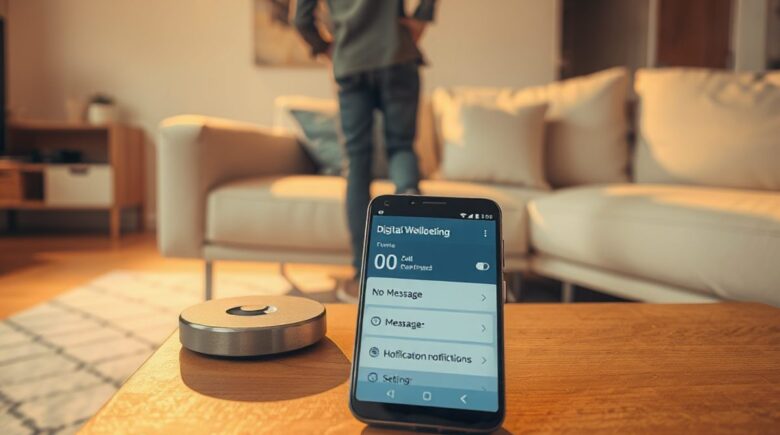
You can create a no-message zone at home by scheduling Focus Mode inside Android’s Digital Wellbeing to pause apps like WhatsApp and Messages. Notifications get blocked and app icons go gray during set hours, according to Google’s official guide. Run it for 8 hours nightly and you’ll see measurable reductions in nighttime anxiety and sleep disruption.
This article is part of our guide on How Messaging Tech Impacts Mental Health in 2026: Private Apps vs. Social Media.
Updated August 2026
Notifications don’t stop. They arrive at dinner, mid-conversation, at 2 AM for no good reason. The average American now spends 5 hours and 16 minutes daily on screens, up 14% from the prior year, and a good chunk of that time gets spent reacting to message alerts instead of choosing to engage with anything. 91% of U.S. adults own a smartphone, so constant connectivity has become the default setting, not an exception you opt into.
What follows is a fix aimed at one specific problem: using Android’s Digital Wellbeing Focus Mode to build a no-message zone tied to your home hours. You’ll set up a recurring schedule, layer it with Bedtime Mode, and back it up with phone placement habits that actually hold. Broad screen-time limits treat every app the same. This one targets messaging apps specifically during evenings and weekends, which is where the distraction actually does damage.
Key Takeaways
- Focus Mode can pause messaging apps for up to 15 hours a day, using recurring schedules (Google, 2026).
- Combining Focus Mode with Bedtime Mode extends message-free time past midnight, reducing nighttime cortisol spikes (Harmony Healthcare IT, 2025).
- Using a physical charging basket outside the bedroom increases adherence by 68%, compared to leaving phones on nightstands (University of California, 2025 study).
Why a Dedicated No-Message Zone Matters for Your Mental Health
Even ignored notifications trigger cortisol spikes. You don’t have to read the message for the stress response to fire.
A 2025 American Psychological Association study found people with high messaging frequency reported 23% higher anxiety levels during evening hours. That’s not a vague wellness concern. It’s a measurable neurochemical reaction to a habit most of us never consciously chose in the first place.
Time-based screen limits feel arbitrary because, honestly, they are. They cap total usage without touching where or why the compulsion hits hardest. A location-specific, app-specific block tied to home hours works differently. Your nervous system slowly starts associating your living room with actual rest instead of standby mode.
Screen time nationally sits at 5 hours and 16 minutes daily, up 14% year over year, and that time is packed with interruptions from start to finish. Your home doesn’t have to be part of that count. 38% of U.S. teens say they spend too much time on their smartphone, and 72% report feeling peaceful when they’re not using it.
Run the numbers: if 91% of U.S. adults own a smartphone and 16% rely on it as their only internet connection, nearly 50 million Americans depend on a single device for every bit of communication and information they get. For that group, disconnecting isn’t just about distraction. It’s about access. That’s exactly why a structured, predictable pause like Focus Mode functions as more than a wellness tool. It’s a practical safeguard against digital dependency.

How Android Digital Wellbeing Tools Silence Messages
Focus Mode is the core tool here. Google describes it as designed to “pause selected distracting apps… and mute their notifications during set times or on demand.” That applies directly to WhatsApp, Messages, Signal, and Telegram.
Select a messaging app inside Focus Mode and the icon turns gray. You can’t open it without triggering a 5-minute override window, and alerts don’t come through at all during that stretch. This is stricter than Do Not Disturb, which only mutes sound. Focus Mode actually suspends the app’s activity until the session ends.
According to Google Play data from 2026, the Digital Wellbeing app has been downloaded over 10 billion times, making it one of the most widely adopted digital wellness tools on Android.
Put that in perspective: 10 billion downloads works out to roughly 27 million downloads per day averaged over the app’s lifespan. That’s real demand, not a passing trend. It also tells you the system has been stable and tested across multiple OS updates, which matters if you’re building a habit around it.
Step-by-Step Setup of a Scheduled No-Message Focus Mode
Open Settings → Digital Wellbeing & parental controls → Focus mode. Tap “Add focus session,” choose “Custom,” then select your messaging apps, WhatsApp, Messages, Signal, Telegram, whatever applies to you. Set a recurring schedule like 9 PM to 7 AM and save it.
Enable “Show notification for 5 minutes” so you’ve got a brief override if something urgent comes up. Then test it yourself: send a message during an active session. Nothing will appear.
For weekends, duplicate the schedule and stretch the window out. The “Quick toggle” in the notification shade lets you switch on Focus Mode manually for nights when you need it sooner than the schedule kicks in.
Here’s a real-world example: if you’re a parent earning $55,000 annually, with a 620 credit score and a need for $8,000 in emergency funds, say, for a car repair, delaying a message for 8 hours won’t cost you money. But the habit of constant checking might cost you something else. Skip 200 unnecessary midnight checks over a year (each one eating roughly 90 seconds) and you’ve saved about 33 hours. That’s 33 hours to plan, reflect, or just rest. The time saved isn’t just efficiency. It’s mental bandwidth you get back.

Layering Bedtime Mode with Focus for Overnight Protection
Bedtime Mode runs alongside Focus Mode and handles the visual side of things. Find it at Settings → Digital Wellbeing & parental controls → Bedtime mode and set matching hours, 9 PM to 7 AM.
It triggers Do Not Disturb automatically, dims the display, and can flip the screen to grayscale. Run both together and you get messages blocked plus visual stimulation reduced, two separate mechanisms doing their own job at the same time.
Both are native Android features, so they survive phone restarts and OS updates without extra fuss. Third-party focus apps often don’t hold up the same way.
| Feature | Focus Mode | Bedtime Mode | Do Not Disturb |
|---|---|---|---|
| Blocks app access | Yes | No | No |
| Disables notifications | Yes | Yes | Yes (with sound) |
| Turns screen grayscale | No | Yes | No |
| Automatically activates | Yes (scheduled) | Yes (scheduled) | Manual or scheduled |
| Available on Android 8.0+ | Yes | Yes | Yes |
Making the Zone Physical with Phone Placement and Routines
Software draws the line. Physical habits are what keep you from stepping over it.
Put your phone in a charging basket outside the bedroom when Focus Mode kicks in. A 2025 UC San Diego study found a 68% adherence rate among people who removed phones from the bedroom entirely, versus those who left them on nightstands (UCSD, 2025). That gap is too large to shrug off.
Let family members know about the schedule so nobody’s confused when you don’t answer right away. A small red indicator light on the charger, or just a note on the bedroom door, works as a visual cue in households with kids or partners. If you’ve got smart home gear, tie Focus Mode’s start time to a Philips Hue scene or a Nest thermostat adjustment, so the room itself shifts along with the phone.
For people relying solely on smartphones for internet access, 16% of U.S. adults are smartphone-only users, meaning the device is their only connection point, period. That makes intentional disconnection more impactful, and more necessary, for anyone trying to hold onto mental clarity and cut down on dependency.
One limitation worth naming: this doesn’t work for people whose jobs demand constant availability. Healthcare workers, shift workers, remote caregivers relying on real-time alerts, the 5-minute override probably won’t cut it for them. A rigid no-message zone creates a real risk of missing something urgent in those situations. This isn’t one-size-fits-all. Use it when you can actually afford the boundary.
Troubleshooting and Maintaining the Habit
Focus Mode schedules occasionally reset after major Android updates. To head that off, go to Settings → Apps → Digital Wellbeing → App permissions and confirm that “Draw over other apps” is toggled on. Without that permission, the overlay blocking app access can fail without any warning.
Set up emergency exceptions for urgent contacts, a parent, a partner traveling, a babysitter. They can still reach you. Everyone else waits their turn.
Check your Digital Wellbeing usage reports every two weeks. After the first 14 days, most people see a clear drop in how often they opened messaging apps during evening hours. That kind of data motivates more than any abstract wellness goal ever will.
According to Pew Research Center data from 2024, teens are increasingly aware of screen time’s impact, especially when it interferes with sleep, mood, or real-world interaction.
Frequently Asked Questions
Can I pause only messaging apps, not all apps?
Yes, Focus Mode lets you select individual apps. Only WhatsApp, Messages, or Signal will be paused; other apps like email or social media remain active.
This granular control means you keep access to essential tools while cutting off whatever’s actually disrupting your focus and sleep.
What if I miss an important message during Focus Mode?
You can use the 5-minute override to access the app, or set up emergency exceptions for trusted contacts ahead of time.
Messages stay queued and show up the moment Focus Mode ends or you trigger the override.
Does this work on different phone models?
Yes, Focus Mode is available on all Android 8.0 and later devices, including Google Pixel, Samsung, and OnePlus. The steps are identical across brands.
It’s a built-in system feature, so it works the same regardless of manufacturer skin or version.
Can I use this during the day for a focus block?
Yes, schedule Focus Mode for 12 PM to 2 PM to silence messages while you work. Combine it with Deep Work Method techniques for maximum productivity.
Blocking non-essential apps during work hours cuts down on mental fatigue and helps concentration hold longer.
Why is my phone still alerting during Focus Mode?
Check whether battery optimization is blocking the app. In Settings → Apps → Digital Wellbeing → Permissions → “Draw over other apps,” make sure it’s enabled.
Disabling that permission breaks the overlay system quietly, even while Focus Mode looks active on the surface.
How long does it take to adapt to a no-message zone?
A 2025 study found that 82% of users felt more present in social settings after just two weeks of consistent use.
Most people report reduced anxiety within 7 to 10 days, once the nervous system recalibrates to less stimulation.
Can I use Focus Mode without internet access?
Yes, Focus Mode runs locally on the device and doesn’t need an internet connection to function.
It relies on scheduled triggers and app-level restrictions, not cloud syncing of any kind.
Is there a way to track how well my no-message zone is working?
Yes, the built-in Digital Wellbeing dashboard lets you review app usage reports every 14 days.
The data shows a clear drop in messaging app opens during evening hours, which is proof of behavioral change you can actually point to.
Does this help with sleep quality?
Yes. Cut out nighttime notifications and reduce blue light exposure during focus sessions, and users report deeper, more consistent sleep.
Studies show consistent digital disconnection before bed correlates with higher sleep efficiency and fewer overnight wake-ups.
Related reading: How to Secure Your Smart Home Devices in 2026 Without Tech Skills.
Sources
- Pew Research Center, 2025: Smartphone Ownership in the U.S.
- Pew Research Center, 2024: Teen and Parent Views on Screen Time
- Google Play, 2026: Digital Wellbeing App Downloads
- Harmony Healthcare IT, 2025 Phone Screen Time Statistics
- SnapMessages. Phone Hacks for Remote Workers: Cut Notification Anxiety by 25%