Fact-checked by the SnapMessages editorial team
Key Takeaways
- Wickr Me, the free consumer app most readers are searching for, was permanently shut down in December 2023, any comparison treating it as a live option is outdated and misleading.
- AWS Wickr, the enterprise successor, holds FedRAMP High and DoD IL4/5 certifications and uses 256-bit AES end-to-end encryption, but it requires an AWS account and enterprise-level pricing that puts it out of reach for individual users.
- A 2023 crystal-box security audit of Briar by Radically Open Security found only six issues, one moderate, five low risk, with none in the higher-risk categories, and four were resolved by early 2024.
- The CIA’s venture capital arm In-Q-Tel invested $1.6 million in Wickr, a documented fact that carries real weight for anyone evaluating Wickr for sensitive health privacy.
- Briar is Android-only: if even one party in a conversation uses an iPhone, Briar cannot be used at all, a concrete gap that competing reviews routinely understate.
- For most individual health-privacy needs, neither app is the obvious daily driver; Signal or SimpleX will serve the majority of readers better, and this article says so directly.
In This Guide
- Why Secure Messaging Matters for Your Mental Health
- What Happened to Wickr, and What the Name Even Means in 2026
- How Briar Actually Works
- Head-to-Head: Security Features That Actually Matter
- Who Each App Is Actually Built For
- The HIPAA Question: Can Either App Be Used for Health Conversations?
- Trust, History, and What the Record Shows
- Wickr vs Briar: The Honest Verdict
- Practical Alternatives Worth Knowing About
Why Secure Messaging Matters for Your Mental Health
Most people assume that a conversation about their therapy sessions, a recent diagnosis, or a personal mental health crisis is private by default. It is not. Standard messaging apps collect metadata, who you contacted, at what time, how often, and from which location, even when message content is encrypted. For someone managing a stigmatized condition like bipolar disorder, addiction recovery, or an eating disorder, that metadata alone can expose information they have every right to protect. Choosing between tools like Wickr vs Briar is therefore not an abstract security exercise; it is a decision with real consequences for how safely you can seek support.
The scope of the problem is broader than most people realize. Research published by the Electronic Frontier Foundation’s Surveillance Self-Defense project consistently highlights that metadata collection by mainstream apps creates exposure risks even when message content never leaves an encrypted channel. A contact list showing repeated late-night messages to a suicide prevention line, or a call log showing weekly communication with a psychiatrist, tells a story that could affect employment, custody proceedings, or insurance coverage in ways that direct message content might not. The risk is not theoretical; it is structural.
This guide explains exactly what each app does, where each one falls short, and which readers should use which tool. By the end, you will be able to match your actual threat model, not a hypothetical one, to the right messaging choice for protecting sensitive health conversations.
What Happened to Wickr, and What the Name Means in 2026
The Consumer App Is Gone
This is the fact most competing reviews still get wrong. Wickr Me, the free consumer app that the majority of people searching “Wickr” have in mind, was shut down permanently in December 2023. Amazon, which acquired Wickr in June 2021, discontinued the consumer product entirely and migrated its focus to AWS Wickr, an enterprise and government communications platform. If you downloaded Wickr Me on your personal phone, that product no longer exists. Any article still comparing it as a live option is comparing something that cannot be installed.
The practical implication for this comparison is significant. AWS Wickr requires an AWS organizational account, enterprise-tier pricing, and administrator configuration before a single message can be sent. According to AWS’s official Wickr documentation, the platform encrypts and decrypts messages locally on user devices using 256-bit AES end-to-end encryption, and holds FedRAMP High and DoD IL4/5 certifications, credentials that matter a great deal to government contractors and exactly nothing to an individual trying to message their therapist privately.
The Ownership History You Should Know
Before Amazon, Wickr’s investor list included some names that deserve attention from anyone evaluating it for health privacy. The CIA’s venture capital arm, In-Q-Tel, invested $1.6 million in Wickr. Erik Prince, founder of the private military contractor Blackwater, was also among early investors. Neither association proves wrongdoing, and the technical architecture of Wickr’s encryption has been independently reviewed. But for readers who are specifically protecting health conversations because they distrust corporate or government surveillance, these are documented facts worth knowing before forming a trust judgment.
Amazon’s acquisition adds another layer. AWS operates under U.S. law, which means lawful government requests for business records, even if message content is inaccessible due to encryption, could expose organizational metadata, account registration details, and usage patterns. That is a very different exposure profile than a tool with no central server at all.
The EFF’s Secure Messaging Scorecard gave Wickr a score of 5 out of 7, recognizing its end-to-end encryption, forward secrecy, and completed independent security audit, but this assessment predates both the Amazon acquisition and the December 2023 consumer shutdown.
The brand’s public history also includes its association with illicit activity. Seventy-two documented cases in the US, UK, and Australia involved Wickr Me in child abuse material distribution and drug market transactions, a matter of public record. That history shaped the regulatory pressure that contributed to the consumer app’s closure. An honest evaluation of Wickr’s privacy reputation has to sit alongside its technical spec sheet, not replace it.

How Briar Actually Works
A Serverless Architecture Explained
Briar is unlike almost every other messaging app you have used. There is no central server. Messages do not travel through a company’s infrastructure, which means there is no single point that can be subpoenaed, hacked, or shut down by court order. Instead, Briar syncs messages directly between devices using three possible channels: the Tor network when internet is available, local Wi-Fi when both users are on the same network, or Bluetooth when devices are physically close. According to Briar’s official documentation, the Tor routing layer prevents eavesdroppers from learning which users are communicating, not just what they are saying. Each user’s contact list is encrypted and stored only on their own device.
For a domestic abuse survivor, a journalist protecting a source, or someone in a country where mental health conditions carry legal or social consequences, that architectural difference is not a footnote. It is the entire threat model. No server means no data for an attacker to steal, no records for a government to compel, and no company whose privacy policy can change overnight.
The Real-World Trade-Offs
Briar’s architecture comes with genuine limitations that most reviews handle too gently. The app is Android-only. There is no iOS client, no desktop app (a desktop beta exists but is not fully supported), and no voice or video calling. File sharing is not available. Both parties must have Briar installed and must manually add each other as contacts through a QR code exchange or a shared invitation link, there is no search-by-username feature.
The Bluetooth and Wi-Fi mesh modes, while powerful in theory, carry a practical constraint that matters specifically in health-crisis scenarios. Bluetooth range is roughly 10 meters. Someone relying on Briar’s offline capability during an emergency, a natural disaster, a network outage, or a situation where internet access has been deliberately cut, needs the person they’re contacting to be physically close. A dead phone battery in that moment eliminates the option entirely. These are not edge cases to brush past; they are the exact circumstances where the app’s architectural strengths are supposed to shine.
Briar’s offline Bluetooth mode requires both devices to be within approximately 10 meters of each other. For anyone planning to use Briar as a crisis communication backup, this physical proximity requirement may make it impractical in the exact emergency scenarios it is designed for.
The iOS exclusion matters more in health-privacy contexts than competing reviews acknowledge. Peer support groups, patient advocacy networks, and family support conversations often span mixed-device households. An app that excludes one of the two dominant mobile platforms is not a solution for most of those groups.
Head-to-Head: Security Features That Actually Matter
Encryption and Forward Secrecy
Both apps use strong encryption. AWS Wickr implements 256-bit AES end-to-end encryption with encryption and decryption performed locally on the device, meaning the AWS infrastructure never holds readable message content. Briar uses the Bramble Transport Protocol, which layers the Tor network’s existing encryption with its own end-to-end encrypted messaging, also processed entirely on-device. Both support forward secrecy, the property that means a compromised key today cannot decrypt messages from the past. That is a meaningful protection that mainstream apps like standard SMS or early versions of iMessage did not offer.
The asymmetry that matters is auditability. Briar is fully open-source, and all releases are reproducible, independent researchers can verify that the code running on your phone matches what is publicly published. A 2023 crystal-box security audit by Radically Open Security, commissioned through the Open Tech Fund, found only six issues in total: one moderate severity and five low risk, with none in the higher-risk Extreme, High, or Elevated categories. Four of the six issues were resolved by early 2024. That is a strong audit result for a consumer-grade security application.
Briar’s 2023 independent security audit found 6 total issues: 1 moderate, 5 low risk. Zero issues were classified as Extreme, High, or Elevated severity. Four of the six were resolved within months of the audit’s publication.
The full AWS Wickr source code is not publicly available for independent inspection, only a cryptographic white paper published in 2017 and government-level certification reviews exist. That creates an honest asymmetry: Briar’s security claims can be independently verified by any researcher with the skills to read the code. Wickr’s cannot, at least not at the source level.
Metadata Protection and Anonymous Sign-Up
One underappreciated advantage both apps share is anonymous account creation. Neither Wickr (in its historical consumer form) nor Briar requires a phone number or email address to register. This matters more than most people realize. Signal, which is widely recommended for health privacy, requires a verified phone number to create an account. WhatsApp requires both. That means the platform knows your real-world identity before a single message is exchanged. For someone whose mental health conversations could affect their employment, their legal situation, or their physical safety, anonymous account creation is a foundational protection, not a bonus feature.
Briar goes further on metadata. Because there is no central server, there is no metadata log to harvest. Tor routing obscures which users are communicating with each other, not just what they are saying. AWS Wickr, by contrast, still operates through Amazon’s infrastructure, meaning organizational metadata, account creation, usage timing, and group membership, could be accessible to Amazon and, under lawful process, to law enforcement.
| Feature | AWS Wickr | Briar |
|---|---|---|
| End-to-end encryption | 256-bit AES, device-side | Bramble protocol, device-side |
| Forward secrecy | Yes | Yes |
| Open-source code | No (white paper only) | Yes, fully auditable |
| Independent security audit | Gov. certification reviews | 2023 audit by Radically Open Security |
| Anonymous sign-up | Yes (enterprise context) | Yes |
| Metadata protection | Partial (AWS holds org data) | Strong (no central server) |
| Central server dependency | Yes (AWS infrastructure) | No |
Ephemeral Messaging
Wickr’s consumer product was well-known for its burn-on-read timers, configurable message expiration that could be set to seconds, minutes, or days. AWS Wickr retains this functionality for enterprise users. Briar takes a different approach: messages are stored on-device indefinitely, with no automatic deletion. That is not a flaw so much as a different threat model. Wickr assumes the risk is someone later accessing message history on a device or server. Briar assumes the risk is the network itself being surveilled, and optimizes against that instead. Which design is right depends entirely on what you are protecting against.
Before choosing any secure messaging app for health conversations, write down your actual threat model in one sentence: who are you protecting your messages from, and under what circumstances? The answer will point you to the right tool far more reliably than any feature comparison table.
Who Each App Is Actually Built For
The Enterprise Tool That Outgrew Its Consumer Roots
AWS Wickr is built for organizations. The platform’s compliance documentation covers HIPAA eligibility, FedRAMP High authorization, and DoD Impact Level 4 and 5 certifications. Those credentials exist because its customers are government agencies, defense contractors, and large enterprises managing regulated communications. The product requires an AWS organizational account to deploy, administrator-level configuration, and ongoing management. There is no consumer tier and no free plan.
That profile means AWS Wickr is essentially inaccessible to individual users, peer support groups, or anyone exploring it for personal health privacy. The tool is capable for its intended use case. The problem is the mismatch between what most readers searching “Wickr” expect and what the product actually is in 2026.
Briar’s Intended Audience, and Where It Overlaps with Health Privacy
Briar was designed for journalists, political activists, and people operating under censorship or authoritarian surveillance. That audience overlaps meaningfully with some health-privacy use cases: a person in a country where LGBTQ+ identity is criminalized discussing their mental health, an addiction recovery patient whose communications could be used in legal proceedings, or a domestic abuse survivor whose location and contacts must be hidden from an abusive partner. For those users, Briar’s architecture genuinely provides protections that no server-dependent app can match.
For the average person wanting to discuss anxiety with a friend, share a therapy update with a family member, or message a peer support group, Briar’s learning curve, Android-only limitation, and text-only interface create friction that most users will not tolerate. That is an honest assessment, not a dismissal. The tool is powerful and legitimate, it is just not designed for casual everyday wellness conversations.
| User Profile | AWS Wickr Suitable? | Briar Suitable? |
|---|---|---|
| Government/enterprise org | Yes, purpose-built | No, no admin controls |
| Individual health privacy | No, no consumer tier | Partially, if Android |
| Activist or journalist | Possible with org setup | Yes, purpose-built |
| Domestic abuse survivor | No, too complex | Yes, with caveats |
| Peer support group | No, pricing/complexity | Only if all Android |
| Clinical provider (HIPAA) | Potentially, needs BAA | No, no compliance framework |

The HIPAA Question: Can Either App Be Used for Health Conversations?
What HIPAA Actually Requires
HIPAA compliance in a messaging tool means something specific: a healthcare provider (a covered entity) must use a platform that signs a Business Associate Agreement (BAA), maintains audit logs, enforces access controls, and can demonstrate technical safeguards for protected health information (PHI). AWS Wickr is eligible for a BAA with Amazon, it appears on AWS’s HIPAA-eligible services list, meaning a clinical organization could deploy it as part of a compliant communications architecture. Briar has no compliance framework, no BAA process, and no audit logging capability. For a licensed provider, Briar is not a HIPAA-compliant option under any reasonable interpretation.
This distinction matters because many articles in this space conflate two completely different use cases. A therapist messaging a patient has legal obligations under HIPAA. An individual sharing their own health information with a trusted friend does not. HIPAA governs covered entities and their business associates, it does not regulate private individuals protecting their own conversations. For the individual protecting their own health privacy, the relevant question is not “is this HIPAA compliant?” but rather “does this app give an attacker, a platform, or a government access to my conversations?” That is a meaningfully different standard, and both apps can provide value against it.
It’s also worth noting that HIPAA sits within a broader regulatory environment. The Department of Health and Human Services’ Office for Civil Rights (OCR) enforces HIPAA requirements, and the FTC has taken increasing interest in health data privacy under Section 5 of the FTC Act, particularly for apps that fall outside HIPAA’s scope. Neither AWS Wickr nor Briar is designed to satisfy FTC health data expectations for commercial health apps, but for individual private use, neither agency has jurisdiction over personal communications.
Setting Honest Expectations
For individuals rather than providers, both apps offer genuine privacy protections that mainstream platforms do not. Neither requires a phone number. Neither harvests content for advertising. Briar goes further by eliminating the server infrastructure that creates the most common disclosure risks. But neither app replaces professional mental health support, and neither substitutes for a formal secure communications policy in a clinical setting. Readers considering either tool for personal health privacy should also read our guide on building a personal digital security routine, because secure messaging is one layer of a broader practice, not a complete solution on its own.
Trust, History, and What the Record Shows
Trust in a messaging app is not purely a technical question. It is a question of institutional incentives, ownership structure, and documented behavior over time. AWS Wickr inherits Amazon’s corporate obligations: compliance with U.S. law, responsiveness to lawful government requests, and revenue incentives that favor enterprise customers rather than individual privacy. The In-Q-Tel investment and Erik Prince’s involvement predate Amazon’s ownership, but they are part of the documented record. For a reader whose primary concern is protecting sensitive health information from government or corporate access, that history is directly on point.
Briar’s institutional record is cleaner on the trust dimension. The project is open-source, funded in part by the Open Tech Fund and other digital rights organizations, and has no commercial revenue model that creates pressure to weaken privacy protections. Its 2023 audit result was strong. The architecture does not depend on trusting any organization to keep a server secure or a policy unchanged. That does not mean Briar is perfect, but the trust model is substantially more transparent. Anyone thinking carefully about how attackers exploit institutional access will find Briar’s serverless design more resistant to the legal coercion that has compromised server-based apps in the past.
In-Q-Tel, the CIA’s venture capital arm, invested $1.6 million in Wickr. For context: that single investment, if placed in a 5% annual return account at the time, would have grown to approximately $1.95 million over six years, a modest sum for a government intelligence fund, but a meaningful signal of institutional interest in the platform’s direction.
Wickr vs Briar: The Honest Verdict
Scenario-Based Recommendations
The Wickr vs Briar decision resolves clearly once you name what you actually need. For an individual protecting sensitive health conversations on an Android device, especially where the threat model includes government surveillance, a hostile partner, or an authoritarian environment, Briar is the stronger choice by a significant margin. Its serverless architecture, Tor routing, and zero-infrastructure dependency offer protections that no server-dependent app, however well-encrypted, can replicate. The 2023 audit result adds independent verification that the implementation matches the design.
Organizations with documented HIPAA eligibility requirements, mental health clinics, research institutions, patient advocacy nonprofits, are the right audience for AWS Wickr. The compliance certifications are legitimate: FedRAMP High, DoD IL4/5, and BAA eligibility with Amazon are not marketing claims. The tool is not cheap, and it requires technical administration. The trust considerations above are worth factoring in. But for that specific institutional use case, it is a credible option.
| Scenario | Recommended Tool | Reason |
|---|---|---|
| Individual health privacy, Android | Briar (or Signal) | No server, no phone number required |
| Individual health privacy, iPhone | Signal or SimpleX | Briar unavailable on iOS |
| Clinical HIPAA compliance | AWS Wickr (with BAA) | BAA-eligible, audit logs, certifications |
| Activist or censorship environment | Briar | Functions offline, Tor routing |
| Enterprise secure comms | AWS Wickr | DoD IL4/5, FedRAMP High |
| Mixed iOS/Android group | Signal | Cross-platform, strong encryption |
The Concession Most Articles Skip
For the majority of readers who found this article by searching for a secure app for personal health conversations, neither Wickr nor Briar is the right daily driver. Signal offers strong end-to-end encryption, disappearing messages, a well-documented ephemeral messaging system, and cross-platform availability, with the one caveat that it requires a phone number for registration. SimpleX Chat goes further by eliminating phone number requirements entirely while still offering a usable interface on both Android and iOS. The Signal Protocol itself has been independently validated and adopted by WhatsApp and Google Messages, a measure of how widely its cryptographic design is trusted across the industry. For most people whose threat model is “I want my therapy conversations and health disclosures to be private from data brokers and casual surveillance,” Signal is the more practical answer, and this guide would be incomplete without saying so directly.
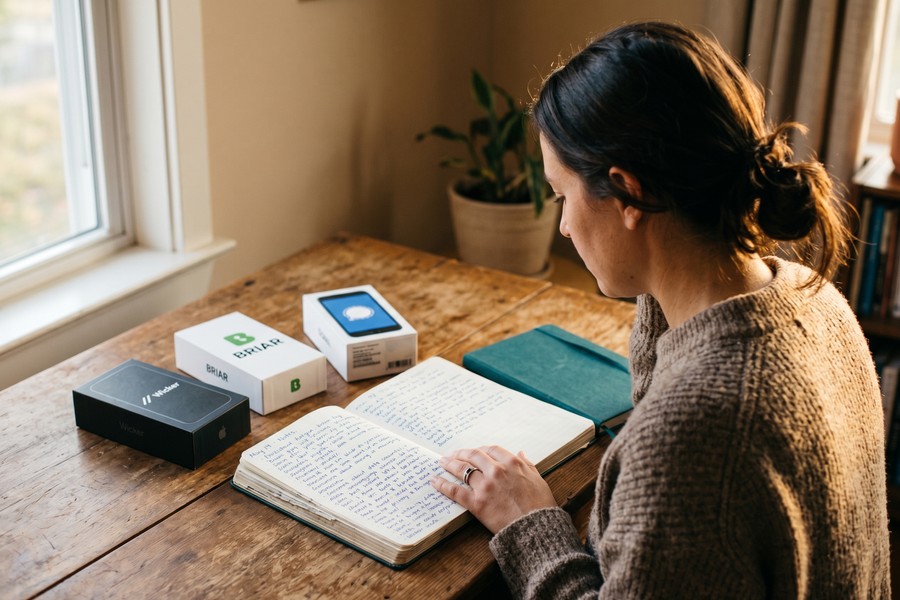
SimpleX Chat, released to stable production in 2023, requires no phone number, no email address, and no username to create an account, making it one of the few mainstream secure messaging options with fully anonymous onboarding available on both Android and iOS.
Practical Alternatives Worth Knowing About
Signal and SimpleX for Everyday Health Privacy
Signal is the most widely audited consumer-grade secure messaging app available. It uses the Signal Protocol, which has been adopted by WhatsApp, Facebook Messenger’s secret conversations feature, and Google Messages. Its main limitation for maximum anonymity is the phone number requirement. For most health-privacy use cases, that is an acceptable trade-off given how well-tested the rest of the system is.
SimpleX Chat addresses the phone number gap. It uses a novel double-ratchet architecture with no user identifiers, not even a pseudonymous ID, making it the closest consumer alternative to Briar’s anonymous model while still supporting iOS, voice calls, and file sharing. Our coverage of securing messaging apps before international travel includes additional context on choosing the right tool for high-risk communication environments.
What to Look for in Any Secure Health Messaging Tool
Whatever app you choose, two criteria should anchor the decision above all others: end-to-end encryption by default (not optional, not limited to “secret” modes) and independent security audits with published results. Beyond those, weigh minimal metadata collection and whether the app allows anonymous or pseudonymous account creation. Tools that score well on all four, Signal, Briar, SimpleX, give you a meaningful baseline. Tools that fail on any one of them create exposure points that sophisticated attackers, installed spyware, or legal process can exploit. The NIST SP 800-175B Rev. 1 cryptographic guidance provides the federal standard against which the encryption mechanisms in these apps are measured, worth reading if you want to understand what “256-bit AES” actually means in practice.
According to NIST SP 800-175B, AES-256 provides a security strength of 256 bits, the highest level recommended for protecting sensitive federal information. Both AWS Wickr and Briar implement AES-256 or equivalent-strength encryption for message content.
Real-World Example: A Peer Support Group Navigating Platform Choice
Consider an illustrative example: a small peer support group of eight people, all managing anxiety disorders, decides in early 2025 to move off a mainstream group chat app after one member discovers that the app’s terms of service permit sharing anonymized data with third-party health researchers. The group’s conversations include detailed descriptions of medication side effects, crisis episodes, and therapist contact information. They spend two weeks evaluating their options.
Three members use iPhones. That fact alone eliminates Briar. The group investigates AWS Wickr but quickly discovers the enterprise pricing and AWS account requirement, estimated setup cost for a small informal group: $0 is not an option; even the minimum AWS Wickr tier assumes an organizational billing account. Two technically capable members spend roughly four hours attempting to set up a test environment before concluding it is not viable for a casual peer group. Total time lost: approximately eight person-hours across the group.
They settle on Signal for the main group conversation, accepting the phone number trade-off as manageable given that they already know each other’s identities. The two members with the highest privacy concerns, one a healthcare worker whose employer monitors professional communications, one a person in a contested custody situation, additionally install Briar on their Android devices for one-to-one conversations where they do not want even Signal’s phone-number-linked account structure in play. The dual-tool approach adds some friction but takes about 30 minutes to configure once both members understand Briar’s contact-exchange process.
Outcome: the group retains meaningful privacy protection at zero cost, with a setup time under two hours total. The lesson from this scenario is not that one app won. The right answer was a layered approach based on each person’s device, threat model, and comfort with complexity. A one-size-fits-all choice would have left at least three members either unprotected or unable to participate.
Your Action Plan
-
Write down your actual threat model before downloading anything
Identify in one or two sentences who you are protecting your health conversations from and under what circumstances. “I want to keep my therapy updates private from data brokers and employers” is a different threat model than “I need to communicate with a support contact in a country where my condition could lead to prosecution.” The right app depends on this answer more than on any feature comparison.
-
Verify whether Briar is viable for your group
Before committing to Briar, check whether every person you need to communicate with uses an Android device. Even one key contact on an iPhone makes Briar unworkable as a shared solution. Do this check first, it will save you from investing setup time in a tool that cannot serve your actual use case.
-
For personal health privacy, start with Signal
For most individuals whose primary concern is protecting health conversations from data harvesting, advertiser profiling, and casual surveillance, Signal is the most practical starting point. It is available on both iOS and Android, has a strong independent audit record, and supports disappearing messages. Accept that the phone number requirement is a real limitation, then decide if it matters for your specific situation.
-
Add Briar as a secondary layer if your threat model warrants it
For zero-infrastructure backup on high-sensitivity one-to-one conversations, or where there is genuine risk from network surveillance or government access to server metadata, install Briar on your Android device alongside your primary app. Use it specifically for the conversations where that added protection matters most. Keep Bluetooth and Wi-Fi sync enabled only when you actively need them, to preserve battery life.
-
Do not pursue AWS Wickr for personal use
Individual users should skip AWS Wickr entirely. It has no consumer tier, requires an organizational AWS account, and is designed for enterprise compliance environments. Investigating it for personal health privacy will cost you time and lead nowhere useful. Organizations evaluating it for a clinic or nonprofit with HIPAA obligations should consult their legal and IT teams, the compliance credentials are legitimate, but implementation requires proper administrative setup and a signed BAA with Amazon.
-
Review your full digital security posture, not just your messaging app
Secure messaging is one layer. Phone lock screen security, app permissions, cloud backup settings, and the security of your accounts all affect how protected your health conversations actually are. A sophisticated attacker who compromises your device through malware, including ransomware or spyware installed via a malicious link, can read messages before encryption takes effect. Review your broader digital security habits alongside your messaging choices.
Related reading: AIO Versus: Signal vs Threema.
Frequently Asked Questions
Is Wickr Me still available to download in 2026?
No. Wickr Me, the free consumer app, was shut down permanently in December 2023. It cannot be downloaded, and existing accounts no longer function. The only active Wickr product is AWS Wickr, which is an enterprise and government platform requiring an organizational AWS account.
Can I use Briar on an iPhone?
No, there is no stable iOS version of Briar. The app is Android-only for practical purposes. A desktop beta exists for Linux and Windows, but it is not a full replacement for the mobile experience. Any member of your intended conversation group on an iPhone will need a different solution.
Does Briar work without an internet connection?
Yes, within limits. Briar can sync messages over Bluetooth or local Wi-Fi when both devices are on the same network or within approximately 10 meters of each other via Bluetooth. This offline capability is genuinely useful in specific scenarios, network outages, censored environments, protests, but it requires physical proximity and functioning device batteries. It is not a reliable substitute for internet-based messaging for most users.
Is AWS Wickr HIPAA compliant?
AWS Wickr is HIPAA-eligible, meaning it appears on Amazon’s list of services that can be covered under a Business Associate Agreement (BAA). HIPAA eligibility is not the same as automatic compliance, an organization must sign a BAA with AWS, configure the platform appropriately, and implement the required administrative, physical, and technical safeguards. A BAA alone does not make a deployment compliant.
Does either app require a phone number to sign up?
Neither app requires a phone number for account creation. This is a meaningful privacy advantage over Signal (which requires a phone number) and WhatsApp (which requires both a phone number and, in practice, a Google or Apple account). Anonymous onboarding matters especially for people whose identity, if linked to their account, could expose sensitive health information.
Which app offers better metadata protection?
Briar offers stronger metadata protection by design. Because it has no central server, there is no metadata log to harvest, subpoena, or breach. Tor routing obscures which users are communicating, not just what they are saying. AWS Wickr encrypts message content end-to-end, but organizational metadata, account information, usage timing, group membership, passes through Amazon’s infrastructure and could be subject to lawful government access requests.
Has Briar been independently audited?
Yes. A crystal-box security audit commissioned by the Open Tech Fund and conducted by Radically Open Security in 2023 found six issues: one moderate severity and five low risk, with none in the Extreme, High, or Elevated categories. Four of the six identified issues were resolved by early 2024. Briar’s code is fully open-source and all releases are reproducible, meaning independent researchers can verify that the published code matches the app running on your device.
Should I use Briar or Signal for health privacy?
For most people, Signal is the more practical choice. It works on both Android and iOS, supports voice calls, file sharing, and group chats, and has a well-documented security track record. Briar is the better choice if your threat model specifically includes government surveillance, network-level monitoring, or situations where you need zero-infrastructure communication. For maximum anonymity without the iOS limitation, SimpleX Chat is also worth evaluating.
Can Briar be used for group mental health support conversations?
Briar does support group chats, but with real constraints. All participants must be on Android. Groups are formed through the same manual contact-exchange process as individual connections. There is no voice, no file sharing, and no media support. For a small group of Android users with high privacy needs, it is functional. For a mixed-device peer support group, it will exclude some members entirely.
What is the most important factor when choosing a secure messaging app for sensitive health topics?
The most important factor is matching the app’s architecture to your actual threat model. Strong encryption matters, but so does metadata protection, account anonymity, platform availability, and whether the app requires trusting a central server or company. An app that is technically excellent but unusable by half your contacts provides no real protection. Consult resources like the EFF’s Surveillance Self-Defense guide for updated, scenario-specific recommendations, and consider building your secure messaging choice into a broader personal digital security routine.
Sources
- Amazon Web Services, AWS Wickr Administrator Guide: What Is AWS Wickr?
- Open Tech Fund, Briar Security Audit (Radically Open Security, 2023)
- Briar Project, How Briar Works: Architecture and Threat Model
- Electronic Frontier Foundation, Surveillance Self-Defense Guide
- NIST, SP 800-175B Rev. 1: Guideline for Using Cryptographic Standards in the Federal Government
- Wikipedia, Wickr: History, Investors, and Secure Messaging Scorecard
- Wikipedia, Briar (Software): Architecture and Features
- Briar Project, Official Homepage and Download Information
- Amazon Web Services, HIPAA Eligible Services Reference
- SimpleX Chat, Official Site: Privacy Architecture and No-Identifier Design
- Wikipedia, In-Q-Tel: CIA Venture Capital Arm and Portfolio Investments