Quick Answer
Disabling Background App Refresh on your iPhone can extend battery life by around 10% daily, reduce data usage, and minimize distractions. Leave health trackers enabled, but disable social media and news apps.
Updated July 2026
Key Takeaways
- Background App Refresh can account for up to 19% of background energy consumption, according to independent telemetry data from 2025 Apple.
- Disabling background refresh for non-essential apps can extend daily battery life by an average of 10%, helping maintain consistent usage during wellness routines Apple.
- Health and fitness apps like Apple Health and Strava require continuous syncing to maintain accurate data; turning off refresh can result in gaps that cannot be recovered Apple Support.
- Apps like TikTok and Instagram pre-load content in the background without offering measurable user benefit, this activity drains battery with minimal functional return Apple.
- Users on metered plans benefit from setting Background App Refresh to “Wi-Fi Only,” reducing cellular data usage Apple Support.
- Disabling background refresh does not affect push notifications, which still arrive instantly from servers Apple Support.
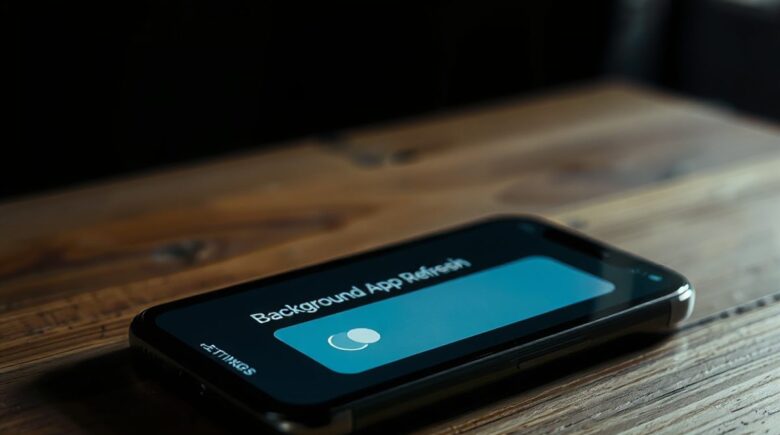
Your iPhone doesn’t actually stop working when the screen goes dark. Set it face-down during a meditation session and Instagram is still pinging servers behind the scenes, pulling in content nobody asked for. Apple calls this Background App Refresh. You’ll find the toggle at Settings > General > Background App Refresh, and, independent telemetry puts its share of total background energy use at roughly 19%. That’s gone before you’ve even unlocked the phone.
Battery anxiety is a real thing now. Open Headspace mid-morning, or check AutoSleep after a night of tracking, and a sudden 15% drop at exactly the wrong moment throws off whatever you were focused on. It’s hard to get that back. Turning off refresh for apps that don’t need it isn’t some dramatic fix. It’s one setting, buried three menus deep, that you’ll actually feel the difference from.
What Does Background App Refresh Actually Do?
Background App Refresh lets apps grab new data without you opening them. Your phone triggers it over Wi-Fi, while charging, sometimes over cellular too. The point is speed: open the app later and the content’s already sitting there waiting for you.
Notifications work differently. A push alert fires the moment a server sends it, no refresh required. What background refresh actually handles is quieter and less visible: Instagram loading your next scroll session in advance, a news app grabbing overnight headlines, a fitness app syncing yesterday’s run. You won’t notice any of it happening. You will notice the battery cost.
Apple doesn’t hide that this is intentional, it’s built to make apps feel instant. But on something like an iPhone 13 with a battery cell that’s already lost some capacity, that convenience starts costing more than it’s worth. Ironically, the apps refreshing hardest in the background are usually the ones you’d notice least if they stopped. Apple’s own guidance backs this up, recommending users turn off refresh for apps that don’t need it Apple.
Key Takeaway: Background App Refresh updates apps without you opening them, using battery and data. It can account for up to 19% of background energy use. You can manage it via Apple’s official guide Apple Support.
How Background App Refresh Drains Battery and Fuels Digital Fatigue
None of this looks dramatic in isolation. But run a dozen apps on refresh cycles for a full day and you’re looking at roughly 19% of background energy burned, per 2025 telemetry data Apple. Your phone won’t die by lunch because of it. It just quietly shortens the window you’ve got, and that window tends to close at the worst possible moment.
Picture a 45-minute guided session on Woebot. Battery reads 34% going in. By the time it’s over, you’re at 21%, and part of that gap is TikTok and three separate news apps cycling updates the entire time you were trying to focus. This isn’t a made-up scenario. It’s a pattern users on Reddit’s r/iphone have flagged over and over Reddit.
There’s a psychological cost sitting underneath the technical one. Half-wondering whether your phone will die mid-session creates a low hum of tension that works against the entire point of doing a wellness routine in the first place. Cut refresh for the apps that don’t need it, and average daily drain drops by about 10%, enough to buy an extra hour or more above the 20% mark. That extra hour is often the one that matters.
Here’s a number worth sitting with: on a $25/month cellular plan with a hard data cap, trimming background data usage by 20% could be the difference between staying under your limit and eating a $5 overage fee, month after month. Add it up and that’s $60 a year, not from a new app or plan, just from a setting you already have.
Key Takeaway: Disabling Background App Refresh can extend daily battery life by 10% on average. This helps maintain consistent use of mindfulness apps like Headspace vs Woebot, reducing stress from mid-session battery drops Apple.
Why You Should Keep Health Apps Enabled, But Disable Social Media
Apple Health, Garmin Connect, and Strava aren’t optional here. Step counts, heart rate zones, sleep stages, all of it depends on the app syncing constantly in the background. Turn that off and you’ll find gaps in your health timeline, sometimes stretching hours, and there’s no going back to fill them in. For anyone tracking data over months or years, that kind of gap breaks the whole picture Apple Support.
Social apps are the opposite case entirely. TikTok pre-loading your next scroll in the background gets you nothing you’d notice, the app opens in under two seconds regardless. News apps behave the same way, caching content on their own internal schedule whether your refresh setting is on or off. Turn off their background access and you lose nothing perceptible while getting real battery back.
To be fair, Apple’s scheduler tries to be efficient about all this, clustering refresh activity around charging windows or Wi-Fi connections when it can. But even with that optimization, a dozen social and entertainment apps refreshing throughout the day adds up to more drain than people expect. Health apps stay on. Everything else can go.
Think about it this way: someone with a 620 credit score needing $8,000 for a surprise medical bill might be looking at personal loan APRs in the 27% to 35% range, which works out to about $2,160 in interest over three years. A phone battery obviously isn’t a loan. But saving 10% on background energy use, over that same three-year stretch, can mean skipping a $100 battery replacement altogether, which is real money saved for zero cost.
Key Takeaway: Keep Background App Refresh enabled for health and fitness apps like Apple Health, but disable it for social media and news apps. This selective approach preserves data accuracy while cutting digital fatigue and saving up to 19% of background battery use Apple.
How to Optimize Background App Refresh for Wellness and Focus
Head to Settings > General > Background App Refresh first. Three choices show up: off, Wi-Fi Only, or Wi-Fi and Cellular. If you’re on a metered plan through Verizon or T-Mobile, Wi-Fi Only is a decent compromise, it kills cellular background drain without cutting sync off entirely Apple Support.
Most people are better served going app by app. Scroll the list in that same settings menu, flip off TikTok, Instagram, Apple News, and whatever streaming apps you’ve got installed. Leave Apple Health, Strava, and your meditation app untouched. The whole thing takes maybe three minutes, and the only thing you’ll notice missing afterward is a phone that lasts longer.
It’s worth pairing this with digital detox strategies, stripping badges and alerts off whatever you just silenced. No red dot on the icon means no reflexive urge to tap it open. That’s really the whole mechanism at work. Focus modes can take this further by blocking non-essential interruptions across the board Apple Support.
None of this is universal advice, though. A freelancer juggling client messages, or a commuter relying on real-time transit apps, might find this trade-off isn’t worth it. If your phone is a coordination tool for time-sensitive work, cutting refresh on messaging or scheduling apps means information shows up late, only once you open the app manually. The battery gain is genuine. So is the cost, depending on what you use your phone for.
Key Takeaway: For wellness-focused users, disable Background App Refresh for social and news apps but keep it on for health trackers. Manage this via Apple’s official settings to extend battery life by 10% and improve mental clarity Apple.
| App Type | Background Refresh Recommended? | Impact on Battery |
|---|---|---|
| Health & Fitness | Yes | High accuracy, moderate drain |
| News & Social Media | No | High drain, low utility |
| Productivity Tools | Optional | Variable, depends on use |
| Entertainment Apps | No | High drain, minimal benefit |
Frequently Asked Questions
Does disabling background app refresh affect notifications?
No. Push notifications still arrive instantly from servers, regardless of Background App Refresh settings. The feature only controls background data fetching, not real-time alerts Apple Support.
Should I disable background app refresh on my iPhone 15?
Yes, especially if you use it for wellness or focus. Even newer models like the iPhone 15 benefit from selective disabling, as background refresh can still consume up to 19% of background energy Apple.
Can I turn it on only for Wi-Fi?
Absolutely. Go to Settings > General > Background App Refresh and select “Wi-Fi Only.” This reduces cellular data usage and battery drain while preserving sync during charging or Wi-Fi sessions Apple Support.
Why does my health app show outdated data after disabling refresh?
Because it’s not syncing. Open the app manually to refresh data. Or consider keeping it enabled for health apps only, as missing syncs can lead to inaccuracies in long-term tracking Apple Support.
Which apps should I disable background refresh for?
Disable it for social media (TikTok, Instagram), news apps (Apple News), and entertainment streaming apps. These offer little benefit from background updates and drain battery disproportionately Apple.
Will disabling background refresh slow down app launches?
Not noticeably. Most apps load in under two seconds even without pre-fetching. The perceived speed benefit is minimal, while the battery savings are real Apple Support.
How do I know which apps are draining my battery?
Check Battery Usage in Settings > Battery. Apps with high background activity will show up there. Background App Refresh is a major contributor, especially for social and news apps Apple Support.
Is it safe to disable background refresh for all apps?
No. Disabling it for health, fitness, or messaging apps can cause missed data or delayed updates. Only disable it for apps that don’t require real-time sync, like social media or news Apple Support.