Fact-checked by the SnapMessages editorial team
Quick Answer
The best meditation apps for sleep in July 2025 include Calm, Headspace, Insight Timer, and Sleep Cycle. Studies show guided meditation can reduce the time it takes to fall asleep by up to 52%. Calm and Headspace consistently rank highest for sleep-specific content, offering dedicated sleep stories, body scans, and soundscapes proven to lower cortisol and improve sleep onset.
Meditation apps sleep benefits are well-documented: a 2019 meta-analysis published in JAMA Internal Medicine found that mindfulness-based programs significantly improved insomnia severity, sleep quality, and daytime fatigue compared to control groups. Millions of people now use guided audio on their phones as a primary sleep intervention, making the choice of app more consequential than ever.
If you are struggling to fall asleep or stay asleep, picking the right app matters. This guide ranks the top meditation apps for sleep, breaks down their key features, compares pricing, and explains exactly what the science says about why they work.
Key Takeaways
- 52% faster sleep onset was reported in participants using mindfulness meditation regularly, according to research published in JAMA Internal Medicine.
- Calm is the most downloaded wellness app globally, with over 100 million downloads as of 2024, per Business of Apps data.
- Headspace users reported a 14% improvement in sleep quality after just two weeks of use, based on Headspace’s own published clinical research.
- Insight Timer offers more than 200,000 free guided meditations, making it the largest free library of any meditation platform, per Insight Timer’s official statistics.
- Roughly 1 in 3 adults in the United States does not get enough sleep, according to the Centers for Disease Control and Prevention.
In This Guide
- Do Meditation Apps Actually Improve Sleep?
- Which Meditation Apps Are Best for Sleep?
- How Do Calm and Headspace Compare for Sleep?
- What Features Should You Look for in a Sleep Meditation App?
- Are Free Meditation Apps Good Enough for Sleep?
- How Should You Use a Meditation App to Sleep Better?
- Frequently Asked Questions
Do Meditation Apps Actually Improve Sleep?
Yes — meditation apps deliver clinically meaningful sleep improvements, particularly for people with chronic insomnia or high stress. A landmark study in JAMA Internal Medicine found that participants using a structured mindfulness program fell asleep faster, woke up less often, and reported significantly less daytime fatigue.
What the Research Says
Guided meditation activates the parasympathetic nervous system, lowering heart rate and cortisol levels. The National Sleep Foundation notes that chronic stress is the leading behavioral cause of insomnia in adults, which is precisely what meditation addresses.
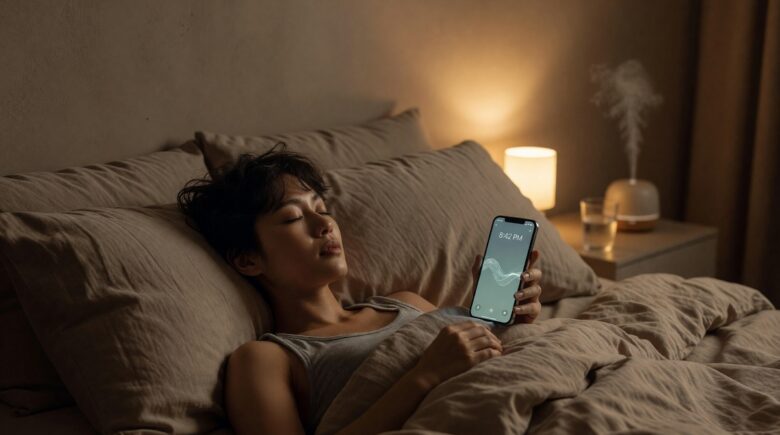
Apps translate these clinical techniques into accessible, on-demand audio. Body scans, progressive muscle relaxation, and guided breathing are the three most studied modalities — and all three are available inside leading meditation apps sleep platforms.
Mindfulness-Based Stress Reduction (MBSR), the gold-standard clinical program developed by Dr. Jon Kabat-Zinn at the University of Massachusetts, forms the scientific backbone of most sleep-focused features in major meditation apps today.
Phone Use and Sleep: A Real Concern
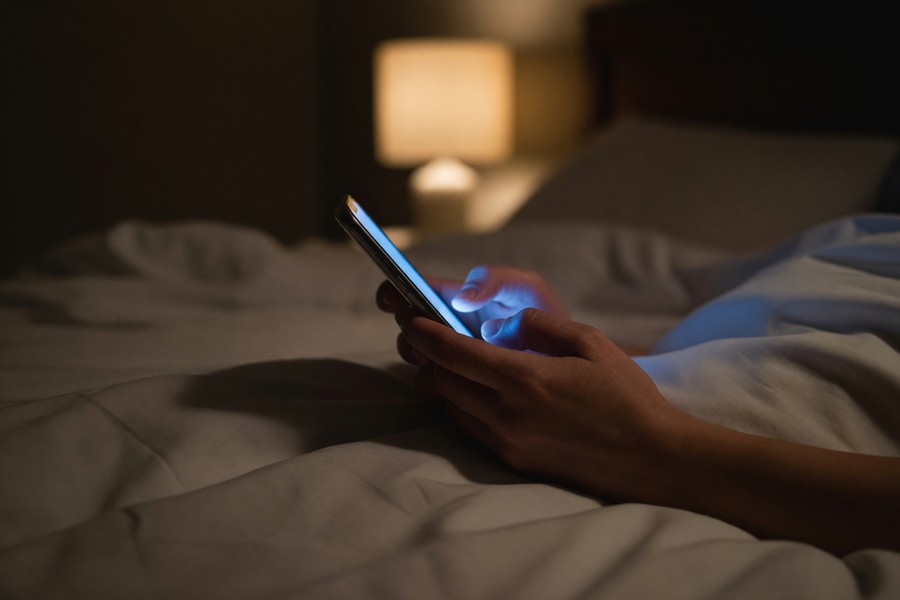
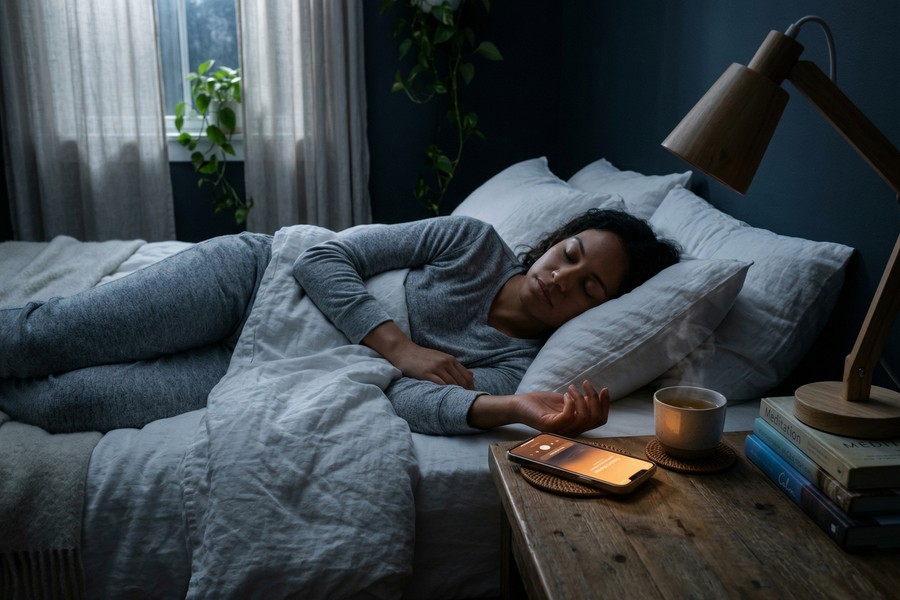
Using a phone at night carries a trade-off. Blue light from screens suppresses melatonin production. The American Academy of Sleep Medicine recommends enabling Night Mode or setting your phone face-down after launching audio content. Many top apps now include an auto-screen-off timer specifically for this reason.
Which Meditation Apps Are Best for Sleep?
The best meditation apps for sleep are Calm, Headspace, Insight Timer, Sleep Cycle, and Breethe — each excels in a different area. Calm leads in sleep story depth, Headspace in structured programs, and Insight Timer in free content volume.
App-by-App Overview
Calm built its reputation on Sleep Stories narrated by celebrities including Matthew McConaughey and Stephen Fry. The app offers over 300 sleep-specific audio tracks and daily meditations curated for evening wind-down.
Headspace takes a more clinical approach. Its “Sleepcasts” pair ambient audio with narrative imagery, and its sleep courses are structured over 10- or 30-night progressions. Headspace has partnered with major healthcare providers and has published over 25 peer-reviewed studies validating its methods.
Insight Timer is the best choice for budget-conscious users. With more than 200,000 free tracks, it provides access to global teachers without a paywall. The app also tracks meditation streaks and sleep journal entries, which supports habit formation.
Sleep Cycle takes a data-driven approach, using your phone’s microphone to analyze sleep phases and wake you during your lightest sleep stage. It integrates with meditation content to create a full sleep routine. For readers also interested in sleep data, our guide to the best sleep tracking apps covers complementary tools in depth.
Breethe is a lesser-known but highly effective option for anxiety-driven insomnia. It includes hypnotherapy sessions and sleep coaching unavailable in competing apps.
| App | Sleep-Specific Tracks | Free Tier | Annual Price (USD) | Best For |
|---|---|---|---|---|
| Calm | 300+ | Limited (7 sessions) | $69.99 | Sleep stories, ambient sound |
| Headspace | 200+ | Limited (basic courses) | $69.99 | Structured sleep programs |
| Insight Timer | 200,000+ | Full (most content free) | $59.99 (Plus) | Free content, community |
| Sleep Cycle | 50+ | Yes (core tracking free) | $39.99 | Sleep tracking + meditation |
| Breethe | 100+ | Limited (7-day trial) | $89.99 | Anxiety, hypnotherapy |
The global meditation app market was valued at $533 million in 2023 and is projected to exceed $4.2 billion by 2033, according to Precedence Research market analysis.
How Do Calm and Headspace Compare for Sleep?
Calm wins on variety and production quality; Headspace wins on structured progression and clinical backing. Your choice depends on whether you prefer passive listening or a guided program with measurable milestones.
Calm: Sleep Stories and Soundscapes
Calm’s Sleep Stories are its defining feature. Each story is written to slow cognitive activity gradually — sentences grow shorter, pace decreases, and the narrator’s voice becomes quieter over time. This mirrors techniques used in clinical sleep restriction therapy.
Calm also offers “Daily Calm” sessions of 10 minutes each, plus a dedicated “Sleep” tab with breathing exercises, body scans, and music tracks. The app scores 4.8 out of 5 on the Apple App Store, based on over 1.5 million ratings.
Headspace: Programs and Clinical Research
Headspace structures sleep content as multi-night courses rather than standalone tracks. The “Sleep by Headspace” section includes Sleepcasts, wind-down exercises, and a dedicated “SOS” tool for nights when anxiety spikes unexpectedly.
“Meditation apps that guide users through consistent pre-sleep routines create conditioned relaxation responses over time — the brain begins to associate the app’s audio cues with sleep onset, reinforcing the behavior neurologically.”
Headspace’s published research includes a randomized controlled trial showing a 14% improvement in sleep quality among participants who used the app’s sleep tools for two weeks. That level of peer-reviewed transparency is rare in the app category.
What Features Should You Look for in a Sleep Meditation App?
The most important features in a sleep meditation app are sleep-specific content libraries, a screen timer, offline access, and sleep tracking integration. Not every app optimized for daytime mindfulness performs equally well for sleep.
Must-Have Features
- Sleep-specific audio: Body scans, sleep stories, and progressive muscle relaxation — not just generic meditation sessions repurposed for evening.
- Screen-off timer: Automatically dims or locks the screen after audio starts so you are not exposed to blue light while drifting off.
- Offline mode: Downloads content for use without Wi-Fi — useful for travel or in areas with poor signal.
- Background audio playback: Continues playing when the screen locks, which is critical for sleep use.
- Sleep timer / fade-out: Audio gradually fades after a set interval, avoiding abrupt wakeup if you fall asleep during a session.
Nice-to-Have Features
- Sleep journal integration for tracking patterns over time.
- Personalized recommendations based on mood or stress level inputs.
- Wearable integration with Apple Health, Google Fit, or Fitbit for sleep data correlation.
Set a consistent alarm to start your meditation app 30 minutes before your target bedtime, not when you are already lying awake. Pre-sleep routines that begin before cognitive arousal peaks are significantly more effective, according to sleep behavior research from the American Academy of Sleep Medicine.
Are Free Meditation Apps Good Enough for Sleep?
Yes — free meditation apps can be genuinely effective for improving sleep, especially for beginners. Insight Timer’s entirely free core library and YouTube channels from certified mindfulness teachers offer clinically sound techniques at no cost.
Best Free Options
Insight Timer is the clear leader for free sleep meditation content. Its library includes MBSR-certified instructors, Yoga Nidra sessions (a deeply restorative practice shown to reduce sleep latency), and ambient sleep music. There is no content paywall for the core library.
UCLA Mindful is a free app from the UCLA Mindful Awareness Research Center. It offers guided meditations in both English and Spanish, all grounded in clinical research. It lacks sleep stories but excels at body scans and breath-based techniques.
For users primarily interested in tracking rather than guided audio, our overview of top sleep tracking apps outlines which tools pair best with meditation platforms.
When to Upgrade to a Paid Plan
Consider a paid subscription if you want structured multi-week sleep programs, celebrity-narrated stories, or offline downloads. Paid tiers also typically offer better personalization algorithms that surface relevant content faster. At roughly $6 per month for Calm or Headspace on an annual plan, the cost is comparable to a single coffee.
How Should You Use a Meditation App to Sleep Better?
Use your meditation app as the anchor of a consistent pre-sleep routine, not as a last resort after lying awake for an hour. Consistency, timing, and environment all amplify the app’s effectiveness significantly.
Building an Effective Routine
Start with a 10-minute body scan 20 to 30 minutes before your intended sleep time. Body scans are the most consistently supported technique for reducing sleep onset latency in clinical trials. Pair this with dimmed lights and a cool room temperature — the National Sleep Foundation recommends a bedroom temperature of 65 to 68 degrees Fahrenheit for optimal sleep.
After two weeks of consistent use, most users report that the app’s intro music or narration alone begins to trigger drowsiness — a conditioned response that reinforces the habit loop.
Privacy Considerations for Sleep Apps
Sleep apps often request microphone access (for snore detection), health data, and location. Review app permissions carefully. If you are sharing a device or concerned about data exposure, see our guide on how to secure your personal data for best practices. You should also consider how much data your phone collects while you sleep — our article on what message metadata reveals about you covers broader data privacy concepts that apply here.
Most reputable apps publish HIPAA-compliant privacy policies and do not sell health data to third parties. Always verify this in the app’s privacy settings before enabling health integrations.
Yoga Nidra — a guided body awareness practice available on Insight Timer and Calm — has been shown in peer-reviewed research from the National Institutes of Health to produce brainwave states equivalent to the early stages of sleep, even while the practitioner remains conscious.
Pairing Meditation Apps with Other Sleep Tools
Meditation apps work best as one component of broader sleep hygiene. Combining guided meditation with consistent wake times, limited caffeine after 2 p.m., and a dark bedroom produces compounding benefits. For users interested in maximizing their phone’s productivity without disrupting sleep, our piece on using your phone calendar to stick to a schedule includes techniques for building consistent bedtime alarms and wind-down reminders.
If phone storage is a concern — particularly relevant for offline meditation downloads — our guide on freeing up phone storage without deleting photos can help you make room for large audio libraries.
Frequently Asked Questions
Which meditation app is best specifically for insomnia?
Headspace is the top choice for insomnia because it offers structured multi-week sleep courses built on Cognitive Behavioral Therapy for Insomnia (CBT-I) principles. Its published clinical research demonstrates measurable improvements in sleep onset and maintenance, which is more rigorous validation than most competitors provide.
Can meditation apps replace sleeping pills?
Meditation apps are not a medical replacement for prescription sleep aids, but they can reduce reliance on them for mild-to-moderate insomnia. The American College of Physicians recommends CBT-I — which meditation apps approximate — as the first-line treatment for chronic insomnia before medication. Always consult a physician before changing any medication regimen.
How long does it take for a meditation app to improve sleep?
Most users notice improvement within two to four weeks of consistent nightly use. Headspace’s clinical trial showed a 14% improvement in sleep quality in just 14 days. Results compound over time as the brain forms a conditioned relaxation response to the app’s audio cues.
Is Calm or Headspace better for sleep?
Calm is better for passive listeners who want diverse audio experiences, including sleep stories and ambient soundscapes. Headspace is better for users who want a structured, program-based approach with clinical research backing. Both cost approximately $69.99 per year and offer comparable core sleep features.
Are meditation apps safe to use every night?
Yes — nightly use of meditation apps is safe and encouraged by sleep researchers. Unlike sleep aids, there is no dependency risk, tolerance buildup, or withdrawal effect. The American Academy of Sleep Medicine supports mindfulness practices as a low-risk, evidence-based sleep intervention.
Do free meditation apps for sleep actually work?
Free apps like Insight Timer and UCLA Mindful contain clinically validated techniques identical to those in paid apps. The primary difference is content variety and personalization, not effectiveness. For beginners, free apps are an excellent starting point before committing to a subscription.
What is the best meditation technique for falling asleep fast?
Body scan meditation is the most evidence-supported technique for reducing sleep onset latency. It systematically relaxes each muscle group from head to toe, redirecting attention away from anxious thoughts. Most top meditation apps sleep libraries include multiple body scan lengths — 10, 20, and 30 minutes — to match user preference.
Sources
- JAMA Internal Medicine — Mindfulness Meditation and Improvement in Sleep Quality and Daytime Impairment Among Older Adults
- Centers for Disease Control and Prevention — Adults Sleep Facts and Stats
- National Sleep Foundation — Best Temperature for Sleep
- Headspace — Sleep Research and Clinical Evidence
- Business of Apps — Calm App Revenue and Usage Statistics 2024
- National Institutes of Health (NIH) — Yoga Nidra and Its Effects on Physiological and Mental States
- Precedence Research — Meditation App Market Size and Forecast 2024–2033
- Insight Timer — About: Platform Statistics and Content Library
- JAMA Internal Medicine — Randomized Clinical Trial: Mindfulness Meditation vs Sleep Hygiene Education
- American Academy of Sleep Medicine — Clinical Practice Guideline for the Pharmacologic Treatment of Chronic Insomnia