Fact-checked by the SnapMessages editorial team
Quick Answer
RCS messaging vs SMS comes down to a fundamental capability gap. RCS (Rich Communication Services) supports high-resolution media, read receipts, typing indicators, and group chats up to 100 participants, while SMS is capped at 160 characters per message with no encryption. As of July 2025, RCS is now supported on both Android and iPhone, making the upgrade broadly accessible for the first time.
RCS messaging vs SMS is a comparison between the legacy text protocol that has powered mobile communication since 1992 and its modern successor built for smartphone-era expectations. SMS (Short Message Service) transmits plain text over cellular networks with a hard 160-character limit, while RCS (Rich Communication Services) delivers a feature set closer to WhatsApp or iMessage — including end-to-end encryption, high-resolution photo sharing, and real-time delivery indicators, all within the native messaging app. According to GSMA’s RCS Market Status Report, RCS surpassed 1.1 billion monthly active users globally in 2024.
The gap between these two protocols matters more now than ever. Apple’s decision to add RCS support in iOS 18 removed the last major barrier to universal adoption, meaning the upgrade is no longer an Android-only advantage. This guide explains exactly what changes when you move from SMS to RCS, where RCS still falls short, and what both protocols mean for your privacy and security.
Key Takeaways
- SMS is limited to 160 characters per message and has no native encryption — all messages travel as plain text over cellular infrastructure (ETSI 2G Standards Documentation).
- RCS supports file attachments up to 100 MB, compared to MMS’s typical cap of 300 KB to 1 MB, enabling genuine high-resolution media sharing (GSMA RCS Market Status Report).
- Apple added RCS support in iOS 18, released September 2024, making cross-platform RCS between iPhone and Android users possible for the first time (Apple iOS 18 Feature Overview).
- RCS with end-to-end encryption is now enabled by default in Google Messages, the most widely deployed RCS client, protecting one-to-one conversations from interception (Google Messages Encryption Support Page).
- Global RCS adoption reached 1.1 billion monthly active users in 2024, a figure GSMA projects will grow to over 2 billion by 2026 (GSMA RCS Market Status Report).
In This Guide
What Exactly Is RCS and How Is It Different From SMS?
RCS is a next-generation messaging protocol designed to replace SMS as the native standard for carrier-based text communication. Where SMS was engineered in the early 1990s for 2G networks with minimal data overhead, RCS runs over IP data connections and Wi-Fi, enabling a richer, app-like experience inside a phone’s default messaging client.
The standard is maintained by the GSMA (GSM Association), the global trade body representing mobile operators. Its current form, the Universal Profile, standardizes features across carriers so that an RCS message sent from one network behaves consistently when received on another. If you want a deeper technical breakdown, our guide on what RCS messaging is and how it works covers the protocol architecture in detail.
The Technical Gap Between Protocols
SMS encodes messages as signaling data — the same channel used to manage calls — which is why it works even with almost no signal. RCS requires a data connection to function. That dependency is a real-world limitation, but it is also what enables everything from high-resolution video to typing indicators.
MMS (Multimedia Messaging Service), often treated as “upgraded SMS,” is a separate protocol that adds media support but still carries strict file-size limits and no interactivity. RCS supersedes both SMS and MMS in a single unified standard.
How Do RCS and SMS Compare Feature by Feature?
The feature gap between RCS and SMS is substantial. RCS delivers capabilities that SMS cannot support by design — not due to implementation choices, but because the underlying protocol was never built for them.
| Feature | SMS | RCS |
|---|---|---|
| Message Length | 160 characters | Up to 8,000 characters |
| Media File Size | 300 KB (MMS) | Up to 100 MB |
| Read Receipts | Not supported | Supported natively |
| Typing Indicators | Not supported | Supported natively |
| Group Chat Size | Up to 10 (MMS group) | Up to 100 participants |
| End-to-End Encryption | None | Available (Google Messages default) |
| Wi-Fi Sending | Not supported | Supported |
| Network Requirement | 2G cellular minimum | Data or Wi-Fi connection |
What RCS Looks Like in Practice
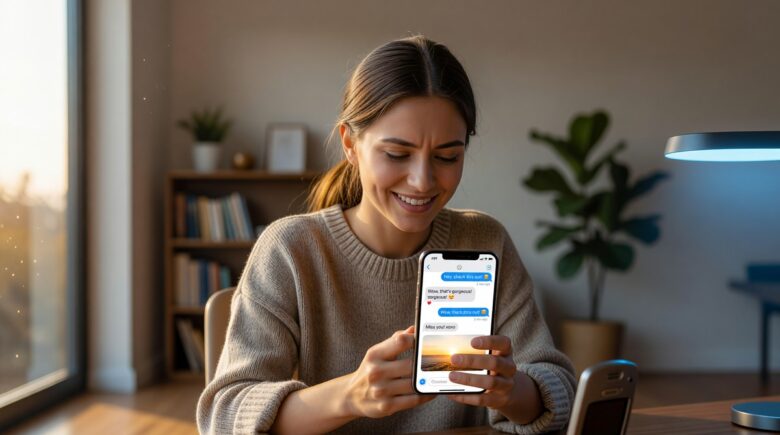
In a typical RCS conversation on Google Messages, you see when a contact is typing, when they have read your message, and you can share full-quality photos without compression artifacts. Group conversations behave more like a Slack channel than a legacy MMS thread.
The experience closely mirrors what Apple iMessage users have had within the Apple ecosystem since 2011. The difference is that RCS works across carriers and operating systems rather than requiring all parties to own Apple hardware.
SMS messages are still delivered globally across more than 5 billion devices, making it the most universally compatible communication protocol ever deployed. RCS cannot yet match that reach because it depends on carrier support and a data connection.
Is RCS Actually More Secure Than SMS?
RCS is significantly more secure than SMS, but only under specific conditions. SMS has zero native encryption — every message travels as readable plain text through carrier infrastructure, making it vulnerable to interception by network-level attacks and tools like IMSI catchers (also called Stingrays).
RCS with end-to-end encryption, as implemented by Google Messages, prevents interception in transit. According to Google’s Messages encryption documentation, E2E encryption in Google Messages is enabled by default for one-to-one RCS chats and is being rolled out for group conversations. If you’re concerned about who can access your messages in transit, our guide on what message metadata is and who can see it explains what even encrypted messages can still reveal.
Where the Security Gap Persists
RCS encryption is not universal. If your carrier runs its own RCS platform rather than routing through Google Messages, encryption may not apply. The GSMA Universal Profile does not yet mandate E2E encryption at the standard level — it is an implementation choice left to individual clients.
SMS remains a significant attack surface for smishing — phishing attacks delivered via text message. Because SMS has no sender authentication, spoofing a phone number is straightforward. If you receive suspicious texts, our breakdown of what smishing is and how to protect yourself is essential reading. RCS introduces verified sender IDs for business messaging, which meaningfully reduces — though does not eliminate — spoofing risk.
“RCS represents a real improvement in messaging security over SMS, but users should understand that encryption quality depends entirely on the client and carrier implementation. The GSMA standard itself does not guarantee end-to-end encryption across all deployments.”
Does RCS Work Between iPhone and Android?
Yes, as of September 2024, RCS works between iPhone and Android devices. Apple’s iOS 18 added native RCS support, ending years of cross-platform friction where iPhone-to-Android conversations defaulted to SMS or MMS — stripping out features and degrading media quality in the process.
Before iOS 18, sending a video from Android to iPhone compressed it to near-unwatchable quality and delivered it as a standard MMS. According to Apple’s iOS 18 feature overview, RCS is now handled through the native Messages app on iPhone, with support for high-resolution media, read receipts, and typing indicators in cross-platform threads.
What Still Differs on Apple’s Implementation
Apple’s RCS implementation does not currently support end-to-end encryption in cross-platform RCS chats — that feature remains exclusive to iMessage (Apple-to-Apple). The GSMA and Apple have publicly committed to advancing E2E encryption within the RCS standard, but no firm release timeline has been confirmed as of July 2025.
iPhone users who want encrypted cross-platform messaging today should use apps like Signal or WhatsApp rather than relying on native RCS. If you’re comparing privacy-focused alternatives, our analysis of Signal vs Telegram privacy breaks down the meaningful differences.
Apple shipped iOS 18 to devices representing over 1.4 billion active iPhones worldwide, according to Statista’s global iPhone active base data. That single software update made RCS accessible to a user base larger than most countries’ entire populations.
How Does RCS Messaging vs SMS Play Out for Businesses?
For businesses, RCS messaging vs SMS is a choice between a static channel and an interactive one. SMS business messaging delivers a text link and a short message. RCS business messaging (also called RBM — Rich Business Messaging) supports branded sender profiles, high-resolution image carousels, action buttons, and verified sender badges — all within the same native messaging app.
According to research from Mobile Squared’s RCS enterprise adoption study, RCS business messages achieve open rates of up to 70%, compared to email’s average open rate of around 20%. The interactive format drives measurably higher engagement because recipients do not need to install a separate app or leave their default messaging client.
RCS Business Use Cases
Airlines use RCS to send boarding pass carousels with live gate updates. Retailers send product recommendation tiles with direct purchase buttons. Banks deliver one-time authentication codes with verified sender identity — reducing the risk of credential phishing that plagues SMS-based two-factor authentication.
If your business currently uses SMS OTPs for authentication, it is worth reading about the broader limitations of SMS-based two-factor authentication before deciding whether RCS or an authenticator app is the right upgrade path. Verified sender IDs in RCS make spoofed business texts much harder to execute, which is a meaningful security improvement for consumer-facing industries.
Where Does RCS Still Fall Short?
RCS has real limitations that prevent it from being a complete replacement for SMS or third-party messaging apps today. Understanding those gaps is as important as understanding the upgrade benefits.
The most significant limitation is network dependency. SMS works with a 2G signal — the bare minimum for a cellular connection. RCS requires a data connection or Wi-Fi. In areas with poor data coverage, RCS clients typically fall back to SMS automatically, but that fallback removes all the advanced features and, critically, all encryption.
Carrier and Device Fragmentation
Not every carrier has deployed RCS, and deployment quality varies. In the United States, all four major carriers — AT&T, Verizon, T-Mobile, and US Cellular — now support RCS, but international coverage remains uneven. The GSMA’s carrier deployment tracker shows RCS live on networks covering over 60 countries, but gaps remain in parts of Africa, Southeast Asia, and Latin America.
Group chat encryption is another gap. While Google Messages encrypts one-to-one RCS chats by default, encrypted group RCS chats are still rolling out and are not yet universal. Users who need guaranteed private group conversations should still use Signal or another purpose-built secure messaging app. For a comparison of those options, see our detailed breakdown of SMS vs RCS differences.
To confirm whether your RCS connection is active and encrypted in Google Messages, open a conversation and tap the contact’s name at the top. If you see “End-to-end encrypted” listed under chat details, your messages are protected. If you see “Sending via SMS/MMS,” the conversation is falling back to the unencrypted legacy protocol.
The FBI and CISA issued a joint advisory in December 2024 recommending that Americans use end-to-end encrypted messaging apps rather than SMS or standard carrier RCS, citing active exploitation of telecom infrastructure by threat actors. The advisory specifically referenced vulnerabilities in SS7 — the same signaling network that SMS relies on — according to CISA’s official advisory page.
Frequently Asked Questions
Do I need to do anything to enable RCS on my phone?
On most Android devices running Google Messages, RCS is enabled automatically if your carrier supports it. On iPhone, RCS is active by default in iOS 18 and later — no manual setup is required. You can verify the status by checking the chat details in your messaging app.
Does RCS use my data plan or cost extra?
RCS messages send over your mobile data or Wi-Fi connection, not the SMS channel, so they consume a small amount of data. Most carrier plans include unlimited data, making this effectively free. However, if you have a limited data plan, heavy media sharing over RCS will count against your allowance.
Can I send RCS messages when I have no data signal?
No. RCS requires an active data connection or Wi-Fi. If you are in an area with only a voice signal and no data, your messaging app will fall back to SMS automatically. The fallback is seamless from the user’s perspective, but the message will be sent without encryption or advanced features.
Is RCS the same as iMessage?
No. iMessage is Apple’s proprietary messaging protocol, available only between Apple devices. RCS is an open carrier standard managed by GSMA that works across Android and iPhone, and across different carrier networks. Both offer similar features, but iMessage offers end-to-end encryption in cross-platform RCS chats, which RCS does not yet universally support.
Is RCS messaging vs SMS a privacy upgrade?
It is a partial upgrade. RCS with end-to-end encryption in Google Messages is meaningfully more private than SMS, which has no encryption at all. However, RCS encryption is not mandated by the GSMA standard, so it depends on your client and carrier. For maximum privacy, purpose-built encrypted apps like Signal remain the stronger choice.
Will SMS ever be shut down?
Not imminently. SMS remains active on networks globally and serves as the fallback protocol when RCS is unavailable. Carriers have financial and regulatory incentives to maintain SMS infrastructure for years to come. A complete industry sunset of SMS, if it happens, is likely more than a decade away.
Can businesses send RCS messages to iPhone users?
Yes, since iOS 18 added RCS support, businesses using RCS Business Messaging platforms can reach iPhone users with rich content including carousels and action buttons. The experience depends on carrier RCS deployment and may not yet be uniformly available in all regions as of July 2025.
Sources
- GSMA — RCS Market Status Report
- Google Messages — End-to-End Encryption in Messages
- Apple — iOS 18 Feature Overview
- CISA — Joint Guidance on Mobile Communications Best Practices
- GSMA — GSMA and Apple Advance RCS Messaging Standard
- ETSI — 2G Mobile Technology Standards
- Statista — Global Active iPhone Base Worldwide
- Mobile Squared — RCS Enterprise Adoption Research