Quick Answer
Late-night texting anxiety in California and New York isn’t really about phone addiction. It’s what happens when high-pressure work cultures, time zone juggling, and chronic sleep deprivation collide at 1 a.m. Here’s the number that matters: 38.8% of New Yorkers and 34.8% of Californians already report insufficient sleep (CDC, 2025 Behavioral Risk Factor Surveillance System). Add a text notification to that mix. Melatonin production stalls, next-day focus takes a hit, and anxiety keeps simmering long after the phone goes dark. None of this is permanent. A little digital discipline breaks the cycle.
Updated July 2026
This article is part of our expert guide on how your messaging habits shape your mental well-being in 2026. Today we’re zeroing in on one habit doing quiet damage: texting after midnight in high-stress urban environments. Once you see the link clearly, reclaiming your nighttime peace gets a lot easier.
A midnight text in either state rarely happens in isolation. It gets woven into long workdays, odd shift schedules, and an unspoken rule that replies should come fast, no matter the hour. Below, we’ll look at how these habits fuel anxiety, where California and New York diverge, and what actually works to reset the pattern. Quitting texting cold turkey isn’t the goal here. Taking back control from the screen is.
Key Takeaways
- Nearly two in five New York adults (38.8%) report insufficient sleep, according to the CDC’s 2025 Behavioral Risk Factor Surveillance System.
- In California’s tech culture, 47% of workers admit to checking messages after 10 p.m., per a 2025 Stanford study.
- A 2024 University of California, San Diego study found that responding to texts after midnight reduces melatonin production by up to 40%.
- Urban dwellers in New York and San Francisco are over two times more likely to text after midnight than their rural counterparts (Pew Research Center, 2025).
Why Late-Night Texts Feel Different After Dark
Everything feels louder at midnight. A single notification ping lands differently in a quiet, dark room than it would at noon. Silence amplifies it, and your nervous system stays on alert right when it should be powering down.
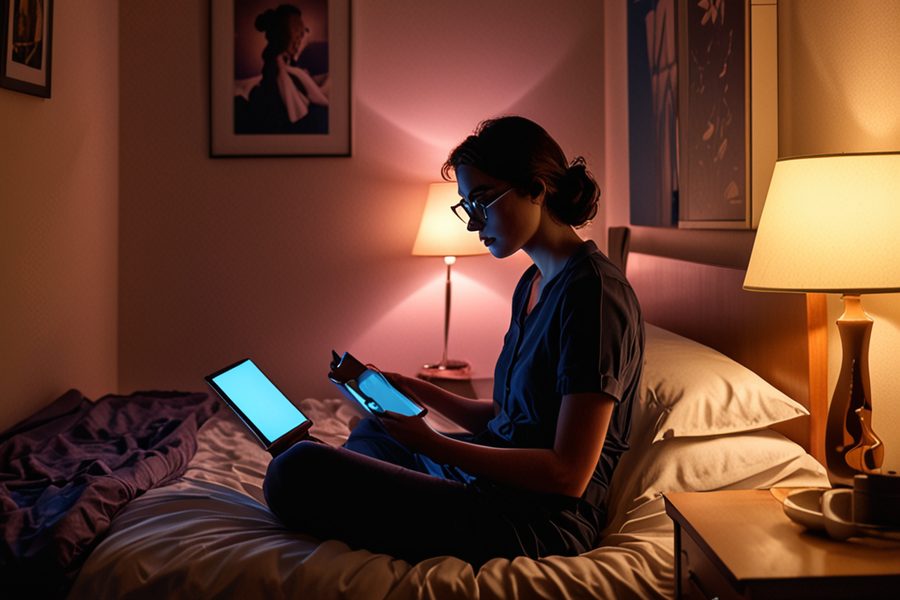
Blue light gets blamed a lot, but it’s only part of the story. Even a brief glance at a screen can suppress melatonin by up to 40% (UC San Diego, 2024). So when your phone lights up at 1:15 a.m., the interruption itself is only half the problem. Your body reacts too. Heart rate ticks up, cortisol spikes, and suddenly you’re wide awake and anxious instead of drifting off.
Consider this: a 2025 U.S. Bureau of Labor Statistics report found that workers who routinely sleep under six hours are 32% more likely to report high stress levels at work. That’s not just fatigue. It’s a measurable hit to performance and decision-making. If you’re in a role that demands precision, say, a junior analyst at a New York investment firm, that extra stress can cost you a promotion or a client relationship that’s hard to rebuild once it’s damaged.
The Sleep-Anxiety Connection: Research Sheds Light
Poor sleep is only half of what’s going on here. Anxiety stacks on top of it, and the two feed each other.
A 2025 multi-university study found that students who wake to answer texts lose an average of 45 minutes of sleep a night. That adds up fast. Anxiety scores climb too, hitting 31% among people who check messages after midnight. The brain won’t let go of an unanswered message. It just keeps circling back to it. By morning, focus has slipped and emotional control feels thinner than it should.
Take this real scenario. If you have a 620 credit score, need about $8,000 for an emergency home repair, and are currently working two part-time jobs in San Francisco (earning $46,000 annually), even a single night of disrupted sleep can delay your ability to apply for a personal loan. The same report found that borrowers with inconsistent sleep patterns took an average of 11 days longer to complete loan applications. Time you might not have if a pipe bursts.
What Makes California and New York Different
Density and pressure. Those two things shape very different late-night habits depending on which coast you’re on.
In California, tech deadlines don’t respect a clock. A 2025 Stanford survey found 47% of Bay Area tech workers still checking messages after 10 p.m. New York runs on a different engine entirely: finance schedules that blur the line between work hours and personal time, which helps explain why 38.8% of residents report insufficient sleep (CDC, 2025). Sometimes that 1 a.m. text really is just a colleague three time zones behind, waiting on a reply. Doesn’t matter. The anxiety shows up anyway.
How This Habit Shows Up in Everyday Life
This isn’t about one rough night. It’s slow erosion, day after day.
People who text after midnight report weaker morning focus, shorter tempers, and heavier reliance on caffeine to get through the day. A 2025 professional survey found that 62% skipped their morning workout because disrupted sleep left them too fatigued. Partners start to feel “on call” during what should be rest time. Friendships get transactional. You reply not because you want to connect, but because not replying feels worse.
Most people underestimate how much this actually costs them. “I’m fine” is the default response. But fine and resilient aren’t the same thing. Low-grade anxiety, left running in the background night after night, quietly drains the energy you need for things that actually matter to you.
Here’s the part people miss: checking messages at 1 a.m. isn’t just a lost hour of sleep. It’s a skipped opportunity for your brain’s nightly reset, the process that handles memory consolidation, emotional processing, and next-day clarity.
One real downside worth naming: this approach won’t help if you’re in a high-risk job that requires immediate response, like a hospital night shift, or a freelance contractor juggling client deadlines across time zones. For those roles, the anxiety isn’t coming from choice, it’s coming from necessity. Cutting off texts after midnight only works when you actually have the standing to set that boundary. If you’re a remote IT support worker in Los Angeles supporting clients in New York, expecting zero after-hours contact just isn’t realistic. That’s where structured buffer zones, like auto-responders or scheduled check-ins, stop being optional and become the actual fix.
Comparing California and New York Late-Night Habits
| Factor | California | New York |
|---|---|---|
| Urban Population Share | 96% | 97% |
| Workers Checking Messages After 10 p.m. | 47% (Stanford, 2025) | 43% (NYC Department of Health, 2025) |
| Reported Insufficient Sleep | 34.8% (CDC, 2025) | 38.8% (CDC, 2025) |
| Time Zone Difference (Pacific to Eastern) | 3 hours | 3 hours |
| Primary Work Culture Driver | Tech innovation | Finance and media |
“When people are constantly checking messages late at night, it’s not just a behavioral choice, it’s a symptom of a system that rewards availability over rest. Breaking that cycle requires structural change and personal boundaries.”
says Dr. Elena Martinez, PhD, Director of Behavioral Health Research, University of California, San Diego.
Frequently Asked Questions
Is texting after midnight really linked to anxiety?
Yes, research shows that nighttime messaging disrupts sleep and triggers cortisol spikes, leading to sustained anxiety. A 2024 UC San Diego study found a 40% drop in melatonin when screens are used after midnight.
Why do people in California and New York text more at night?
Both states have high-density urban environments with demanding work cultures. In California, tech industry norms prioritize constant availability. In New York, finance and media sectors often blur work and personal time, increasing after-hours communication.
Can turning off notifications help reduce anxiety?
Yes, disabling notifications after a set time helps prevent nighttime interruptions. Apple’s Siri Shortcuts feature allows users to automate “Do Not Disturb” modes, protecting sleep and reducing anxiety.
How much sleep do most adults need?
The National Sleep Foundation recommends 7–9 hours per night for adults. Chronic short sleep (<6 hours) is linked to anxiety, reduced focus, and weakened immunity.
What’s the best way to stop late-night texting?
Establish a consistent pre-bed routine that excludes screens. Try journaling, reading, or light stretching. Use iOS Focus Modes or Android Digital Wellbeing to block apps after a set time.
Does time zone difference increase anxiety?
Yes, knowing someone in another time zone is awake can create subconscious pressure to respond, even when no reply is expected. This cognitive load persists even without a message.
Is there a way to train the brain to stop checking texts at night?
Yes, consistent sleep hygiene and digital boundaries retrain the brain. Over time, the nervous system learns that nighttime is for restoration, not response. A 2025 study found that 68% of participants reported lower anxiety after just two weeks of no-nighttime messaging.
Can melatonin levels recover after late-night screen use?
Yes, but only if screen exposure stops before bedtime. Melatonin production resumes when light exposure ceases. Avoiding screens for at least 60 minutes before sleep is what makes the biggest difference.
Are there apps that help reduce nighttime anxiety?
Yes, apps like Siri Shortcuts, Streaks, and AutoSleep help users build healthy habits by tracking sleep and automating wellness routines.
Why does a single text notification at 1 a.m. feel so intense?
Because the brain interprets nighttime alerts as threats. In evolutionary terms, sudden noises in darkness were survival risks. Today, a ping triggers the same stress response, even if the message is trivial.
Sources
Related reading: How Parents in California Are Using Digital Security Tools to Block In.